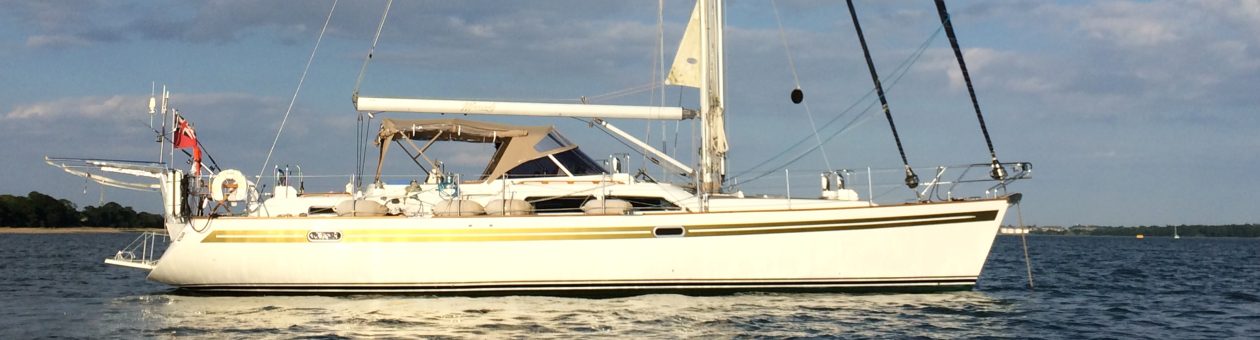

So at the end of our Easter weekend sailing we had a problem. Our solar array was designed to recharge the batteries whilst looking after the power requirements while sailing. On the trip back up at the Orwell, it looked like somewhere we were losing about 30A at 24V. This meant we were drawing power out of the batteries even in bright sunshine. If that kind of power usage was within the boat then it would likely be generating a lot of heat.
We set about understanding the cause of this on our return. We had already established that it as the second circuit in our bank which controlled winches and the bow thruster. All of these seemed to work fine which added to the confusion. By disconnecting the individual elements, we were able to trace the power loss to the bow thruster. This is located under the fore peak berth. Opening this up we found a few issues. Firstly, there had clearly been some heat on the positive terminal. 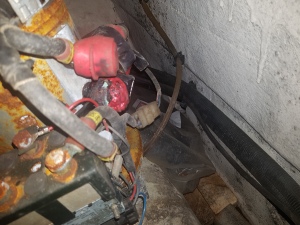 The wiring had melted. We had this once before in the aft cabin where the wiring for the davits came into the boat. On this occasion it was some corrosion within the wiring that had caused the problem.
Our belief is that this stems from well before our ownership of the Moody. A long time ago, a dehumidifier had been left running on the boat and had caught fire. This caused damage to the floorboards, galley and headlining. We imagine that putting this out required a fair amount of water and that when the boat was awaiting repair this water was left to stand with quite a bit of our low down electrical wiring in it. As the wiring corroded it became less efficient creating heat and then melting parts of the wiring. This could be rubbish but seems a plausible explanation. So the heat may be the cause of our loss of power but it didn’t explain why this was happening even when the bow thruster was not operating.
We disconnected the negative wire from the bow thruster and there was no drop in the amps going out of the boat. Oh dear. So the amps are going out through the bow thruster into the water. Fortunately, this circuit is only switched on when we are sailing and not when we are berthed or anchored so at least we haven’t done too much damage to our neighbours but this could also explain why our anodes were eaten through within fifteen months. May be this had been going on for longer without us noticing.
Potentially we could have tried to repair the existing bow thruster drive unit but with our plans, this didn’t seem sensible, not least of all because cost wise a rebuild would probably have been a similar cost to a new one. 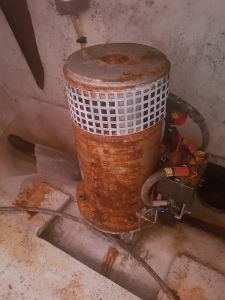 There was also quite a bit of surface rust of the bow thruster too which in an area that is mostly dry seemed strange – maybe reinforcing our theory about the fire.
There was some concern as to whether the drive unit would detach from the housing or whether we would have to come out of the water to do the work. Fortunately the combination of corrosion X, WD40 and a little time worked wonders and the bolts could be undone to take out the old unit. The new one was a lot of money but I guess now we have peace of mind.

 ) which works an absolute treat and is very low cost (especially for anything that can be used in a marina setting!).
 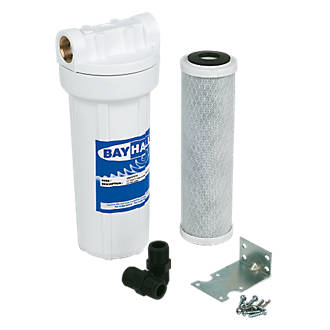 We bought a filter and have the option of fitting this in line with the outlet from our water tank. Instead we have decided to make sure that the water is clean going into the tank by buying hose attachments (quite posh ones). Having emptied the tanks before refilling with the new filter, it took two flushes of the tank but the difference is unbelievable with no smell of chlorine.
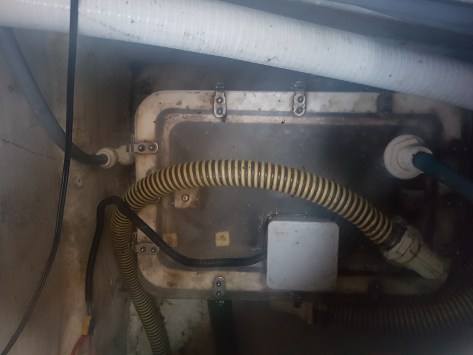 I open up the grey water box expecting to see the switch stuck in the up position and jammed with the white soapy scum. It’s a little dirty but not too bad and the switch is down. Hmmm. Now to check if this is a problem in the switch or the pump. It doesn’t take long to determine that the float switch is the problem since it seems to be powering the pump irrespective of its position, although interestingly more power when the switch is activated. Our friend Mark pops over and is also keen to understand the problem. Using a multimeter we can see that there is some power even when the switch is meant to be off. It’s a sealed unit, and relatively inexpensive so we decide that we will replace it. Maria will be shopping at Fox’s chandlery tomorrow morning. In the meantime, we can use it as long as we do it manually at the wall, not ideal.
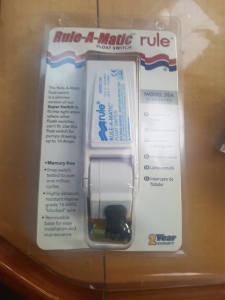 The next day and Maria has bought two
  ,we like a spare! On my return from work, I settle down to the “ten minute job” of replacing the switch. An initial test outside of the box proves that we have made the right decision so now it is getting the wiring in the box and fixing the float switch to its holding bracket. Running the wires is easy enough. The wiring on the boat is actually well done, although in places we have water damage from early in the boat’s life. This area is perfect and I just need a couple of spade connectors to connect up the switch. But first recheck it is working by jamming the wires in. All works well. But I can’t find my spade connectors and crimper anywhere. They are not where they should be. Now, Maria is famous for tidying up things and putting them out of sight rather than where they should be. It is a source of some frustration because there are so many nooks and crannies on a boat that the search takes ages. Anyway, no one can accuse Maria on this count so I am hung by my own petard! Anyway, I wanted a different crimper and there weren’t a lot of connectors so I will buy loads and that will sort it. Next day delivery on amazon prime, jobs a good ‘un. I tell Maria it’s fine to use in the meantime too, and that was my first mistake. Having washed up, I empty a bowl of greasy water down the sink and wait for the inevitable whoosh whoosh of the pump. And I’m waiting, I’m waiting…..I’M WAITING! Nothing 😦 so it’s carpet back, floor boards up and look at the low capacity grey water box surrounded by a pool of water in the bilge. Great! And I can also see the gleaming wires of my new switch nicely hanging away from the pump wires. Reconnecting these and the pump works as it should. Right, in true Basil Faulty style I am going to sort this out. Some industrial tape will do this and then they won’t come out. Second mistake, since when I return the next day to do the crimping, the tape is really difficult to get off and is a mucky job! Anyway, spade connectors crimped onto switch wires and plugged in and we have a permanent fix – now to clean the bilge that should never have needed it!
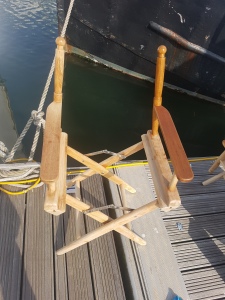 We decided to do this using teak oil that we bought from the original manufacturer of the chairs although any teak oil would have been fine I’m sure. The instructions were to make sure the teak was clean and then to apply the oil using a soft cloth. You could tell how important it was to Maria since she was right next to me doing a chair :). You can tell the difference in the picture where the work is part done and we were so pleased that we decided to do the same for our teak table.
 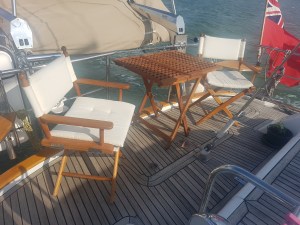 Unfortunately the preparation of a dirty table that we have had for a few years was a bit more intense. We used teak wonder to remove the dirt from the table and then did the same with the teak oil. The most difficult part was getting the teak oil into all the nooks and crannies of the open mesh table, it took time but was worth it. The process doesn’t take long especially with two of you but I imagine we will have to do it again towards the back end of the season.
 product recommended which confusingly is also a two part product with a cleaner and then a brightener. Sorry no before pics but the difference is marked and when wet they go brown rather than green 🙂


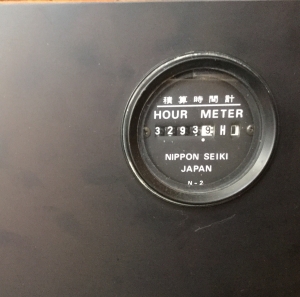 Pulling the two wires that feed the meter out was harder than I thought but revealed the problem. We had twelve volts across these when the circuit was on but no clicking of our counter.
 should be quite easy and then power the circuit to test it. As you will see there is hardly any difference in the counters but it was a shame that I couldn’t spin it forward by the number of hours we already had rather than starting at zero. Well I guess I could if I connected it to a 12v supply for about 130 days!
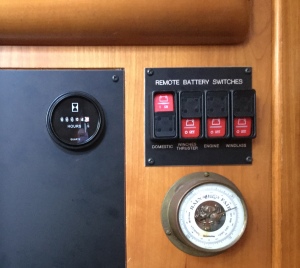 The advantage of having a similar design was it fitted into the existing hole perfectly. A quick test with the ignition circuit on and all is good – proven completely when we went out for the weekend and ran the engine for 4.85 hours on our way to Hamford Water.
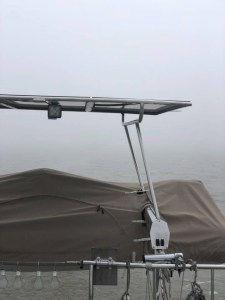 With a weekend away planned, Maria decided that we would also be doing boat chores. This week she wants to clean the stainless steel, all of it, which is why I cursed our friends at ECS! if they didn’t do such a good job maybe we would have less to do.
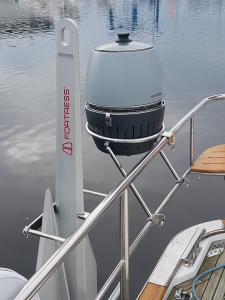 pulpits, eight cleats, two davits, one anchor and a solar panel frame. Not all of this has been done by East Coast Stainless but that won’t stop me blaming them 🙂 . I need to check what the guys use to clean up stainless because it always looks immaculate after they have done it but for us

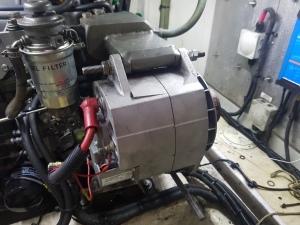 The alternator is fixed to the engine by two bars, one at the top which holds the generator in place and one at 90 degrees at the bottom which provides the adjustment to tighten the fan belt.
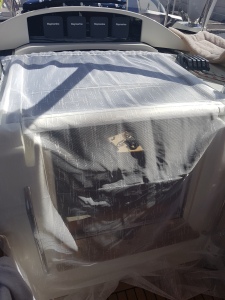 Finding a suitably plain net was easy enough and we only need a couple of square metres so not too expensive. The last task we want to do is to weigh down the bottom edge but in a way that the cats can still push past. That is assuming that they are brave enough to try – Clyde.
 on the cockpit tent and the anti-slip on the deck, where the black marks in the grooves were removed, I decided we should try this on the exposed part of the sail. Mould and Mildew is a mild bleach and so I was keen to make sure that it wasn’t on the sail or any of the deck for too long before being washed off.
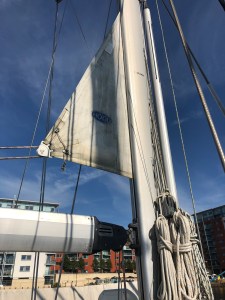 So mould and mildew was applied, scrubbed and then washed off with lots of water. Afterwards, all of the decks were washed down so hopefully we won’t get any bleaching elsewhere. This didn’t take too long and using lots of water and a couple of applications has really brought the sail back up. I am almost tempted to try another application in a few days but the current results can be seen below. Maybe a need for a little more effort on the bottom of the sail….


 It is a very smooth manoeuvre from the lift crew, Mariadz does look good as she slowly moves across to the lift, and before long she is lined up and the lift can start. After a couple of false starts and a consultation with the manual to check for lifting points, she is up and we can see that there is a lot of growth on her especially since she has only been back in the water for four months. That said after some of the issues we have had, we probably haven’t taken her out as much this year so far.
 Maybe these were enough to cause the slight vibration we could hear in the aft cabin when under power. Definitely something that requires more investigation. The original keel cooler was completely covered up with barnacles which explains why this wasn’t working but we need a new one anyway because of the leak. While Paul from Haven refrigeration is on board, he can also fit the PCB for the forepeak aircon unit. This was tricky to order from HFL, but google translate was my friend and we were able to get everything sorted via email – let’s hope i have right one and it works!
