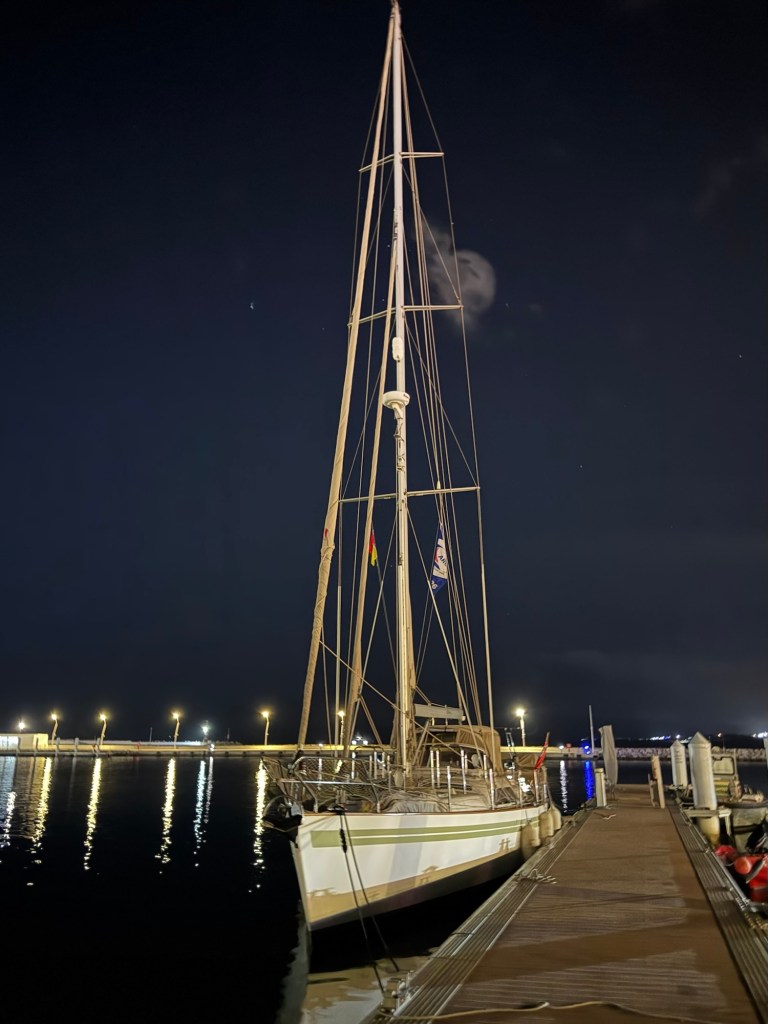



There is always something to do on the boat and we knew when we left Balsamo in Puglia that there were some jobs still to do and some that hadn’t been done well enough. Overnight the intervening months, we have been addressing these to make sure we are ready for the trip. It now feels close but I thought jotting down some of the things we have done could prove helpful.
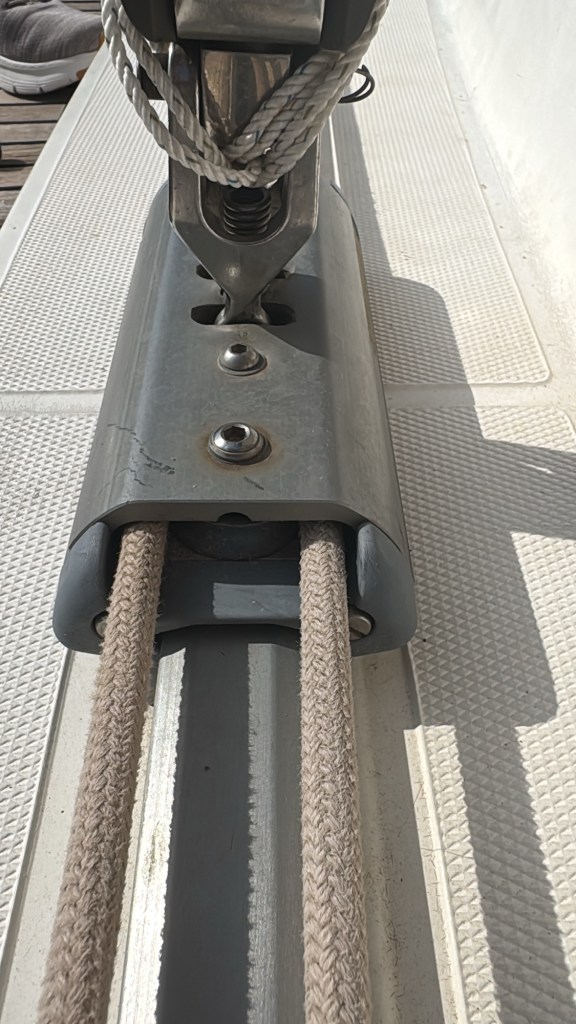
The mainsheet, which is the line that holds the main sail in place has a traveller on Mariadz which allows us to move it from side to side to improve the angle of the sail. Within the car of the traveller there are sheaves, round disks that help the rope go around and back out of the traveller. One of these had shattered and needed replacing. Fortunately we have exactly the same car for the staysail (the smaller sail at the bow of the boat) which actually doesn’t have lines going to the car and just runs free. The immediate resolution is to take the sheave out of one car and put it into the other – then order four replacements to cover us! At the same time the bumpers for the track are brittle and falling apart so we will replace those too.
Our navigation lights on the bow have been a little problematic and I changed the bulbs to fix this but the box for the starboard side light broke which lets in water! That’s now good and they are discontinued. I eventually found a like-for-like replacement which was a result until I found it wasn’t and I had to drill several holes in the stainless steel baseplate – not as easy as it sounds and takes a very long time even with the right, and expensive, drill bit.
Some of the fixes we have had to make are correcting issues or finishing work that we had hoped would be completed by Balsamo in Italy before we left. One of these was the freezer which wasn’t working well and had a coolant leak. We had mentioned this a year ago now and wanted it done over the winter so it could be done properly. Unfortunately the work didn’t get started and then instead of pulling out the freezer and either repairing the pipework or fitting a completely new base unit, they unilaterally decided to fit a new cooling plate within the freezer. Unfortunately the plate was too small and didn’t cool the whole freezer so we would have -15 at the top and then zero degrees and lots of rotting meat at the bottom! B the time that the failed resolution to the problem had been agreed, it was too late to do the job that we had originally requested. We have therefore had to turn the freezer into a second fridge and have bought a second Engel to act as a freezer. Not ideal but a solution to our problem until we can get the work done.
Unfortunately whilst fitting the holder for the starlink on our solar array, Balsamo decided to use an angle grinder to cut metal. Now as most people know flying hot metal sparks and plastic do not mix well and over time the metal rusts leaving lots of rust patches all over the nice shiny hull – that is something we will have to correct in the future. At the same time, it appears they sat on the rib while it was up in its davits which put a lot of pressure on the lifting points – one of these sheared and also needed to be replaced! The Rib had been in the wars as we had a number of new problems with leaks developing in the hard part of the RIB after it had been on the hard at Balsamo. The team did a good job of filling these but at one stage it looked like we might have to change our rib. Anyway now, Connie the rib (Clyde and Bonnie) is back to being watertight. We have also adjusted the way she is held up on the davits to hopefully make this more secure.
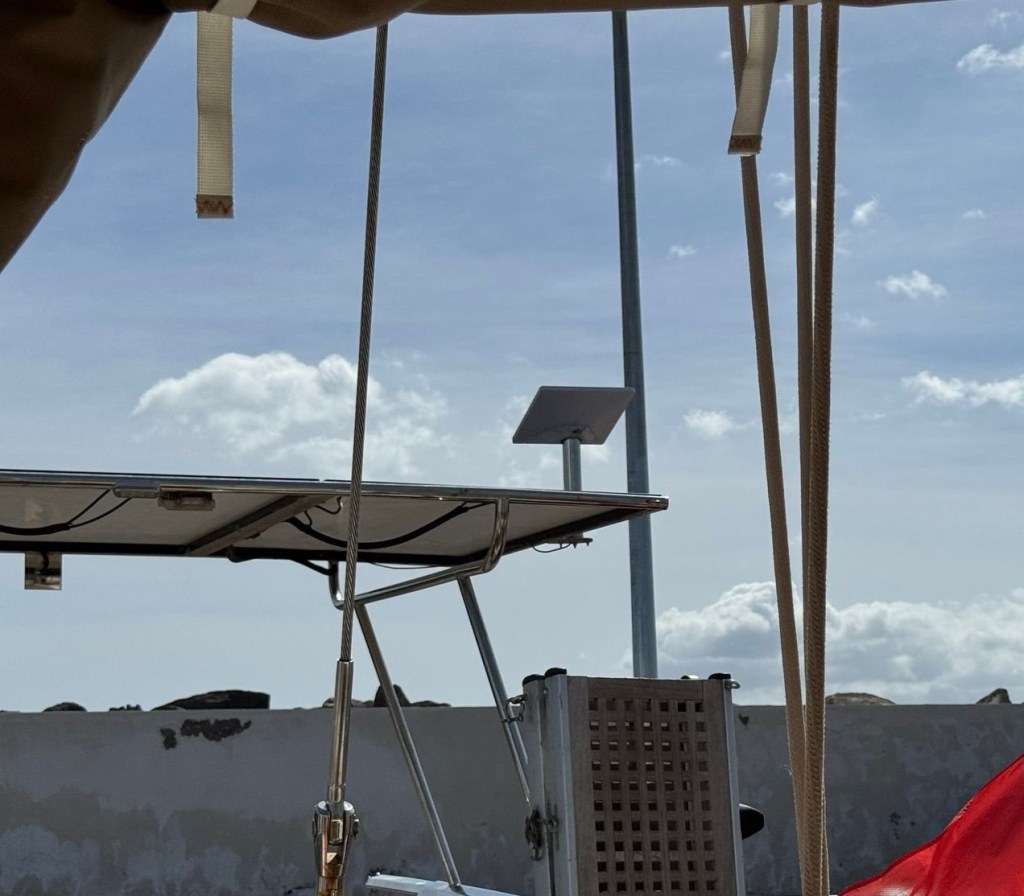
We also ran out of time for the Balsamo team to feed the wire from the starlink mount on the solar array through the boat and they had hit a dead end on how to do it. Fortunately when we got to Pasito Blanco, the electricians there, didn’t see the problem and, with my help, we fed the wire through the boat to a 24v connection that we could use. A small thing that made Maria happy because we didn’t have trailing wires across the boat! For some reason, the Balsamo team had also cut all of the cable ties keeping the solar wires tidy. Not sure I understand why but something else now fixed 😊
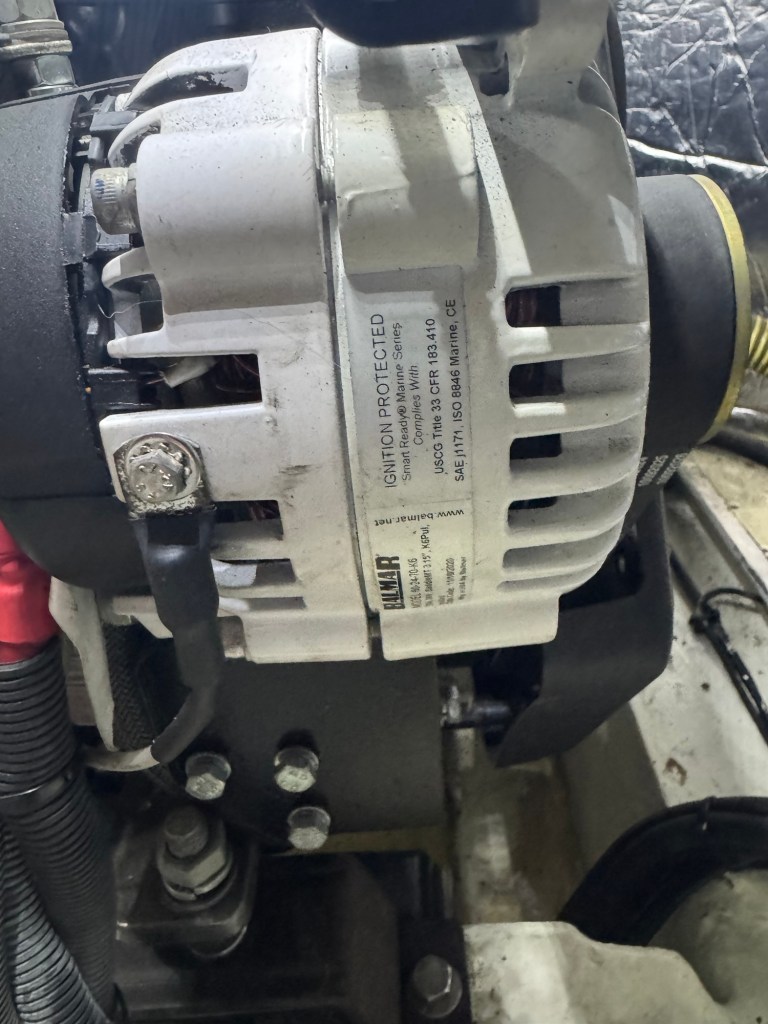
On our first sail away from Italy, I mentioned in another blog that we had an issue with our Balmar alternator that provides the power from the engine to the domestic batteries. It wouldn’t charge which created a few problems. After much diagnosis and checking we found that the wires had been accidentally pulled out on the alternator when the Lewmar engine was serviced! This took a long time to diagnose and I benefitted once again from the remote support of Ollie from Seapower in Ipswich, who was brilliant as always.
One of the things we should have been checking more was the anchor swivel which allows the anchor to turn 360 degrees without twisting the chain. On a check of the fittings on deck after we had got to Sicily, I noticed that this was loose. It pointed to another problem – the way we lash the anchor to the deck was via the shackle. If that bolt had given way we would have held on to the shackle but lost the beautiful anchor. Needless to say we have no intention of losing two anchors! It is tightened up also has Loctite on it to stop it coming loose again. At the same time we now tie down the shackle and the anchor with separate lines – nearly an expensive lesson learned!
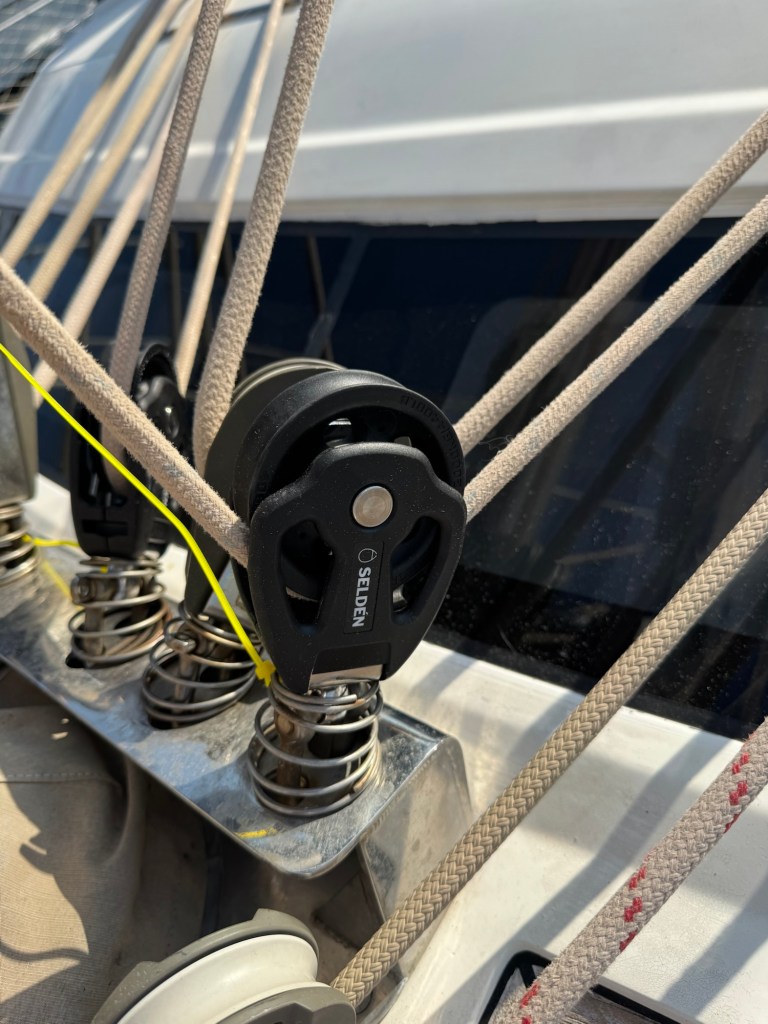
On the sail across to Sicily, one of the 25 year old Lewmar blocks failed and caused us a few problems. These blocks guide the lines that run down the mast and help to change direction to come towards the cockpit. On speaking to Richard at Compass Rigging, we decided to change these to Selden blocks similar to the new blocks supplied when our rig was changed.
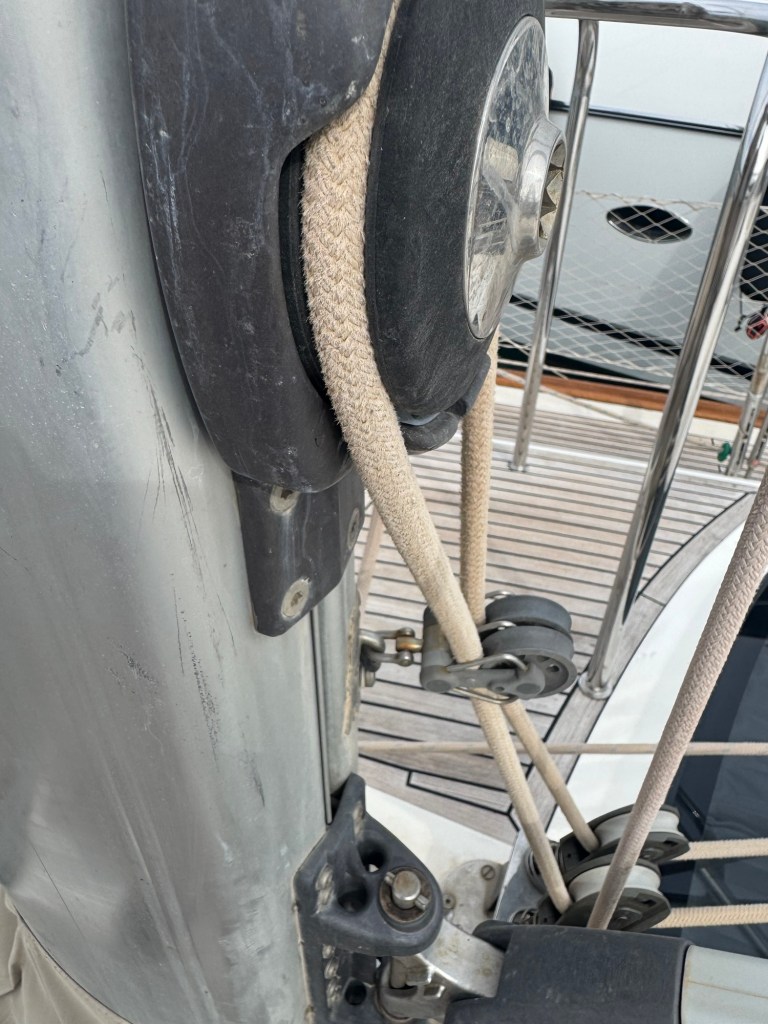
The last part of this job, was changing the continuous line for the mainsail which is a continuous line, a necessary change if we want to have the security of new blocks.
On a boat, all cupboards need to have a lock because the movement of the boat could cause the door to open and the contents to go everywhere. Clearly sub-optimal! On a moody a number of these locks are the push buttom type which makes the lock flush with the door but in its core there is a single pastic guide that gets brittle over time. For some of our doors that time had come. Fortunately I had found some of these locking mechanisms a long time ago and had a supply. I was a bit of a fool on the first one as I decided to take the lock apart and replace the part that was faulty rather than just replacing the whole thing. For the second, I didn’t make that mistake which probably explains why it took more than an hour to do the first one and five minutes to do the second! The second in particular was rewarding, since it locks the knife drawer inside a cupboard. It kept jamming which meant it needed to be teased to open up at times (or actually just don’t lock it!). Having spent five minutes fixing it with a part i have had for years, Maria asked the obvious question of why this hadn’t been done years ago – fair cop to be honest!
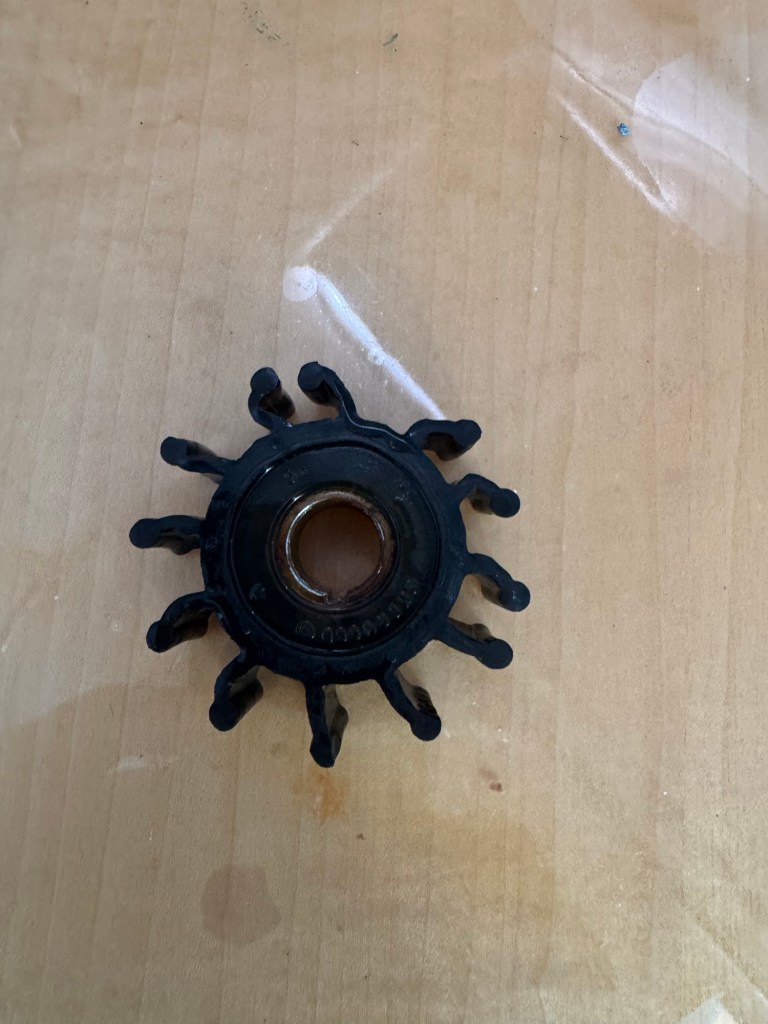
I described the issue we had with the alternator which meant we couldn’t charge our domestic batteries from the engine. We have a lot of redundancy on Mariadz and so in addition to the solar, we can also charge from the generator. Whilst we were having this problem, we decided to use the generator which was fine until a sudden spike in the requirement caused the generator to report a problem with exhaust gas heat (i.e. not enough cooling), after which it shut itself down! The generator, and engine, had been reportedly serviced at Balsamo but clearly this wasn’t the case as we found when we pulled the impellor that drives the water around the generator.
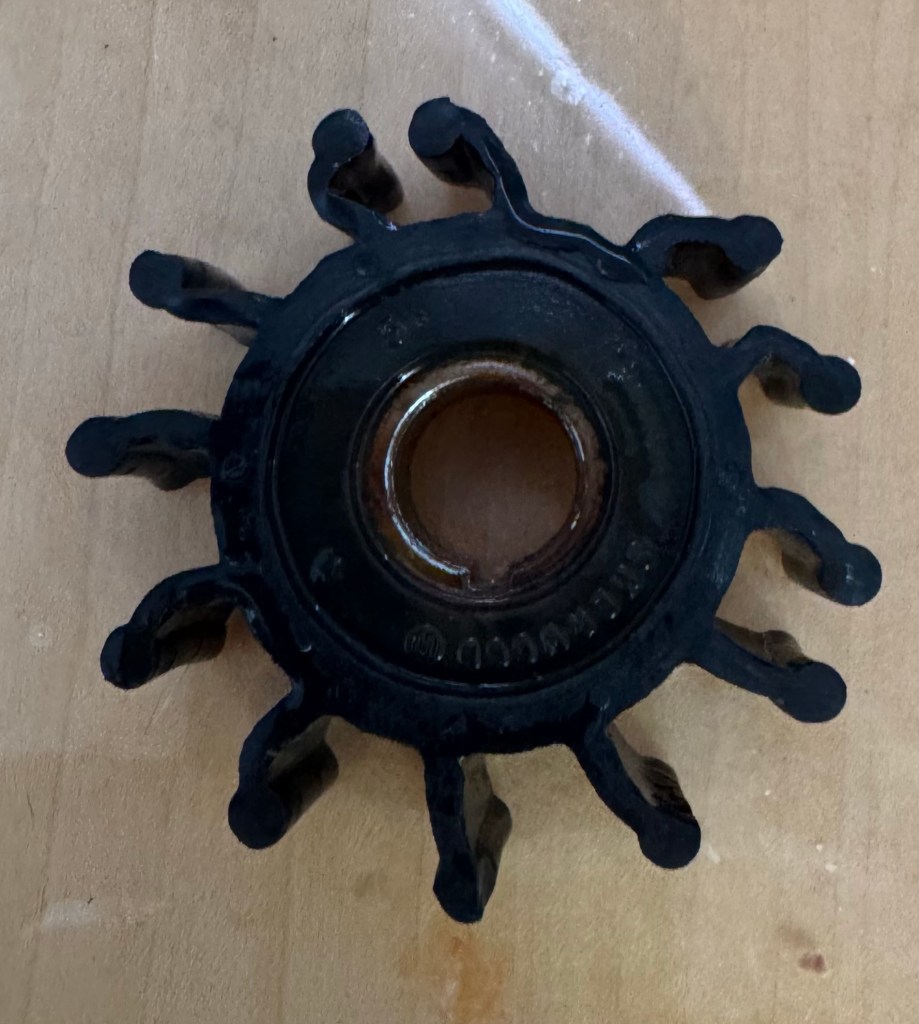
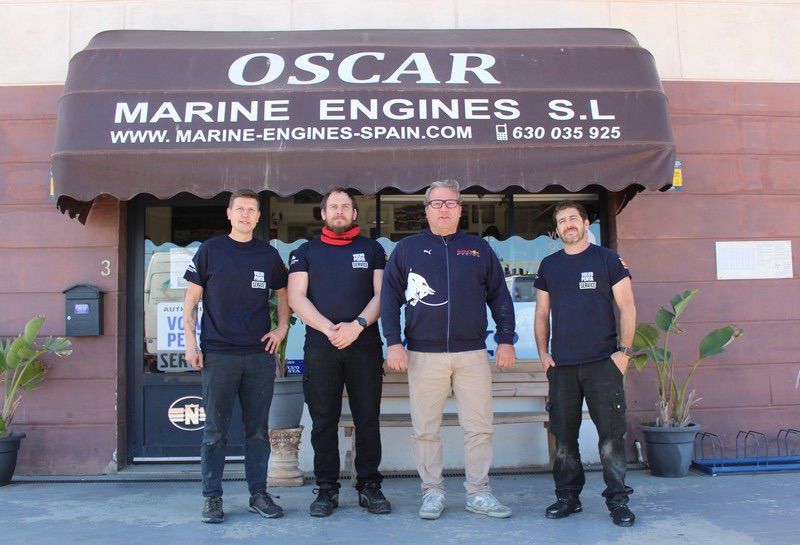
This was clearly old – so another service was organised. We also checked the water coming into the engine from outside that should be colling it and the intake was clear. During the testing of the generator during the service, there was clearly a lot of exhaust back pressure, which should not be happening. We checked there was nothing in the engine, like a broken part of the impellor, that was blocking flow and eventually traced the problem even further downstream. Mariadz has a split exhaust system for the engine and generator. Most boats push out the exhaust gases with water that has cooled the engine which provides a familiar flow of water from the exhaust which helps to confirm that there is cooling to the engine. On Mariadz there is a simple system to split these, with the water going out below the waterline and the exhaust gases coming out of the back of the boat. The eventual diagnosis was that some water had got into the piping for the gases which at times blocked the pipe and pressure built up. We sucked out three litres of water from this pipe and now we are ok. Important diagnosis for the future though when we run the engine or generator in rough seas where water may jump into the air exhaust. At least we now know the generator is serviced properly by the great Oscar Marine Engines in Torrevieja.
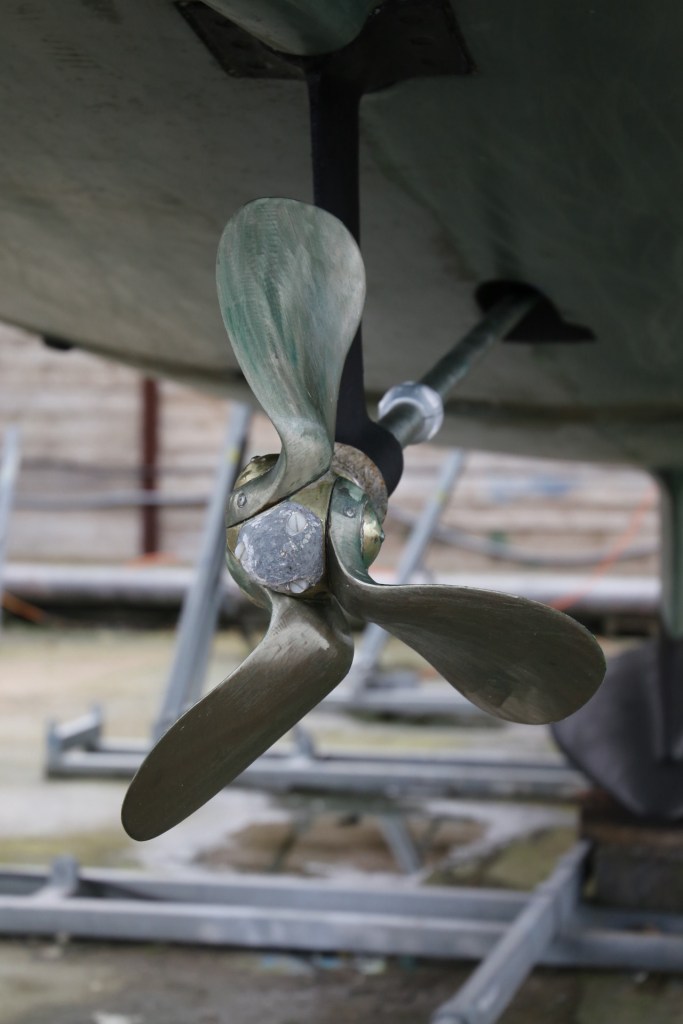
As part of this work, Oscar identified an issue with the stuffing box which provides the water tight seal for the shaft as it exits the boat. Although dry, there was a lot of salt around which signified that water had come in but had evaporated. This meant that we had to come out of the water to have this done (for the second time of the season). A replacement means that we can sleep comfortably for several years knowing this is not going to cause any issues. As part of this work, Oscar also noticed an issue with our Autoprop propellor, which although it had been services, had a lot of play in some of the blades indicating too much wear and tear. This would also need the boat out of the water but with at least a three week delay in getting parts we agreed that we would do it later. It means there is some vibration from the prop but Oscar also reviewed the entire engine setup and checked all of our bolts finding some that needed tightening. We like it when someone checks things over and resolves a problem before it becomes a disaster! It was once we were in Gran Canaria that we were able to get Mariadz back out of the water, for the third time this year, to have the autoprop completely rebuilt and it now works as new.
Our Raymarine autopilot has a remote control commander that allows us to steer the boat from anywhere on the boat – this was always amusing in the Orwell, when I would be sat on the stern steering Mariadz remotely while Clyde sat in front of the wheel looking out – we may have got some funny looks then! However, like all rechargeable batteries, eventually the battery dies. The job is reasonably simple to replace it with a standard rechargeable battery with some soldering required to connect it up, but all sorted now and there was an easily followed youtube video that helped a lot!
At times in the Mediterranean, you have to use the engine for long periods – there is either no wind or too much in the wrong direction it seems! The engine room obviously gets warm at this time but Mariadz has a powerful fan that gets rid of the hot air and cools down the room. When we were returning o our home berth this was never a problem but the fan, having been set in the UK, worked tirelessly for up to eight hours to get the temperature down to 40 degrees! In the Med, that is quite difficult when it could well be 40 degrees outside without running an engine or generator. The other disadvantage of this was the huge amount of power that was used. Not large in domestic terms but on a boat this used a sizeable chunk of our battery power. We decide we didn’t need the engine room to be another fridge! I have adjusted the thermostat and now we stop the fan after an hour or two and let the rest of the heat dissipate naturally. A really minor thing but something that had implications for the battery usage and comfort on the boat with the noise of the fan.
One of the projects over the last year was the replacement of the air conditioning system after 25 years. The latest technology is really advanced and the inverter versions don’t even have the massive spike of power drawer when they start. We decided to swap to the frigomar units and replace like for like across the boat. As part of this we discovered that two of the units drained the condensation that they gathered into the bilge. That wasn’t right so we added a new box to get this water and move it through the grey water box out of the boat. Marine air conditioning, like the engine, cools using seawater. Sometimes when the boat heels over a lot the through hull where the water comes in is out of the water and drains leaving an airpocket. The solution to this is a little bleed valve near the water pump that allows the air to exit and water to be drawn in. I fitted a new one of these for the aft unit as part of this work, making sure that I used top quality parts that are used for through hulls. The one for the saloon aircon had already been fitted before we took ownership. Over time, this was deteriorating but this also wasn’t helped by Balsamo fitting the pipework for the new aircon over the top of it! How am I meant to access that! The first time this year I had to bleed the pipe the valve handle broke so I decide to replace it all with top quality component and also move it to above the pipework to ease access!
Another common problem with the Moody 54, and other models, is the cloth headlining. The glue they used over time failed and the cloth sagged looking really poor. We have tried several things to resolve with mixed results. One of the areas that was bad was the sea berth which also had really poor plastic fixings that over time fail and the headlining falls down. Fortunately, I have finally fixed this by using long screws on the lughtswitch which hold the headlining against the wooden frame. Fingers crossed but since then we haven’t had an issue. This did uncover an issue when I was doing the work while Maria washed the boat – we know Maria is dangerous with a hose and hence I always wear swimming trunks because I know I am going to constantly get soaked with cold water accidentally I presume. however, I now found myself getting wet through the sea berth window! We found that there were missing bolts and loose bolts in the frame which let water come into the boat. A trawl through the assortment of screws and bolts found some candidates that could take up position and tightening them gave Maria second opportunity to soak me through the window – this time unsuccessfully!
Regular readers will know that we like to look after the wood on Mariadz and have tried several things on our toe rail. While in Balsamo marina, and we were in the UK, the stern part of our toe rail was damaged. We decided to have it replaced with a new piece of teak. This looked amazing but had been varnished which put the rest of the toe rail to shame meaning it all had to be varnished. The end result was great and our job now is to keep it looking good. However, while in Torrevieja, we believe that a boat trying to get into the berth next to us had a problem and got caught on our bow lines. They loosened these off, not telling us and not tightening them up afterwards. Of course when the winds came the new piece of teak got an absolute beating and has now split. Gutting. Rather than replace it again I have added screws across the grain to keep the wood together and filled these with wood covers to hopefully make it look ok. It isn’t perfect by any means but once revarnished should work well.
We have also looked at our rig and how best this can work for the transatlantic and beyond. When you are downwind sailing with twin headsails, you use a pole to keep the foot of the sail out an in the right position. This means that the sheets (or ropes!) are then led back to the boat on an alternative route. In the Biscay when we did this, we used the existing rig as much as possible but it was clear that we needed to add a couple of turning blocks to make this more efficient and safe. The work on the turning blocks at the mast has freed up some blocks which helps and we now have a new way of rigging the boat. Equally, in this configuration traditionally you have one pole and use the boom as a second pole. This isn’t optimal since the boom is further back in the boat. Some yachts are fitted with twin poles for this reason and we decided to go this way, agreeing with the yard in Gran Canaria that we will have a second pole fitted. We expect that this will significantly improve our downwind sailing. We just need to make sure that we run the lines the right way and make sure we don’t have a problem with damage to the lines caused by chafe.
We use netting at the bow of Mariadz which stops things, or people falling off the boat. We first fitted these before Biscay and have decided it is time to replace these.
Our pasarelle is the posh plank we use to get off the stern of the boat (we also have a cheaper real plank that we can use too!). This was originally with the boat and had a guard rail on the side which wasn’t there. I have now had a new one manufactured so that we can safely walk the plank!
After twelve years the Marco UP3/E water pump that we had fitted gave up the ghost. This was originally fitted because of a particularly quiet one we heard on a friends Moody 54. Ours wasn’t quiet – it screamed. We never got to the bottom of it until…… It finally failed and I needed to replace it. Whilst researching to understand what I needed to do, I checked about the “screaming” – oh this is a common issue when there is not enough water coming from the water tank and the pump is suffering water starvation. That got me thinking. The Marco pump was quite a bit smaller than its predecessor and to overcome the issue with the length of pipes I had, quite proudly, fitted a second filter – nothing will get through those two babies! Bad! The extra filter slowed the water flow too much and caused our problem. Just removing the filter element of it and using it as an expansion tank would have resolved the screaming! Anyway, when fitting the new one (which was a UP2/E by accident during ordering), I did this correctly and now we have the quiet pump that I promised Maria twelve years ago 😊
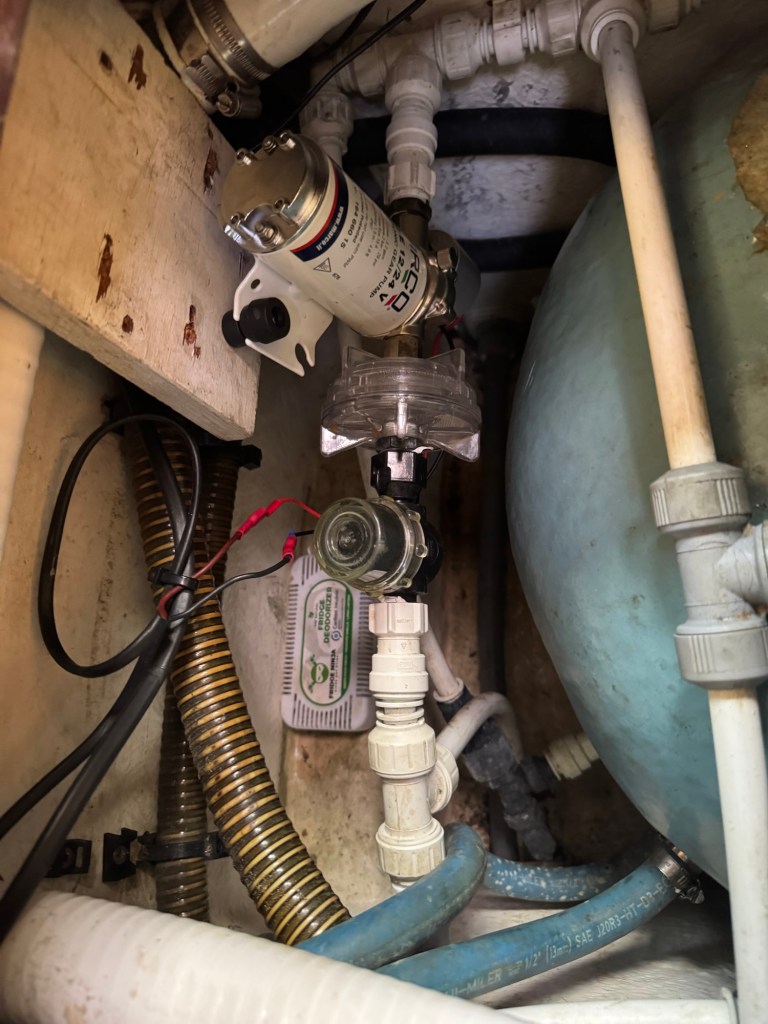
As you can see a lot can go wrong on a boat even after it has had a lot of work done. This is also likely to keep happening and we wont always be close to a supplier of spare parts. To that end, we have had to equip Mariadz almost like a chandlery with key spare parts to keep us going and hoping the redundancy we have with multiple systems will help us to keep going. We have added a number of key spares to our inventory:
- Autopilot – having had the problems in Biscay we have added a drive and gearbox to the other mechanical spares we had,. In addition we have a new autopilot EV400 drive unit.
- Raw water pump for the Yanmar engine – this is a common failure and causes the engine to overheat.
- Life jacket rearming kits – in case we fall in and want to reset the lifejacket!
- Another Marco water pump – the original may have lasted a long time but we are taking no chances
- Complete service kits and other spares for the yanmar engine, the Onan generator and the Suzuki outboard
- Several water pumps – whenever a waterpump has gone, I have replaced it with a new one and then have set about repairing the old one. With the exception of the first Marco pump which had water ingress into the electronics, I have been able to fix them all – we now have nine water pumps of different types
- Spare filters for the water system and watermaker
Then we have additional requirements that the Atlantic Rally for Cruisers require you to have on board. Most of this is common sense although some people, would argue that it is a bit of overkill. When first deciding to do the ARC we had though that the thorough safety check at this stage would act as a good test of whether we were truly ready to go around the world.
- 24v search light – we had originally bough one of these for finding anything in the water several years ago and when we recently tested it the on-off switch was faulty. Grr, so that has to be replaced.
- Document the Man Overboard Procedure. It is important that we all know what to do if someone goes overboard and documenting this effectively will help people remember every step when stress is at its highest
- Document the mayday call – we have all been on courses and simulated a mayday call. In the calmness of the classroom it is easy to get this right. In the stress of a real emergency, this isn’t so easy. A script that can be read will help make sure that important call has all the important information.
- A plan of the boat with safety equipment locations – we actually have five plans which show the locations of emergency equipment both above and below deck, storage locations (which can be cross checked against the inventory), positions of through hulls (each of which has to have a dedicated and labelled wooden bung to seal it if necessary!) and key locations for items such as batteries
- We need a new high power 24v socket and electrical connections behind it to power an independent high power water pump which can get water out of the boat or bring water in if you are trying to stop a fire.
- Additional lines and buckets to allow us to scoop water up if we need iot (again putting out a fire maybe)
- Another checklist of everything you should pick up in the event you have to abandon ship including mobiles, radios, satellite phone, hand held navigation, extra water and food etc
- Emergency VHF Antenna, in case the mast is lost
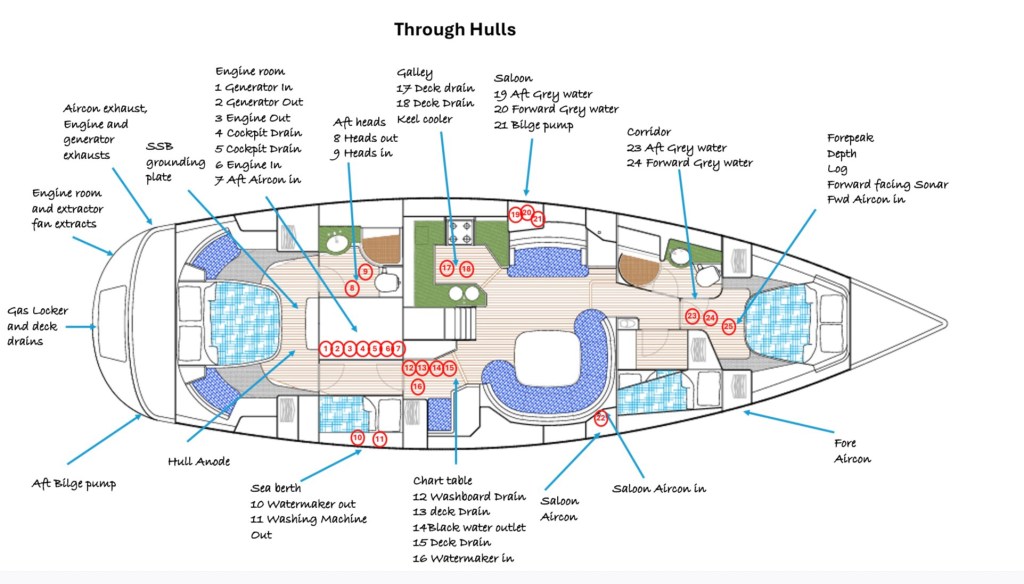
As you can see, getting a boat fixed, ready and prepared for a world cruise is a big job, taking time and money and, as we know, cruising is really fixing a boat in exotic locations so the list will go on!