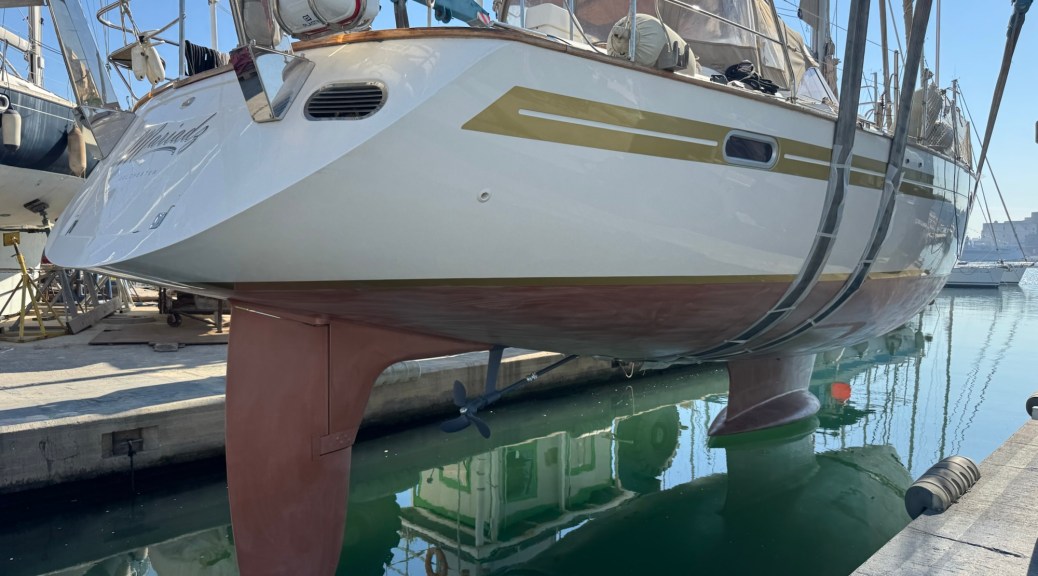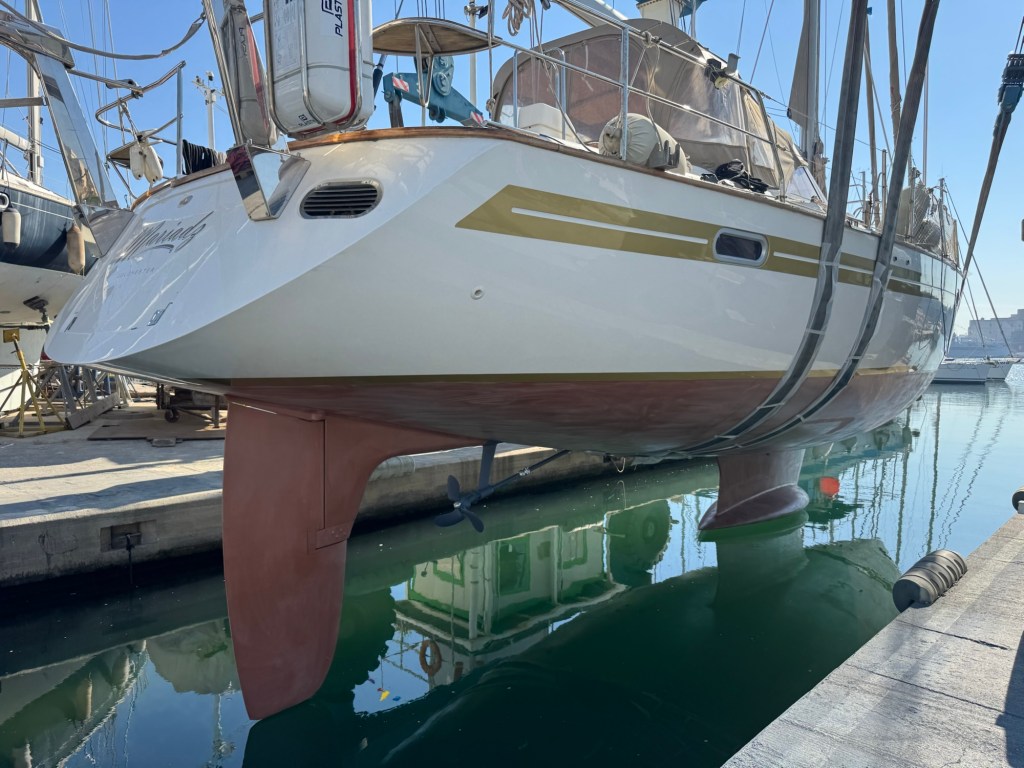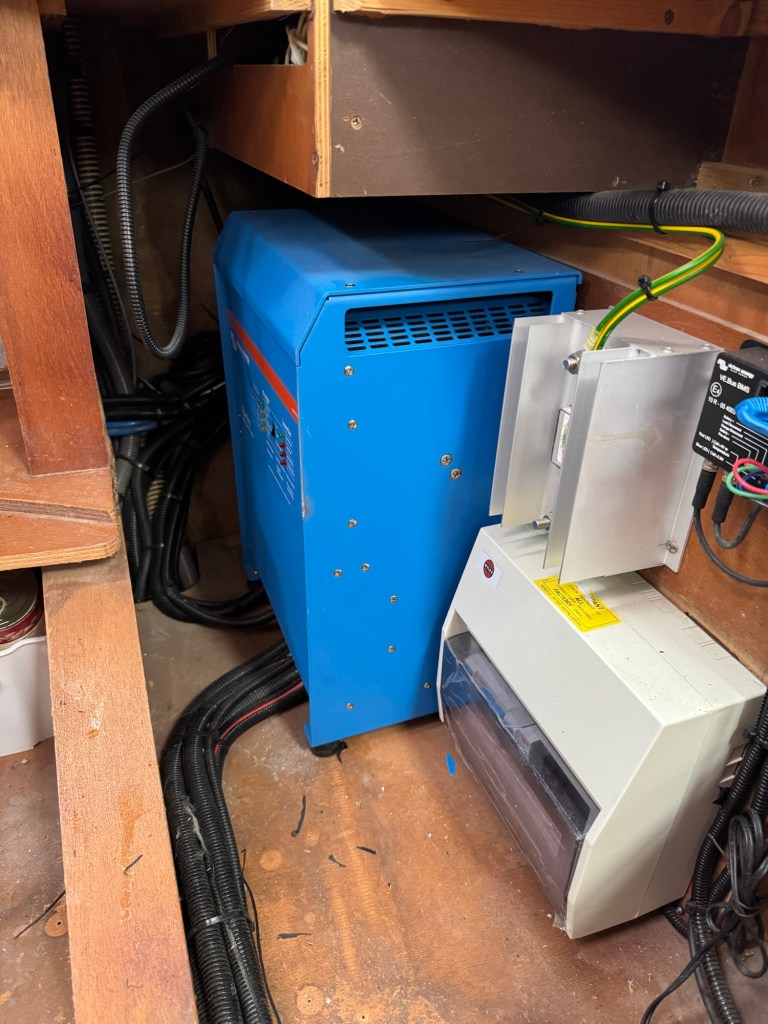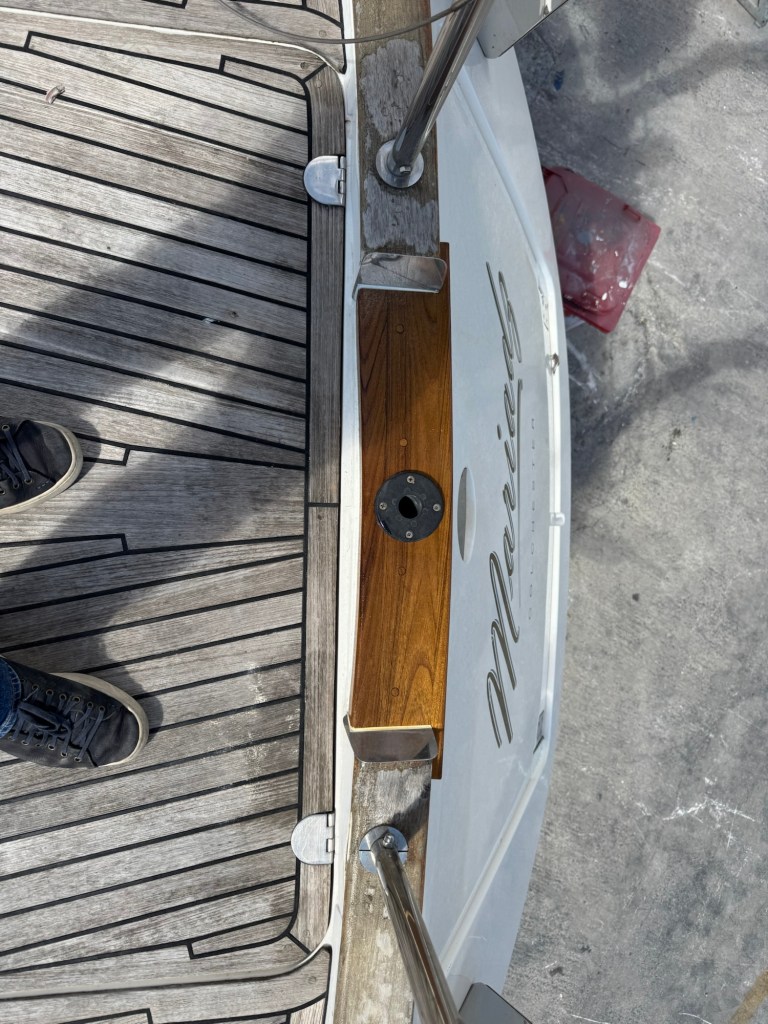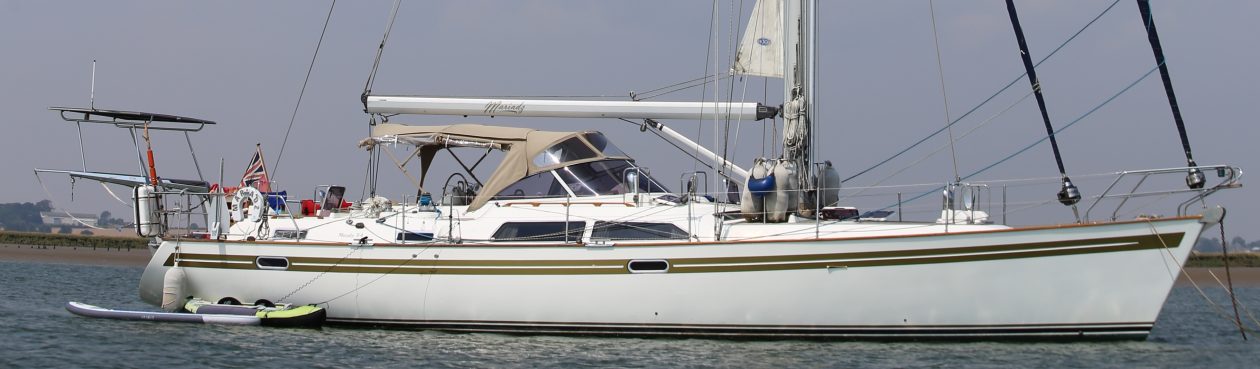

The sea, Earth’s watery frontier. These are the logs of the sailing yacht Mariadz, her “n” year mission (where n is an integer in the range 2-5) to explore new lands, to seek out fun and explore different civilisations, to boldly go where some sailboats have probably gone before. {cue music}
Back in 2009, when we first tried sailing, we had no idea where our ambitions would end. Initially, we wanted to have our own boat, then we would go into the Mediterranean, later a transatlantic before we read a book from Nicola Rodriguez about sailing around the world. That sounded amazing and with family and friends dotted around the world, being a floating nomad sounded a fantastic life.
We bought our first boat, a Dufour 455, and loved her but as regular readers will know, a difficult return from Dunkirk made us realise her limitations or probably more accurately our limitations with her. We decided on a heavier boat which could handle bad weather a lot better and started looking at Moody yachts. We then met Nicola’s husband John who had a tired Moody 54 available and the rest is history.
When we brought Mariadz over to Italy we recognised that the journey from Plymouth was a warm up for the main event and that the start of our journey would really be in Brindisi. A shakedown week in Corfu demonstrated that Mariadz was mostly ready as long as we could get those last few jobs over the line.
The freezer situation was worrying, nine months previously we had suggested removing the old freezer and dropping a new unit in, as we had with the fridge. You lose a lot of space compared to the bespoke design which maximised the unique shape next to the hull but at least you had a complete new system which would hopefully be successful. Balsamo, the team doing the work, had suggested that a new cold plate in the freezer would do the job just as well and would keep most of the available freezer space. However, having fitted the new plate several weeks previously, we were having real problems getting the freezer down to temperature. It was not consistent and there was a wide range of temperatures in different zones – freezing at the top and lukewarm at the bottom. Having lost food discovering this, it became clear that our original plan was the only viable option. And now we have a week to do it. This effectively means a couple of days so that we can test the new setup and confirm it works, and that nothing else has been broken (which had happened the last time the fridge was removed!). The wiring for the new Starlink was the second job which should be easy since we had a base plate fitted when we fitted the solar panels and there are lots of wires threaded through to the boat. However, over the course of the week it became clear that neither of these jobs were going to get done. The yard expected us to delay by another two weeks, having already been delayed by over two months.
Maria and I agreed that weather permitting, we would depart as expected. I return to England to work while Maria finishes preparing the boat and it feels close!
At the end of the week, I return to Brindisi and the weather is good for the next few days and the trip down the coast in particular.

On the Saturday morning, the long awaited day has finally come and we are starting our journey towards Gran Canaria and the trans-Atlantic. We had always said that we would celebrate this day and also that there are certain songs that we would want to play – “Let’s Go” being the first! During the week I have prepared a mix of songs for us and on arrival I have put a bottle of champagne in the fridge. We are not drinkers on passage but a glass to celebrate our departure sounds good.
We are leaving early in the morning and the wind has died down a little from earlier in the week when it was a little hairy. I have split emotions about that, a large following wind would be great for the trip down the coast and reminiscent of the 20 knot winds and over 10 knots through the water that we achieved crossing Biscay. However, that is offset by the trouble initially getting off the pontoon when you are being pinned on by a strong wind. Today it is an easy departure and it looks like the north westerly will build to about 12 knots during the day and gives us a good push down the coast. A lot of recreational sailors, including us in the past, are on a clock and hence if the wind isn’t perfect you have to use the engine, and lots of fuel, to make your destination. When you are cruising, this subtly changes, fuel is a valuable commodity and no-one can carry enough fuel for a long journey across an ocean so you learn to deal with what the weather gives you. We are in a half way state, although we are now cruising, the delays have meant we have six days to get to Palermo in Sicily. This could be just a three or four day sail if the weather gods are kind but I have a flight to catch and we need to make sure we get there.
However, the north-westerly is good and we sail down the coast at a steady 6+ knots with no engine noise and just the sound of Mariadz cutting through the water and the gentle whirring of the autopilot as it constantly micro adjusts the course. We have a preventer on the boom as it is out a long way gathering up the following wind. We have all sails out at this stage and Mariadz feels comfortable.
The other thing about cruising is that it is apparently mostly fixing your boat in exotic locations and we experience our fist breakage of the trip after about ten hours. The wind is shifting slightly and we decide we can try and be goose winged. We decide to move the main across to achieve this and Maria starts to bring in the boom in using the main sheet while I control the preventer. Maria reports that the winch is struggling although the main sheet at the end of the boom is running free. We look forward to find one of the stand up blocks at the front of the mast looking different to the rest. I go to investigate to find it has failed with the outer casing broken and the main sheet line tucked between the case and the wheel it should be on. It is jammed tight. I am now at the mast trying to free this line and it isn’t going well. Maria suggested hitting it with a hammer and with a subtle adjustment that seems a viable plan. I now have a hammer and a flat head screwdriver. I don’t want to drive the point into the line because that will case a lot of damage and mean that we will need to replace or at the very least make the line shorter. So I have the screwdriver lying parallel to the rope and I am hitting it to hopefully get it out of its tight spot. After several minutes I am making progress and eventually I am able to free the line. We agree that we should limit mainsheet activity though since we don’t want to have the issue recur and the block is clearly not in good shape. All is not lost though, since we have a traveller at the back of the cockpit which can be used to move the sail around without adding too much pressure on the mainsheet. We then go to adjust the traveller and the end of a line goes into it and one of the sheaves (wheels within the traveller car) shatters. There are two on each side and this one is really a guide but that will be our second breakage. We resist the urge to find the nearest marina and replace everything that is broken. We have enough experience to roll with these punches and continue.

We also decide to pole out our headsail which will give it a better shape for the following wind and also stop it flapping too much as we rock and roll with the following waves. I have remembered how we do this but it is the first time Maria and I have done this together, and the first time it has been done in four years. Despite some issues with the pole which was a bit stiff, we are able to get the job done. Unfortunately, this only lasts 90 minutes before the wind dies and we have to start the engine.
We had seen on the forecast that the North Westerly we enjoyed was turning into a South Westerly as we got to the foot of Italy. The winds are quite strong and coming exactly from where we want to go so we decide to head a bit further south and go around the storm.
Food and keeping your energy levels up is really important on long trips and Maria has all the food sorted for our trip having done a lot of batch cooking in the week I was away. We don’t eat masses on passage, preferring little and often, but it is nice to have a little variety and Maria has a selection of our favourites ready for us and light lunches as well as my standard breakfast of cereal with various fruits for me. We certainly won’t starve.

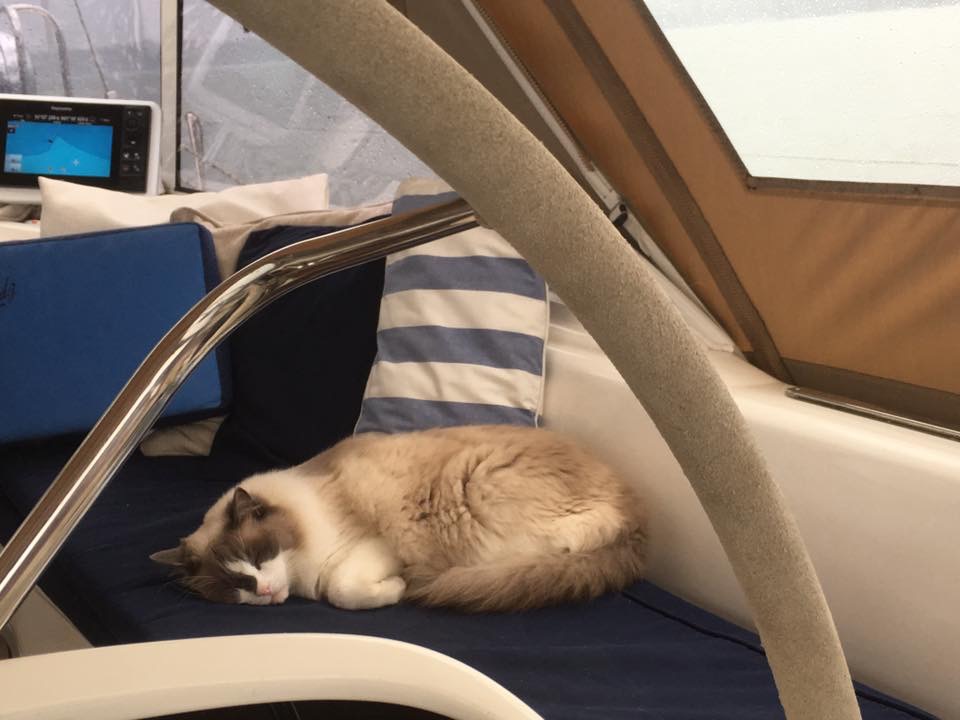
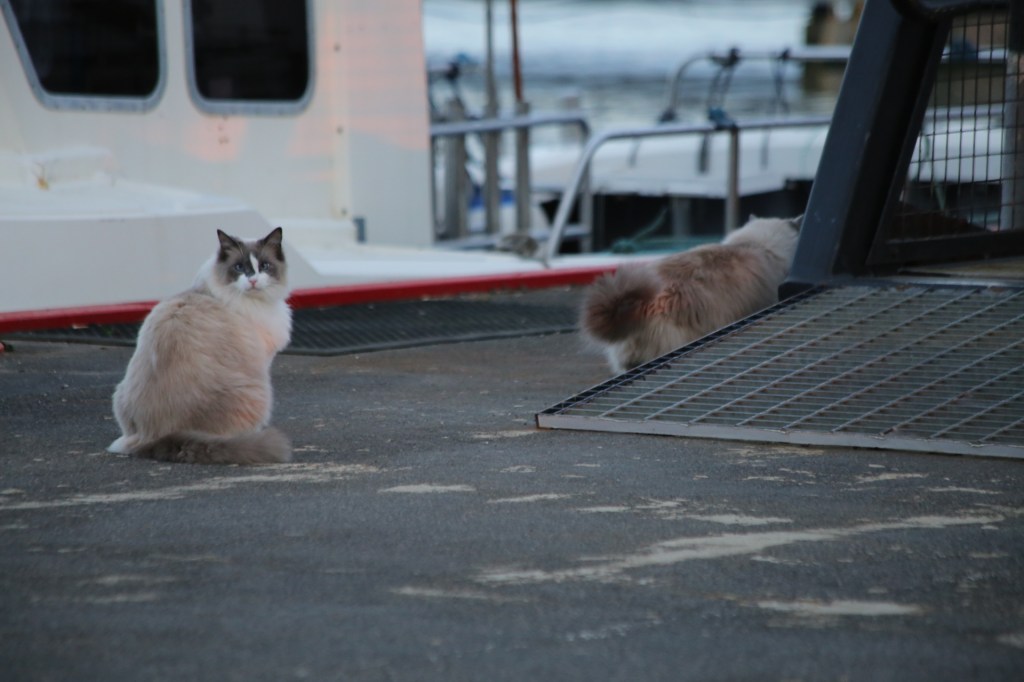
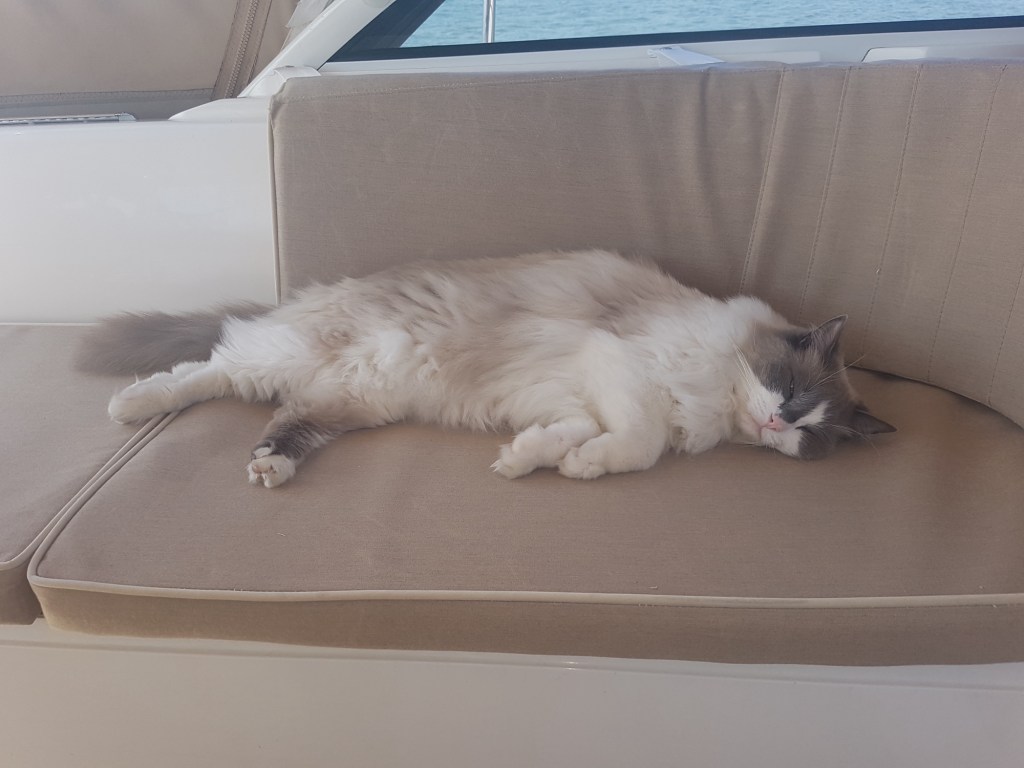
It is now getting later and we love night sailing but the issue with long distance sailing as a couple is that someone needs to be responsible for the boat at all times. The difficulty is getting rest, since you can’t really go to bed for eight hours and leave the other to look after the boat. Our view is normally to have a couple of hour watches through the night and also catch up on sleep during the day. I am normally pretty good at this and can sleep anywhere, all those late night inter-continental flights have helped there. However, Maria struggles to get her rest, a fact we noticed when crossing from Spain to Italy a few years ago. Add to that the excitement of starting the journey and you have a recipe for two tired people. In addition, we have the stress of making sure Bonnie is ok when this is her first multi-day passage. To be fair, these days, she spends a lot of time eating, sleeping and washing but did get into the habit of an early evening walk around the cockpit and some quality time with her parents.
Maria gets some food out and we have a really nice Lasagne with salad in the cockpit. It sets us up for the night and because of all the preparatory work, Maria knocks this up really quickly despite the movements of the boat.
Through the night, the wind has turned against us a little and we are now sailing to windward rather than enjoying an easy push down the coast. We continue heading South to get around the storm, recognising that we are adding a lot of distance and hence time to the journey.
We have been sailing for 36 hours and we decide it is time to make the turn towards the straits of Messina. The Sirocco isn’t good and the wind strength has increased. This is the earliest point we could turn and use the wind effectively. However, the sea state is rough with two to three meter waves coming at us and occasionally the boat being hit hard and losing a lot of momentum. This is resulting in an uncomfortable ride and a day of this would not be good. We abort the first attempt to head to Messina, as we crash through the waves. We return to our southerly course with a view to trying again when the storm has settled a bit and the wind spend has reduced from 20 knots. At this stage we are using our staysail and less than two thirds of our main as the winds could be rising towards thirty knots. We are also using our engine to try and make a little more progress so we can hopefully get to better weather.
After a couple of hours, we are not making good progress South but we now have a better angle towards Messina even if not quite perfect yet. We agree that we should start heading back in the right direction. It is more comfortable than our last attempt but not perfect by any means. A feature of this trip, and particularly the last twenty four hours has been any slight change in the wind has always been to our detriment, and that seems to be continuing through the day. This means that rather than aiming at the Messina Straight we are having to aim 20-30 miles up the Italian coast. This means we would need to do that 20-30 miles, assuming everything stays the same, as an uncomfortable run down the coast miles into big waves and wind. However, the wind is due to let off before the next front comes in quite quickly and hopefully that window will present an opportunity. A number of hours later, we continue to make good progress towards Italy but still have the conundrum above and the wind is strengthening. It is now up to 25 knots and gusting near to thirty. We are close hauled to the wind with relatively little sail out so Mariadz is taking it very well and continuing to go faster than six knots with a reasonable amount of heel – we know our girl doesn’t like to be over-heeled!
I recall from our first trip through the Messina Straight, the issues with whirlpools, and potentially sea monsters! The flow of water is quite fast and for a sailing yacht it is important to hit the right window to go through the Straights or the flow of water will significantly offset the speed you are doing. This window starts approximately between 10 and 11 in the morning and the night for the days we are likely to traverse the Straights. As we head back to land we are making good progress and we will be around the window, although the three hours lost for the extra tack is not good news for us.

Then our first bit of luck, the wind shifts slightly to the South and softens a little so I can bring Mariadz further South West and now we are aimed at the entrance to the Straits. Our speed remains good and we are back on target for going through the straits at a good time.
As we follow the Italian coast round into the Messina Straits, the last part is a little strange with huge waves crashing against us amidships and rolling the boat from side to side as Mariadz rides the waves. It isn’t fun but it isn’t long before we are turning to go into the straits themselves from the Italian side and then it gets very strange. We are due a lull but the last of the wind is giving its all. We have a 15-20ft headwind, which is not good. The current should be against us and the waves seem to be aimed at us with the wind. However, the prevailing winds for some time have been from behind our current position and we are definitely surfing the waves in, even though I don’t think we should be doing that into a headwind! Mariadz is incredibly stable but does fall off the wave when surfing a few times, some minor alterations and we resolve that but it feels strange as we make good progress into weather that should be stopping us.
As we approach, we speak to Messina VTS, who control the Straits, and they give us permission to proceed but we are three abreast with two cargo ships, one of which is almost going exactly the same speed as us. The straits tighten up and I decide that just as discretion is the better part of valour, cowardice is the better part of discretion – I slow down and tuck in behind the second cargo ship, the first having got a little ahead of us all. We now have the fun of playing frogger (the old game where the frog has to across the busy road!) with the ferries crossing between Italy and Sicily. They are all on AIS so we can see them with me handling everything in the vicinity and Maria checking a bit further ahead for potential hazards. This team effort works really well as we work our way through the Straits, just as I negotiate one potential issue, Maria gives me advance warning of the next. Soon enough we are past the worst of the traffic and heading towards the starboard turn as you start the exit of the Straits. I notice the slow moving cargo ship ahead of us has gone quite close to the middle of the traffic separation scheme, which effectively gives you sides of the road, interesting but maybe we will stay in the middle….. As we make our turn it becomes clear why they have done that. We have been travelling at a steady seven knots and our autopilot has been faultless. Suddenly our autopilot is struggling to keep us on course and Mariadz is turning by herself and the speed over ground is down to 1-2 knots. Nothing has changed on Mariadz and we are still making revs to achieve seven knots easily. Clearly, we have been caught up in a whirlpool (I don’t mean the washing machine although the effect feels quite similar!). we are powering through and still making some progress but it is slow. After a few minutes, we are out of it and everything returns to normal but a lesson learned when the locals give that right hand corner (when you are going North) a wide berth!
It has been a hard few days and we are clearly both a little tired so Maria’s suggestion that we stop in Milazzo rather than continue to Palermo seems really sensible. We now only have three or fours left to go but it will still be after 3am when we arrive. The next few hours are uneventful and we get a little rest. It is great that Milazzo have said they have space for us and we are looking forward to an alongside berth and a good nights sleep in our bed.
We approach and radio in with the team saying they will come and get us in the rib. Excellent, concierge service! Our recent journey has been the first time in Mariadz for quite some time, more than a year, and Maria has yet to regain her confidence behind the wheel. It therefore falls to our less experienced helmsman to bring Mariadz into the marina. And it looks tight! And we have only just had the topsides beautifully done at Balsamo and I really don’t want to damage her!
Our guide tells me we have to go in astern which is not a huge surprise, especially as the path we have to go down is little wider than Mariadz, maybe two metres. I am taking it very slow, especially since I have no idea where we are going. The guy is now out of the rib and on the dock pointing to a small gap between two big, expensive-looking boats! Maria confirms that we have to turn into there but I am worried that any attempt to turn straight in would push the bow out to the other side and into the anchors, lazy lines (and general trouble) on our port side. I continue to back up slowly and slowly edge towards the starboard side. Please remember that this is after several days of sailing and at 3:30am! As we go past the berth it is clear that not only is this area not very wide but the gap they are proposing is a couple of metres bigger than Mariadz. Now I can hear some of you saying, its parallel parking, that’s easy in a gap that is not much bigger than your car! Hmmm, it’s a fair point but when you are parallel parking you have a lot more control over direction and the road isn’t moving! Anyway having now gone past the space and shifted from the centre towards the starboard side of the channel, I am confident I have enough space to swing the stern out a little and point into the gap. As we edge in, a burst of the bow thruster (sometimes I wish I had something like that on the car), simultaneously moves the bow out and brings the stern in and we are now only a couple of metres from the dock. Maria expertly throws the mid line to the marina guy so we are attached and once the stern line is on, it is just a case of edging Mariadz into the space. We have landed and no boats were hurt in the making of this story! You may think I have exaggerated the difficulty of this but to put it into context, I immediately got off to see how much space I had and it was literally 50cms from the rib to the boat behind and a meter and a half to the swim platform of the one in front. The nod I got from the guy on the dock was enough to know that he thought it was impressive (so why did he put us there if it was so difficult…..).

After a good nights sleep, we talk to the office the next day and they tell us that we need to come out of that space and go into another space for our second night. Being lucky once is one thing, but the problem with Russian roulette is that if you keep doing it, eventually you lose! We also need to refuel and so will combine those together. My first request is to make the space a little larger so we can get out. I point out that the boat in front could move forward a couple of metres and then I could bring Mariadz off almost sideways, something we have done loads. “I’m sorry I can’t touch that boat!”. Ok, scratch that. You need to come and help us by attaching a rib to the stern and pulling the stern off while use the bow thruster to get the bow off. OK, and actually that was even easier than it sounds. Mariadz glides off sideways and I am in the middle of the not very wide channel. As we exit, Maria is worried we may hit the motorboat moored at an angle at the end but I recall that we cant swing over too early or we get caught up in the lazy lines on the other side. We sneak out without any problems but Maria was very worried! So it is over to the fuel berth where we are told we can’t refuel because it is only two metres deep – that’s ok, we only draw 1.8m. However, we do need to be careful of that unforgiving rock that seems to be five metres behind the fuel pontoon. We go in astern, so our fuel cap is on the correct side and are tied up quite quickly. Over 500 litres later and one work call, we are topped up and it is time to go to our new berth. This is in the next channel against the wall where all the big boats go except there appears to be a large rib exactly where we are being told to go. We wait while that is moved and then gently get Mariadz into her new position without any issues representing three landings in twelve hours and no damage to Mariadz 😊
We will be here for another twenty four hours which gives us a little time to try and resolve a few issues:
• The wiring for the solar has been cut from the cable ties whilst at Balsamo, that needs redoing
• We need to fix the stand up block so that our mainsheet can be fully functional again
• The bad weather has ripped some of the lines holding the netting at the bow
• I need to buy a new long hose since the last one split
• Our starboard navigation light stopped working, admittedly after the bow had been buried in water so that may just have been a little water getting into it
• Maria wants additional freezer capability, now that we know that our drop in freezer wont be done any time soon
• I have noticed that the rib is not sitting well on the straps and on closer inspection find that one of the lifting points has sheared – that will need to be fixed before we continue our journey
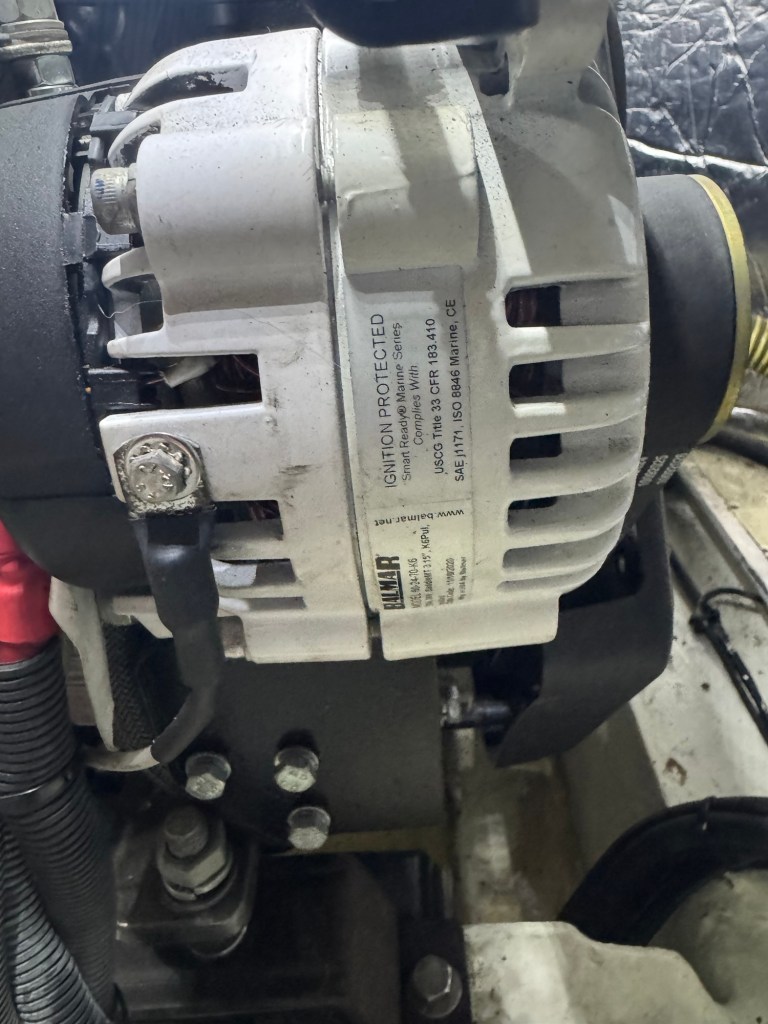
• The alternator is not charging the batteries again! More investigation required and possibly the help of a professional
So a reasonable list to fix quickly! But more of that next time….