Apparently there are few jobs worse than a blocked toilet on a boat, I can use the term “heads” but trying to be inclusive will use a term that non-yachties will understand. Anyway, no one wants to have to work out the blockage in a toilet system in a confined space with some pretty nasty smells and mess. It is bad enough in a domestic setting, a boat is much worse.
So it was with great joy that we found on our second use of the boat, that the toilet system had blocked. The problem is that the waste pipes that carry the water and human waste to the holding tank get a deposit within them caused by urine reacting to the salt water. Over time this builds up until the pipes can take very little without blocking. It almost becomes like the Greek model where the only thing allowed down the toilet has to have gone through you. Mariadz still had the original pipe work, and clearly the toilets had been used a fair bit….try not to think about that too much because the circumference of the pipe had reduced from an inch and a quarter ( as I recall) to less than the diameter of a 5p piece. So what is the cure? You have a choice here. The first option is to plug both ends (very important that bit) get the pipe off the boat (very difficult that bit) and thrash the pipe on the floor (just urgh! And what happens if you haven’t plugged it effectively??) to shift the deposit before replacing said pipe. The second is that you do the important and difficult bits before throwing away said pipe and replacing with brand new, clean perfect pipes. Now we are not ones to shirk a nasty job and in fact Maria helped Stevie from Watercraft UK to do this for us. Our concern was that firstly, you needed to be sure that the amount of thrashing was sufficient or you were going to be doing the whole job again very shortly. Secondly, the pipes were 15 years old and likely to be brittle, what was the chance of a minor split being introduced by the thrashing resulting in a glorious and messy hunt for a hole in the pipe that you can guarantee would be in an inaccessible place and was resulting in a rich aroma of human waste emanating from the bilge? We calculated the chances…..it was 0.00000001%. We decided it was just too risky. Brand new pipes were installed. That sounds simple, it isn’t. The pipe runs on a Moody are difficult and it took a lot of work to get the pipes out at all, in fact some had to be cut – lucky we were replacing them! The new pipes were a little easier to get in not least of all because we did change some of the routing to make this simpler.
The second part of the operation was to review the toilet in the state room. 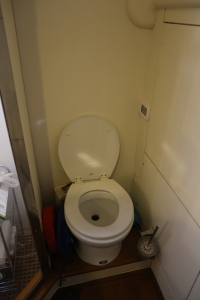 In most marine toilets, you have enjoyable, and fitness enhancing pump action where you first fill the toilet with water before evacuating it into the pipe work, finally cleaning with another few pumps. On Bavarias and Dufours, six pumps three times was adequate. With the Moody and its unique, read very long, pipe work you would be best at around about twenty times three unless you would like to leave something in the pipe work to react with sea water and return us to the fine mess we had started with. This would then involve thrashing again, and this time I imagine a) i could be the recipient and b) I would be certainly doing the messy bit on my own since Maria had done her stint and knew how gross it was! The advantages of an electric toilet are many. Firstly, it is likely to have a macerater built in which chops up everything going into the pipe into small, easy to digest (for the pipe work) chunks so no mess 🙂 Secondly, there is a pump for the water so no hand cranking sixty times, massively improving upper body strength but no fun.
So that will be two electric toilets then. No. The clue is in the title, electric toilets require electricity. What if there was a problem with power for some reason. We don’t want to be using a bucket (and chuck it!) – that would be another thrashing and this time not for the pipe. We decided to leave the forepeak toilet as a pump action so that, in the event of a total power failure, we still have the use of a loo. Of course it means that guests of Mariadz also get the opportunity to develop their biceps and tone their upper body. It also means that I go into the heads and give it a thorough pump through, 180 pumps (hey I’m a fitness freak 😉 ), after visitors.
The upshot is that we expect that with the precautions we have taken, and the cheapest degradeable toilet paper known to man, we are hoping that we will not have to deal with blocked pipes again in our time of ownership – That is how bad it is!
I can’t believe that I have written so much on toilets! Tune in next time for something even more tedious and gruesome 🙂


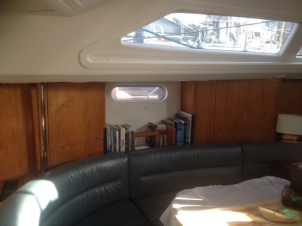
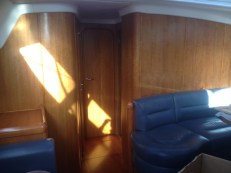

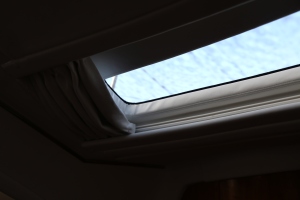 Ours was made worse because every window in the saloon leaked which meant that rainwater went behind the headlining and destroyed the glue between the headlining and the fibreglass. when we first got the boat, we found that the headlining near the curtains was actually falling off the wall.
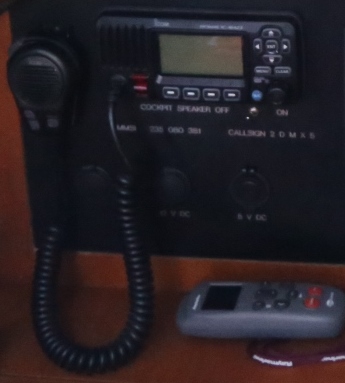
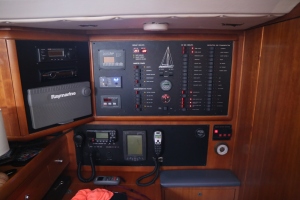 Maria and I both enjoy our music and when we bought the boat there was an adequate stereo that fed speakers in the saloon and cockpit. This was an area we had improved in the Dufour by buying a Bluetooth enabled stereo that could link to any device. We decided that the same would work well on the Moody.
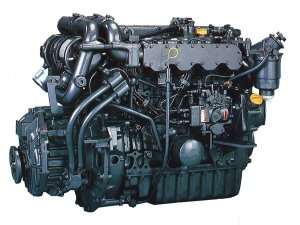 have a full engine survey, and with hindsight this would have been money well spent, on an engine with 3,000 hours on it. Our surveyor did his initial review of the engine both out and in the water and didn’t report anything amiss.
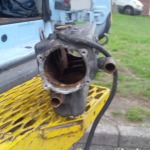 With apologies for the poor quality of the pictures, Travis reported a disaster on both the generator (another story) but also on the engine. The picture shows an extensive amount of corrosion in the heat exchanger which means that the entire unit needed to be replaced and we were lucky not to have caused serious issues when using it. At the same time it was clear that the “recent service” that had been done would have identified these issues and if detected early, the problem we now found could have been avoided. I had the receipt for the most recent service which had been an oil and filter change. I compared this with the Yanmar recommended checklist for a 3,000 hour service….clearly there had been some mistake.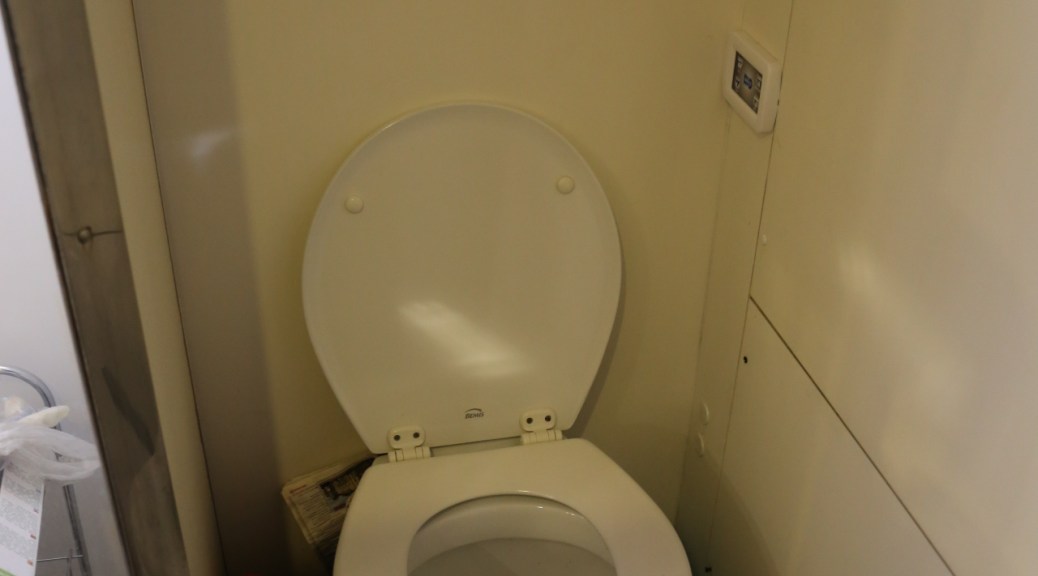

 that means that you have lovely warm towels after a shower. I suspect this will be more important in an English Winter than a Bahamian Summer.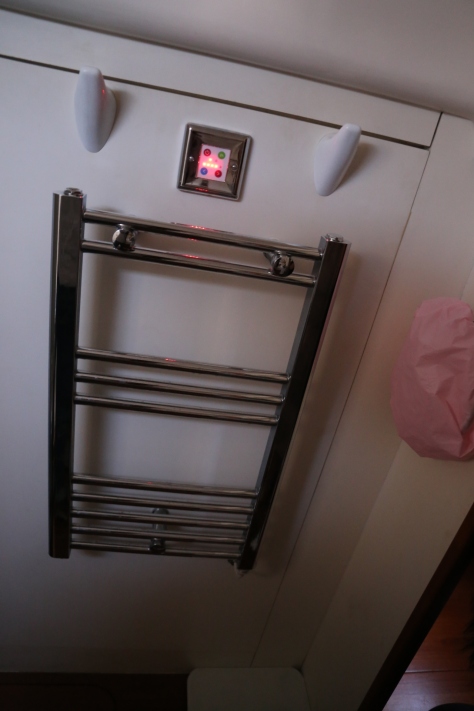
 . The inside of the windows is accessible if you take down the headlining but initially we decided to just do the outside to start.
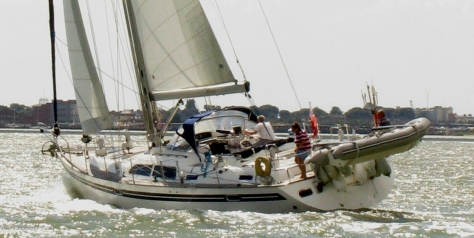 She was itching to show what she could do and even with limited sail we were sailing beautifully balanced at nearly 9 knots. At this point I should mention that the speed limit on this part of the river is 6 knots….under power 🙂 happy days. We passed
  Mariadz