All posts by mariadz2010

Clothes Washing

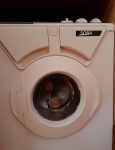
Mariadz, when we first got her, had a SOBA 20170626_114401washing machine which is small and apparently designed for the yachting life.  However, Maria wanted to see if there was a portable solution that would work on the boat, in the motorhome or in Italy before the main house was finished.

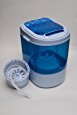
In the end, washing machineshe decided on a PORTABLE 230V MINI 3KG WASHING MACHINE. so watch this space to see how this handles our motorhome holiday to Italy and a few uses on the boat during the summer…..the answer is very well.  It is slower than a normal wash because you have to manually change it from wash to spin and the load is not huge but for washing in a hot climate it seems to be a pretty good solution and got a lot of use on our recent trip to Southern Italy.

I have to say though, that I am looking to see IMG_5857whether the Drumi a low-water usage, foot-operated washer takes off. It looks a really good design but a bit pricey.  The price may come down over time so I am keeping an eye on it.

Fixing the engine – Part 4

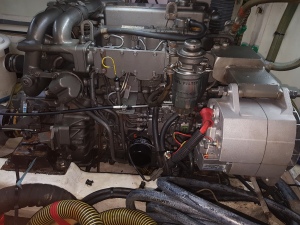
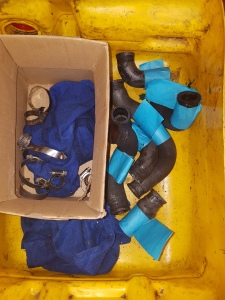
We have done a fair bit of work on the engine over the last year and one of the last of the jobs we had identified was replacing all of the cooling hoses on the engine with new ones.  The old ones had been heat and age damaged and we thought we would take the pre-emptive step of replacing them all so that we didn’t have one go at a bad time and potentially cause damage to the engine.  At the same time, we wanted to resolve the slight oil leak at the front of the engine which we believe to be from the bolts on the engine.  We had reviewed the service manual, identified which variant of the Yanmar engine we have and then the replacement pipes had been ordered for us and we had these on the boat for quite some time before we could get the work scheduled.  Step one was to review what we had against the engine list.  We found that some of the ones we had were right but most of them were not!  Back to the drawing board on the ordering of the pipes.  We also agreed that we would get the key pipes sorted and then look at what was left after that.20170620_135019

Lindsay at Seapower has been great with us on this.  He knows our plans and knows we will have to be self-sufficient and so encourages us to get heavily involved in the work, for instance the last full service of the engine was done by me, assisted by Seapower (to make sure I didn’t mess it up!).

The pipe replacement process is quite simple but time consuming since you need to clean up where the old pipe was before you can put the new pipe in place.  20170620_134937Some of them do not have great access so someone with small hands is best.  Firstly Houghton It is very important to completely empty the coolant before you start!  We don’t want a messy bilge…. Each removed pipe is labelled so that we know what we have replaced and jubilee clips are replaced as required.  As part of this work, various engine parts were cleaned up or replaced including the thermostat.  By the end of this process we will have a pretty new engine 🙂 it takes quite a bit of time to do all of this work.

the other advantage of getting this upfront and personal with your engine is you start to see other things that need to be addressed. A missing injector clip. No pipe running an overflow to the bilge rather than letting it spray all over the top of the engine if there was a problem. Poor running of the fuel pipe too close to the gear change lever which could result in wear on the pipe.  A nice new vetus water strainer opener attached to the water strainer so that we can take the lid off without using a red rope! All of these have been addressed and i think we are now in a position where we can have a little confidence in the engine, at least until the next time we have to do something!

Sorting the engine – Part 3

Sorting the engine – step 2

Sorting the engine – step 1

Yanmar engine – why maintenance is so important

Servicing the wenches (oops I mean winches)

We recognise as we go round the world that every six months or so that we will be servicing the winches.  This regime hasn’t started yet and at the beginning of the week I was still very much a wench winch virgin.

We are fortunate to count as one of our friends Mat Jerram, who is a very experienced marine engineer, and as a friend Mat has imparted knowledge normally in exchange for copious food which has been a small price to pay. So on Sunday, as Maria was making roast dinner for all of us, he raises the fact that I have been talking about servicing the winches for a couple of years….and haven’t done it yet. Maria is twenty minutes from serving so it is enough time to break apart a winch and explain what to do! Mat explains the process really well and takes a look at the winches which have clearly not been properly serviced for some time (i.e long before we had the boat). There is a mass of grease on the entire winch mechanism and I now understand the process.

So the start of a new week and new jobs.  I get the lewmar oil, grease and spare pawl springs, as recommended by Mat, and now will service all of the winches. I start with the one that Mat had broken up on Sunday on the coach roof.  It all seems to be going fine as I clean up the winch using white spirit to remove the previous grease and grime.  I am able to keep hold of the pawl springs and even they get a good clean.  The whole winch was in a pretty bad state but not disastrous or close to failure. Having cleaned everything up, I apply oil to the pawls and move them around to spread it, they are moving really freely. I then apply the grease to the rest of the mechanism, a very thin layer so that it feels greasy to the touch but you cant really see the grease on it. Everything goes back together and I test the winch – all good. The second coach roof winch is in similar condition and the process is pretty much the same apart from the ping as one of the pawl springs goes flying from my hand across the boat and into the drink! Thank you Mat for suggesting that I get some spare springs.  This winch is somewhat quicker since I know what I am doing.  Quicker but ultimately flawed since it doesn’t work when I test it!  I know exactly what I have done, one of the units with pawls could go either way and I haven’t put it back in the right way.  Of course you don’t have to take the winch half apart to change this, the whole thing has to come apart to the base plate so that you can swap the part round the other way!  Retest and success, two down….SIX to go!

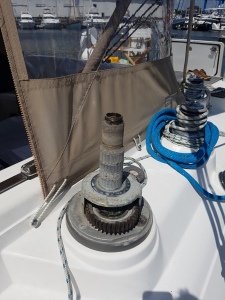
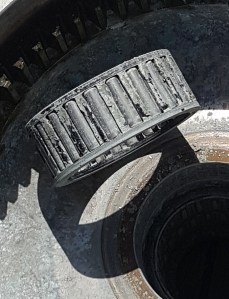
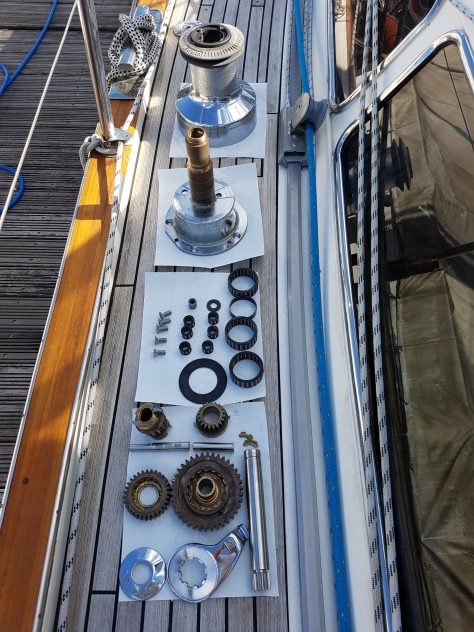
I’m on a roll, so onto the big sheet winches, knock these out in a day (amongst the other things I have on) and then the four small winches should be easy.  Unscrew the cap, take off the self tail mechanism and lift the casing off the mechanism. It moves a quarter of an inch.  Stop being a wimp and lift it! Quarter of an inch again. Last try, all my strength, quarter of an inch! At this stage, you look around for something to beat the winch with in true Basil Fawlty style.  Unfortunately there are no trees in the Marina, so I will have to come up with something else.  I find a couple of blocks that I can rig as a block and tackle. and attach set this up to the boom which I have swung out and tied off above the winch.  My trusty “red rope” (previously used for lifting outboards, freeing water filter caps and pulling pipes off through hull fittings) is at the fore as the attachment to the winch.  I tie it off using a pipe hitch and a round turn and to half hitches to the block, the tail of the line is then used to provide a second lifting point on the other side of the winch so that the pull is straight up.  I am ready to go and …..success….it moves half an inch! Success is measured in degrees when you have successfully lifted the whole winch by a quarter inch on three previous attempts.  I was happy to get it to a half inch on the first attempt.  Push it back down and pull again and it goes a bit further. I continue this making more and more progress until the casing comes clear 🙂  20170615_120841I now get to see what I have to deal with… The entire mechanism is glued together with calcium, salt and lots of old grease which has hardened.  The whole thing was solid and it is difficult to see how the thing moved in the first place.20170615_224543  The bearings are equally bad with no movement.  At this point I have to admit that the act of cleaning these things up and getting them back together is incredibly therapeutic and does give a great feeling of satisfaction when it is all back together again so thoroughly recommended.  When I was young I used to try and fix broken alarm clocks.  In common with a number of people I would take them apart and put them back together again, they never worked again and there were always a few spare parts lying around at the end of the process.  It is important that this isn’t the case when rebuilding a winch! A nice way to try and stop this happening is to be very organised as the winch is taken apart.  20170615_165840I laid out paper towel on the deck and had each group of parts on a single piece.  I found this really helped to make sure that I put it back together in the same order as it came apart.  As you can see, there was a lot of work required to clean these up and the whole process, with a few interruptions, takes a number of hours.  There is no way I am getting the second one done on the same day.

The next day, I set about the other sheet winch.  I have left the block and tackle rigged, I’m clearly going to need that.  This is going smoothly and faster than the first.  I get most of it apart quite quickly and I now have to remove five bolts, with alun key holes, that hold the tower casing onto the base.  On the first winch these were tough cookies but my rachet set up is equal to the task.  I get four off with quite a bit of effort and notice that some of them are a little rounded but they are off.  The last one looks particularly tight and the hole looks even more rounded than some of the others.  Even spraying with WD40 and PlusGas does not help this one to budge and as I try to shift it the wrench twists round and the alun key shaped hole is no longer alun key shaped but round 😦  For the moment I have to clean up everything that I can and reassemble the winch but I will need to drill out the bolt to finish this winch off.

The “half” clean up goes well and the winch works again so at least I can put it back together. I receive quite a bit of advice on how to get the remaining bolt out.  Cut a slot in the top of it and use a flat head setup to get it off, the idea being there is more metal to push against.  Another is to use a “screw extraction” set, which works by burying itself in the bolt and then as you tighten (it has a reverse thread), it loosens itself.  This probably works best when the bolt is not stuck fast into the hole. I cant get the screw extraction tool to bight into the stainless steel bolt.  Time for some help.

Lindsay is on board doing some changes in the engine room, more of that later, an offers to help me drill out the bolt.  Drilling out stainless is not lightly taken on and the trick is to have the drill on a very slow setting and take your time.  We drill out quite a wide hole so that we can get a large screw extractor in there.  I had previously been using the ones that you screw into the bolt but Lindsay’s set is driven in hard.  The large one works well and the head starts to move.  Unfortunately the screw is stuck so tight that the head separates from the rest of the bolt but at least I am now in a position to get the winch apart.  We use a smaller drill to get into the screw but this is still stuck hard so we have covered it with Plusgas which should help the bolt to loosen over twenty four hours.  That said, the whole area had been lightly bathed in WD40 and plusgas for most of the previous 72 hours so it may not be enough. That still doesn’t work so we will be leaving the thread in their for a few weeks soaked in plusgas and have a go at a later date.

Having temporarily resolved the seized bolt issue, I can now continue with the servicing of this winch.  This is as bad as the first with lots of cleaning required again to get it to a standard where you would be happy to reassemble.

Anyway, at least the other winches which should be uneventful since I have done the hardest ones first…. Or maybe not.  we have eight winches dotted around the cockpit and another at the mast.  Each pair in the cockpit are completely different and the mast is a two speed winch without a self tailor.

To be fair the servicing is not bad, except two of the winches are pretty much jammed due to lack of use and poor previous maintenance.

That is easily resolved and it actually makes it more interesting when you have to work out how the winch is put together each time.  Reassembly is also interesting and I was flummoxed for a few minutes when I put a winch back together and couldn’t drop the bolts into the cogs.  On inspection, the whole was out by 2mm.  Now that just isn’t possible, these things are precision engineered and when not covered in gunk go back together beautifully   I worked out that I had put one of the mechanisms in upside down and the two “same-sized” cogs were actually slightly different sizes.

So I am done on the cockpit winches, lets start on the mast one!  this is interesting and again completely different from any other winch I have done.  For the first time, I take the winch casing off and something drops out – that shouldn’t be possible.  It is a pawl, the part of the mechanism that gives the winch is familiar clicking sound.  That’s not good.  I get the winch assembly off the mast and onto the deck so I can see what needs to be done.

This winch is a two speed winch and it is the slower setting that has both Pawls broken.  I have bought some spares and so can set about cleaning up the winch and getting it back to perfect working order.  Now on my ninth winch, ten if you count one on a friends boat that I helped with, I am confident when putting it back together and it all works first time.

My top tips for winch servicing:

  1. Don’t be scared, things are not going to ping all over the place as soon as you take the case off.
  2. Remove everything slowly and make sure you hold the underneath, sometimes some of the components have others within them.  You don’t want them falling out
  3. Read the service guide, the lewmar one has pictures
  4. I put my finger at the end as I lift the pawl out of place, this means that the spring hits your finger rather than pinging off into the water
  5. A very thin layer of grease but nowhere near the pawls and oil around the pawls.  I had it so that they felt greasy but you couldn’t really see grease on them
  6. Take your time and clean everything really well, it will cost an extra five minutes but if you don’t do it you will know it every time you look at the winch


Taking a week fixing what broke in a weekend

We had an eventful weekend in the Stour and the broken list was extensive.

  • Initially the large domestic alternator had broken down and I had disconnected this to try and prevent any further damage.
  • The davits had stopped working and this seemed to be electrical in nature too.
  • We still had a problem with water flow to the engine
  • We had a sheered bolt in the impeller

To this list I added a couple of long outstanding jobs:

  • Replace the hydraulic rams for the swim platform and get this working again
  • Fix the mount for the navigation on the rib and make sure it now charges

Firstly the cooling problem.  We knew that this was related to the through hull and so the first technique we tried was to attach the filling end of the rib’s foot pump to the pipe from the through hull.  This would create air pressure that should shoot out whatever was in it like a torpedo.  Or not.  Lots of pressure and difficult (read almost impossible) to increase the pressure further with the foot pump.  So that didn’t work but we know there is something blocking it.  The next theory was to insert the dockside hose down the pipe and blast it out with water.  I do not like the idea of filling up the boat with a hose (water tanks excepted) but I wont be blasting for long.  With Maria holding the hose in place and a cloth over it to avoid any “blow-back”, we test slowly. I imagine Maria wouldn’t be too pleased if she and the engine room wee soaked by an icy blast of water.  One second burst, five second burst, five minute burst while I discuss with Peter, our neighbour, the problem I am trying to solve.  Oh sorry dear, forgot about the hose. Fortunately no drama or screams from the engine room.  Put everything back together and a quick check of the engine – we have full flow! 🙂  Subsequently, I heard of another technique that I also think would work which was to use a plunger from outside the boat, but Maria wasn’t keen for me to go swimming in the locked Marina water.

For the swim platform and impeller bolt, I will need to go to a chandlery to get spares (hydraulic fluid and bolts).  I go to Fox’s chandlery locally but they don’t have the right bolts and they are asking detailed questions about the rams and the pump before agreeing which hydraulic fluid I need.  I phone the UK distributor for the Bennetts rams who explains that any automatic transmission fluid will do so that saved me some money since it doesn’t have to have marine in the labelling.  On my return to the Ipswich marina, I see Lindsay from Seapower and explain my difficulty obtaining the right bolts for the impeller plate and he has a couple of spares “in the van”.  So I am sorted!

The sheered bolt is remarkably loose and I am able to spin this round with my nail to retrieve it.  Spin may be exaggerating a little, I can move it without drawing blood. I had tried to use a tool to help but the lack of visibility meant it was easier to feel your way with your nail. I replace all of the bolts with longer bolts having checked that they will fit correctly and that is another job ticked off.

Onto the hydraulics replacement, carefully lower the tank to a level where it wont try and fill the system when I take the old ones off.  Place a container under the rams to catch any fluid that leaks out.  The swapping over is easy and it is now time to try and bleed the system.  Back in the lazzarette, to find the reservoir lying nicely on its side and the hydraulic fluid coming out of a rip in the lid, thanks, and after I had tried to be so careful.  Refill the system with the new fluid. It is quite a small system and there appear to be no bleed valves so it’s a case of opening and closing the bypass while activating the pump.  It is all good and I am finishing the bleed when the platform starts to come up. And I am holding the down switch!  Our friend Mat, marine engineer on Song of the Whale, is coming for dinner, maybe I can pick his brains.  Mat and I take a look at this and the Davits.  It seems that whichever button you push it comes up, and if you swap the electrical connections over you can get it to open, no matter which button you push.  So a problem with the switching that needs to be solved when Ollie from Seapower comes back to the boat. To be fair this switch was wired when the platform didn’t work so easy not to get it right.

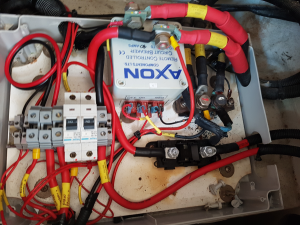
The davits are interesting and we spend time looking in the control box.  There is what appears to be a slow burn fuse that is located on the edge of the box and pokes through the box at the top.  This has the same pins as a car fuse and we swap this for one to test it.  The davits start to work.  Taking apart the black slow burn fuse reveals water is inside it (from all of the rain the previous weekend!).  We clean this all out and replace it.  The davits are now working perfectly. But who puts this outside of the box when there is likely to be water, we cover the top of this in tape to hopefully overcome this problem in the future.

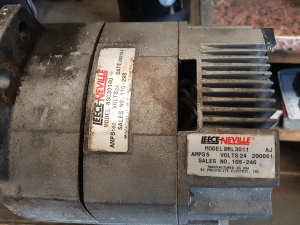
As our final job for the moment, we take a look at the alternator.  alternatorWe had found that a bolt had sheered which held the casing of the alternator together.  This had come out and had significantly damaged the vanes of the fan, which also explained the noise Maria heard.  So we get the alternator off and I will take it to the local specialist to see what can be done.  On investigation the alternator is fried and badly damaged which makes it uneconomical to repair.  A replacement is available and should be with us within 24 hours.

It is interesting though that since removing the alternator, some electrical devices are no longer working, and the engine circuit will not power up.  I had taped off all of the wires for the alternator. We put the negative from the alternator onto an engine bolt and everything starts working again but we are both at a loss to explain why the engine earth is going through the domestic alternator.

The next day I have refitted the alternator and tightened everything up. Just as discretion is the better part of valour, cowardice is the better part of discretion so I want Mat to check my work before I restart the engine.  We are all fine and so decide to test the new setup.  The engine starts well, we have water flow and the charge is also looking good although the batteries are pretty full at this stage anyway. We are working our way through the list well.

The new mount for the rib navigation has arrived which is a straight swap with a little help from Maria to hold the screw driver on one side while I tighten the bolt.  Definitely not a one man job unless you are stretch Armstrong.  When perusing the instructions I discover the original problem.  Apparently the mount comes with an all weather cover for the electrical connections.  That will stop water pooling around them causing corrosion and the mount to fail! RTFM.

Another job ticked off and I’m feeling good – maybe just lift those davits….nothing!  Maybe they are on the engine circuit so I need to power that up.  Nothing! In fact no light on the engine circuit at all. So this appears to be the same problem that I had when I took off the old alternator….but the new alternator is fitted and the negative is connected again.  I speak to Mat quickly to get an opinion and we agree that I need to look into why the domestic and engine circuits are connected.  I have already checked the “parallel” switch, for anyone starting if the engine battery is dead, and this is set correctly.  So it is under the bed in the aft cabin to check out the wiring there.  negative meltdownThere is a problem, it appears the bolt holding the engine earth to the negative bar is loose (right hand side of picture).  This has caused arcing between the cabling and therefore heat build up with some scorching.  In fact one of the negatives has corroded and melted the insulation so much that it has melted through another wires insulation and these are welded together.  That will be what caused our problems and it could even have been what damaged our alternator.  In some respects we were probably lucky the alternator went rather than continuing to build the heat up and potentially start a fire under the bed.  This doesn’t explain why the old alternator used to provide the earth to the engine and the new alternator doesn’t, despite being identical.  The current view is that this was as a result of the damage to the alternator which provided that earthing thereby by-passing the corroded engine earth.  But I will update with more information as it is available.

In the interim we have put a bypass in place for the earth but the engine and alternators will not be used until the above is fixed.

All in all, not a bad week, since we fixed a lot of issues and uncovered a pretty major new one. At least we found them in Ipswich rather than in the middle of nowhere and know how to deal with them in the future – all part of the education!


Problematic East coast weekend

We have spent the last two weekends away, firstly in Lymington, attending a seminar about blue water cruising and then to Italy to pay taxes, speak to builders and check out the house.  We therefore decided that we would have a weekend away somewhere quiet and decided that a few nights in the River Stour would allow us both to relax and chill.  It would also work out because we were expecting to see my son, Matt, over the weekend and it would be easy to pick him up from Harwich.  Maria still had to work on Friday but we decided to leave on Thursday since our setup allows her to work from home wherever we are.

It’s a beautiful evening as we head down the River Orwell and start to discuss where to stop.  We can either pick up a mooring buoy at Levington or anchor either at the bottom of the River Orwell or the top of the River Stour. We decide to keep going to the anchorage opposite Harwich Parkeston Quay at the top of the Stour adjacent to Shotley.  The trip down is mostly uneventful except Maria starts to think the engine doesn’t sound “right”. I go below and notice on the electrical panel that we are charging the batteries intermittently. This is changing the tone of the engine which is what Maria heard. I start to investigate and everything seems to be ok as we continued but I recognise that we will have a job to do when we return understanding why the charging is not consistent. 20170601_191903As we pass Shotley we notice our good friends the Thompson family from Ipswich, coming back up river. They have taken on an amazing project and are living aboard while they renovate their boat before going off travelling. It is an ambitious project but they are committed and we are really pleased to think of them as friends.

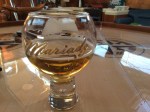
IMG_5772We anchor in a familiar spot and have a quiet evening. IMG_5771The traditional arrival drink, a beer, is ready and this time in our new hand painted glasses!  We also got some good news about a potential new role for me so all is right in our world as we settle down to a dinner of steak.

The next day starts well from a weather perspective and I am checking over the boat as Maria works.

I even break out the hammock that we have had for eighteen months and think about how to rig it.  Maria has always been worried about the pressure on the headsail of rigging it to there, which we have seen a number of times previously. I had noticed that Simon Thompson had rigged a spinnaker line to take the vertical pressure from this setup and thought by using two spinnaker lines and a cleat I could rig this so that both the horizontal and vertical pull was held by two different lines, sounds perfect in principle.  20170602_120504The other end could be held on a masthead cleat and I have been able to set up the hammock in a way acceptable to her majesty, siting on her throne at the chart table.

Between work calls, I am able to distract Maria enough to get her to try out my new setup (having checked it first, can you imagine the trouble I would be in if it failed!). Maria agrees to give it a go. I have video evidence. I also seem to have a court order which bans me from sharing said video evidence.

Anyone who has read about our rib will know one of the main issues we were trying to address was to allow Maria to get in and out with some decorum since she seemed to spend most of her time in an inflatable lying on her tummy with her bum in the air! She also struggled to get out of the Lotus Elise when we had it, with a common outcome being a loud thump and Maria picking herself up off her hands and knees….in front of a packed pub garden. Cool. So with much noise Maria gets into the hammock and we are all good…the camera is still rolling….she starts to get out.  Let’s just say that the first thing to hit the floor was her left hand, and she tried to get out on the right hand side. The final shot of the video that you are not allowed to see is Maria reversing back to the camera as she stands up….. close up and fade to black! I don’t think the court papers specifically excluded a description of the events. If they did my next blog will be from a police cell.

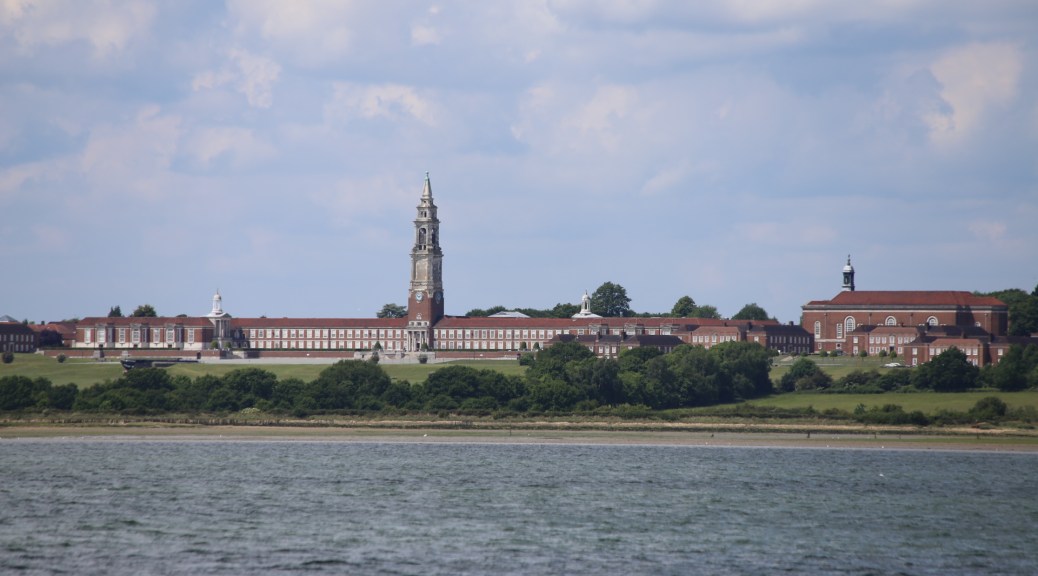
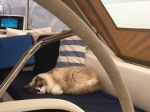
It gets towards the end of the day and Maria is finishing work. The anchorage is nice but is opposite a commercial port with ferries coming in and out infrequently. if we head down the river, it is very quiet under the Royal Hospital School. It’s been a glorious day but some clouds are to the west of us where we are heading. Maria points out that they look pretty evil but I check the wind direction which is gently blowing towards these clouds and point out that unless they are going against the prevailing wind direction, we’ll be fine….. 6243749872_IMG_3278Maria is not one to say I told you so but within ten minutes the rain is lashing down, the wind has turned and it is blowing over 30 knots.  Not the best weather to go on the foredeck and put out the anchor. We decide to float around while the thunderstorm passes, Maria also points out that where we were is still bathed in sunshine and it wasn’t her idea to move!  She points this out quite vociforously. With limited visibility, I take over the boat and decide to check out exactly where we will be anchoring when the weather improves. IMG_5840Quite a few people ask us about how the cats are on the boat, IMG_5841particularly when we are doing longer journeys or the weather isn’t good.  Bonnie and Clyde have grown up around boats and are very relaxed, on passages they will generally be in the cockpit with Maria and I or asleep downstairs.  You can see how stessed they were at the height of the storm.  It isn’t long before the thunder stops, well after three storms roll through, and the weather starts to improve and Maria takes over so that i can set up our anchor gear.
We have to reset the anchor because we weren’t quite where we wanted to be and at low tide it gets a bit shallow in the bay under the hospital school.  Finally we are set up, anchor float attached to the anchor with a line that can be used to retrieve the anchor. Ten metre snubber line to ease 6243749872_IMG_3282the strain on the boat and anchor, and several other snubbers making sure that even if we have a problem the windlass is never exposed to the yank of the chain.  Anchor ball up and we are ready for our evening. When the rain was lashing down earlier, we had taken a look at our BBQ food and thought we may be in trouble here! With IMG_5839the change in weather we decided to have a Thai dinner rather than cooking in the rain and wind.

We settle down down for a quiet evening, Mariadz style… it was probably around 11pm when Maria decided she wanted to listen to music. Oh dear! The Louisa Johnson song where she laments that it was only ten how did it get to three, could have been written for Maria…..obviously three is just the start and if Louisa wanted accuracy she would probably have gone for five or six! This night is no exception and despite a couple of attempts to get her to go to bed, it is “just one more song” until 5am when Maria makes egg and bacon sandwiches before going to bed as most of our (sensible) friends are starting to wake up. 6243749872_IMG_3283Later that day, we are “hanging”. It’s a lovely day, but a bit breezy. However, my hangover is not shifting and I go back to bed for a little while. While I am asleep, Maria chats to Amanda Furber, and agrees that we should all get together – I just need to pick them up from Harwich (4 miles away) in the rib like I am a taxi! I’m still not in a great state but I am sure the river ride will sort that out! While deploying the rib, there is a momentary stutter from the Davits as the motor stops and just clicks.  But it comes back, so another one to put on the list of things that need to be checked.  Just before leaving, Maria asks me how we are doing for fuel.  On the rib, we have the main tank that feeds the engine and a reserve five litre can which is always full.  The wind is blowing down the river towards Harwich and there is quite a swell.  This doesn’t bode well for the return journey but getting there should be fine. We have only done a few miles so I’m sure the fuel is fine…..of course I get a mile downriver and the engine cuts out as the main tank is empty! so it’s lift the seats get the two cans out and transfer fuel from the reserve to the main tank, all while being rolled around, beam onto the waves. 6243749872_IMG_3287Refuel complete, I can restart the engine and get to Halfpenny pier to pick up my fare. Amanda and Mark are waiting on the pier when I arrive.  I throw the rubbish into the bins and am ready to go. But Mark has a cunning plan, he will drive the car to Wrabness, slightly up river from us and I can get him there, it will be a shorter journey. Amanda joins me in the rib and we start to head off back to Mariadz.  I may have mentioned that it was blowing 15-20 knots and the waves are quite deep, probably a metre from the tip to the bottom. We are making progress but it is not particularly comfortable.  On the way to collect Amanda, I had remained dry for the entire journey, that wasn’t the case on the return.  Amanda acted as a good water and wind break but I still got wet.  Her back was also aching from the constant banging up and down and together we arrived at Mariadz wet and tired. Reading that last sentence back I should probably reiterate that this was a journey in the rib and nothing rude! I drop off Amanda and call Mark to find out where he is.  He is on the far side of Wrabness with the beach houses and the mooring buoys. He has waded out to knee height as I approach and climbs in and we have a comfortable ride back to the boat with the wind and waves at our backs.  On return to Mariadz, we go to the stern and decide to lift the rib back onto the Davits to avoid the rib banging the back of the boat overnight.  We are clipped on but the stutter we had previously seems to be here to stay and the davits wont work.  The rib is up enough for overnight and we decide to check it out in the morning.

I can now do the barbecue we have been 6243749872_IMG_3312promising ourselves and we all settle down to a lovely evening in the cockpit chatting, eating and drinking.  Mark is quite tired and bails responsibly early, i.e. before midnight, but Amanda has the bit in her teeth…. and a few drinks in her tummy. It is 3am (again) when we eventually all decide it is time for bed – someone will be feeling a little worse for wear tomorrow.  The next morning we are up reasonably early since we need to get Mark and Amanda back to Wrabness.  At this stage, Mark and I are beginning to think that since I added the 5 or 6 litres of fuel into the tank we have travelled six miles to and from Harwich and a couple of miles return to Wrabness which is now being repeated.  It should be fine…. and I will fill up both tanks when I return to Ipswich.  We get enough from the davits to drop the rib again but they are still playing up.  It is a bit calmer for the journey back to Wrabness and I am able to drop them off quite close to the beach at high tide and they wade back in.

Now for the return journey to Ipswich.  We are still getting nothing from the davits which appears to be an electrical problem, potentially something shorting out.  I have checked in the control box and everything seems fine in there, no loose connections and voltage where I would expect it but I am no expert.  Maria and I decide that we will have to tow the rib back and work it out over the next few days.  We hardly ever tow a rib so we have a large mooring line to do the tow and two back up lines…a bit belt and braces, especially when the mooring line also has a shock absorber built in!

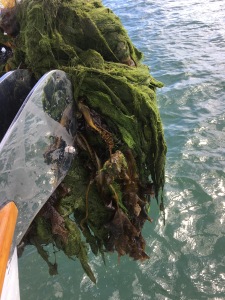
I go to lift the anchor, having previously checked that the davits electrical problem wasn’t impacting the windlass.  This is reasonably uneventful and the anchor comes up surrounded by approximately a two foot ball of mud and weed!  IMG_9679It is a sight.  I call Maria to come and take a look with Mariadz on autopilot and tracking down the middle of the Stour.  As we return from the bow, Maria notices more white smoke than is usual coming from our exhaust.  We check the temperature of the engine and it is above the normal working temperature.  We reduce revs as I go down below to check out what is going on in the engine room. I am greeted by quite a warm engine room. At the best of times the engine room is a “no shirt zone” and this was hotter than usual.  The water strainer on the aft bulkhead is completely green inside and it seems obvious that this is blocking water getting through to the engine.  I explain the situation to Maria and we decide to get some sail up quickly and switch the engine off while I try and fix it.  The clear lids on water strainers on Marine engines are great things, they allow you to see exactly what is going on.  However, they do have a tendency to stick fast, especially if there has been any heat.  Needless to say I can’t budge it.

I phone every chandlery along the Orwell to see if they have the specific devise designed to remove these covers but none have it.  Our friends on facebook, where Maria had updated, are trying to make suggestions: hot water over the top of the cover to make it easier to shift, wd40 under the lid to try and budge it and a wet cloth to get a better grip.  Nothing is working.  Since there is no water in there, perhaps a vacuum has formed so loosen the feeder pipes and let the vacuum out before trying all of the above again.  still nothing working.  On Cliff Elgar’s advice, I try to wrap a line around the lid with a view to pulling and twisting the lid off.  Again I am unsuccessful.  By this time, Mark and Amanda have called us to offer some assistance and some tools!  We agree that Maria and I will go along to Levington, pick up a mooring ball and meet them there.  After 45 minutes of eventful sailing, a regatta of 50 odd boats was coming the other way and not really thinking about how we were going to pass between them, we arrive at Levington.  Maria approaches the buoy perfectly with me midships as her spotter calling down the distance and angle of approach. In fact she sits Mariadz there so perfectly I could have had a cup of tea while I threaded the line and took it back to the bow to tie off.  Once settled, I get in the rib and head to the marina to meet Amanda and Mark.  They have stopped at Halfords and bought various tools that should give us a grip.  They also have their dog, Milly with them, and most importantly a new 5 litre can of petrol for the rib!  The four of us head back to Mariadz so that we can start to fix the problems.

Unfortunately the water strainer is being stubborn, none of the tools that Mark had brought were shifting it and we decided to review the rope technique again. With one minor adjustment, suggested by Mark, we had a better grip and the top started to move. In the end we had a loop in the end and the other end passed through this, this was then placed around the edge of the lid with the loop on the left hand side.  The pull would then tighten and then move the knot anti-clockwise.  With both of us pulling we start to budge the lid.  We can now see the jumble of weed that is in the strainer, we clear this out, put everything back together and are happy that we have fixed the problem.  Engine start and check the flow of water……negligible. oh dear, engine off. We should probably check the impeller.  On the yanmar engine, in common with a lot of marine installations, the impeller is in a very awkward place where I have to unscrew panels to access the impeller and even then I am going under the engine and reaching up to the vertical plate.  Our new lighting in the engine room is great but doesn’t get to this area which is still quite dark and you cant actually see it anyway because of its location.  So you are groping around in the dark and you have to feel your way (as Olivia Newton John would say).  It’s four bolts so release those, catch them so they don’t fall in the bilge (virtually inaccessible if they fall), as the last one goes, remember to catch the plate (similar bilge access issue!).  I have the plate off and a firm grip of all the parts so we can see the impeller, it looks fine and moves as it should.  Lets put it back together then.  Plate in place, don’t drop anything, hand tighten four bolts and then tighten with the spanner, 1, 2, 3, snap! Now that’s unfair, one of the bolts has sheered but at least the other three are on tight which should stop any leaks. Another job for when we are back in our berth.

So we have established that the engine is trying to draw water in, and the problem has to be at the other end where the water comes into the boat.  We decide we need to check the through hull.  Take off the two jubilee clips and lift the pipe off the through hull….nope.  That aint moving either! We have applied heat from Maria’s super hairdryer but still no progress.  Eventually and with a rolling hitch we have successfully attached my trusty, water-strainer-lid-remover rope to the pipe and it does it’s magic!  With the pulling of two of us we are able to get the pipe off the through hull.  Now lets see if we have any water coming through the through hull or whether the problem is in the pipe.  Open the through hull, just for a second, we don’t want to sink… a dribble of water comes out.  We could leave this open for weeks before we would need to worry about the boat sinking.  So there is a blockage on the though hull outside of the boat.  So two techniques, firstly, wire hanger to clear any hard objects and the large brush under the boat from the rib to scrape away any weed.  20170605_161329We test the engine and we have flow and a six inch piece of weed goes straight into the strainer!  At least we know what happened.  Having removed this, the lid comes off without the threat of “the rope”, and put everything back together again we’re ready to go.

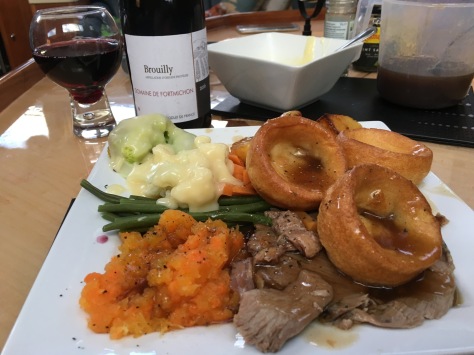
I drop Amanda, Mark and Milly back at the marina so that they can go for a walk and return to Mariadz for the last part of our epic journey home.  We start up and everything is looking good, but within 200 metres the temperature is starting to rise and again we need to slow the engine down.  By staying between 1,000 and 1,500 revs we can keep the temperature under control, less than 100, and we limp back to Ipswich slowly.  This gives Maria time to cook a roast dinner for when we arrive – an advantage of having a great cook for a wife!

Coming into the lock is interesting, Maria has the boat well placed but, after she has stopped, I have to move the rib out of the way before I can bring the stern in.  Everything is tied off, including the rib.  Coming into the berth, one of our neighbours, Peter, offers to help and I throw him a bow line and ask him to tie it to the end of the pontoon so that we can use it as a spring to keep the boat under control while I tie her off.  We’re in and safe and Maria has the engine off before I have finished tying us off, she has confidence in her man!

We can now inspect the damage over the next few days and fix everything….but first time for a lovely roast dinner.IMG_9684

Limoncello and the Cherry equivalent

When we started this blog, Maria did promise to write some recipes as part of the blog.  Eighteen months later and not a sausage, so to speak!

It is somewhat fitting that the first recipe to go up on the site is for an alcoholic beverage, our homemade limoncello.

In the UK, 95% alcohol is banned, probably because UK teenagers (we were once!) would probably try and drink it neat as some kind of test of bravery!  We bring ours in from Italy, which is allowed, for personal use.  So what do you need:

10 unwaxed lemons

1 litre 95% alcohol

1.5 litres of fresh water

500g granulated sugar

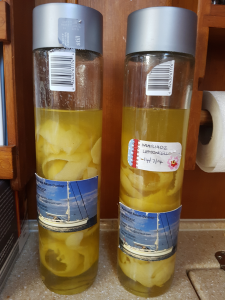
Firstly, peel the unwaxed lemons and keep the peel.  Split the alcohol into two using a couple of litre bottles, preferably with a wide neck, the reason will become clear later.  Put the peel into the bottles equally.  The next part is contentious, (some people don’t do this!) add the juice from the lemons to the alcohol… the peel has enough in it to create the taste but the juice makes it more “lemony”.  limoncelloNow leave it on the side for two weeks shaking and turning it each day.

Two weeks later, it is time to put everything together.  Firstly we need to get our flavoured alcohol out of the bottles and put it to one side for a moment.  We will use these bottles for the limoncello so the peel needs to be emptied too, this is difficult because the peel will have become stiff and it will try and stay in the bottle, hence the wide neck on the bottle so that you can get fingers, chopsticks etc into the bottle to get the peel out!

Put the water into a large pan and bring to the boil, add the sugar and keep simmering until the sugar is dissolved into the water.  Take the pan off the heat and add the flavoured alcohol.  This now needs to be left to cool but first have a taste to check that the mixture is not too bitter. Only a taste kind! If you need to add more sugar then make up a sugary paste with a little boiling water and then mix this into the limoncello.

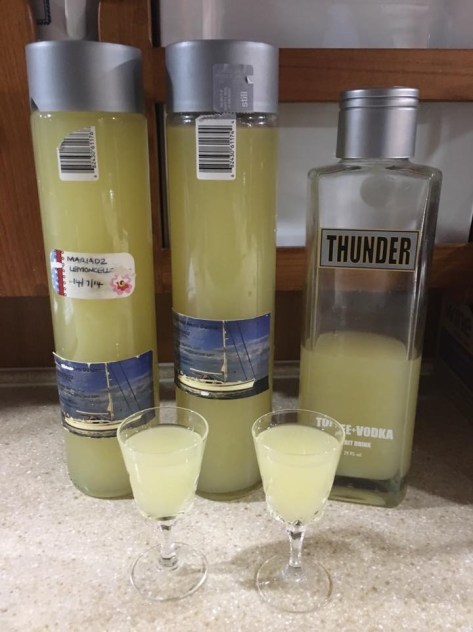
Once cooled, the limoncello can be put into the two litre bottles with some left over for the alcohol bottle.  The bottles can then be put into the freezer so that it is served cold.  The final product is about 35% alcohol so be aware if you decide to sit down and have a few of them! (for the pedants…that might be you Dad 🙂 …, the lemon juice is what brings the mixture down to 35% from 38%! 🙂 )

Drink away!

This works equally well with oranges but remember they have to be unwaxed.

We are now experimenting with a cherry version where the de-stoned cherry is added to the alcohol.  We will update with how this works and the measures. As you can see from the pictures we used a lot of cherries!

And of course label your bottles up and get ready to drink straight from the freezer.

IMG_5844


Entertainment (TV on a boat – yes I know, sorry)

Well there we go I have brought up the dreaded T word -TV.

There seem to be a number of schools of thought on this.

  • I go sailing to get away from the modern world including television
  • There is nothing to watch on TV these days
  • What channels are you going to get in Fiji anyway

However, we have always been very keen watchers of films (movies for our American friends).

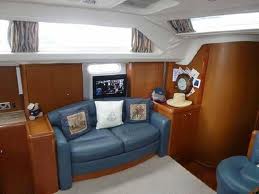
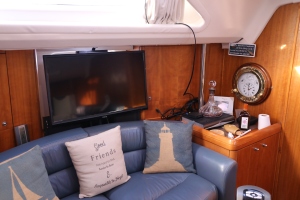
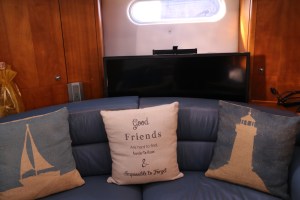
This work was originally done in 2014 when we first got the boat but has had to be refreshed.  When we got her, the boat had a 20 inch TV permanently fitted in the saloon, old TVnow we like watching TV sometimes but a) how will you see that from the other side of the room and b) who would want the TV on display the whole time anyway! When we had viewed the Moody 49, Mornin’ Gorgeous, prior to buying ours, we had admired the simple setup that hid the TV safely behind the seating. IMG_3951That was now our solution and it would allow us to have a large enough TV that we could both see and watch films on.

However, what TV to fit. At the time we did not have an inverter and I am also keen on a 12v solution to the problem. We had done something similar on the Dufour and bought a British made, or assembled, TV (Cello). This had worked really well and had a built in DVD player. When I looked at the options the largest 12v DVD TV that Cello produced was a 32inch, now that’s more like it. You certainly wouldn’t want the TV on display the whole time since it takes a lot of space.  One downside on these TVs can be the sound quality but there are a number of solutions to that these days including soundbars and we bought a cheap sound bar.

Unfortunately my suggestion to emulate the simple, and cheap, solution for lifting and hiding the TV that we had seen previously received some criticism from my co-skipper….IMG_3949 So we looked at lifting cages with remote controls that would achieve the same goal, somewhat more stylishly. These cost more than the TV :(. But work really well and are more stable – quite useful for a boat 🙂  In the end we went for the Venset TS700A.

So now we have the means to watch whatever we like, even home videos of dolphins playing next to our bow :).  Even better than that, if we don’t want the television up, it is hidden away and not obtrusive.IMG_3948

We originally bought two of the Cello TVs and mounted the second in the bedroom of the motorhome (now that is excessive!).  Unfortunately, after eighteen months of not very much use, the screen went black on this TV so I was left with a decision to make.  In the end I decided to swap the Cello out of Mariadz and use it in the motorhome.  This limited any issues I would have with changing the power cable and the mounting.  However, I then had to choose whether to get another Cello for the boat or whether to go for something with a better reputation.  On the motorhome, we had the Avtex 187 TV (now Avtex L188DR 18.5-Inch Widescreen Super Slim LED TV with Freeview HD) and I had also bought an Avtex L218DRS 21.5-Inch Widescreen 1080p Full HD Super Slim LED TV with Freeview HD for our bedroom.  These are very good quality TVs with excellent resolution, a built in HD Freeview and satellite tuner.  I have also been very impressed with the customer service throughout the three year warranty period which has the TV collected and then returned by courier within a few days.  I decided to go for the Avtex L327TRS Super Slim LED Digital TV with SAT-Freeview and Record – Black, 32-Inch. Unfortunately, the original fitter for the lifter had kept the bars that allowed the larger TVs to be mounted so I needed to get some stainless bars made up by East Coast Stainless to help with the mounting.  We are very pleased with the result, in fact the earth loop, the buzzing noise from the speaker, also does not happen with the Avtex – that was getting a little annoying!

Teak Handrails – getting the Woodskin treatment

So early on we decided to use International Woodskin Flexible Wood Oil/Varnish on some of the teak on board.  This is a varnish-like finish that allows the wood to “breathe”.  It also doesn’t need quite as much preparation as varnish with only a light sanding needed to get additional coats on.  Once we are away, we will be doing this on a six-monthly basis to protect the wood and keep it looking good.

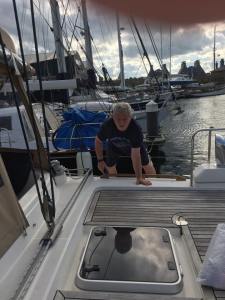
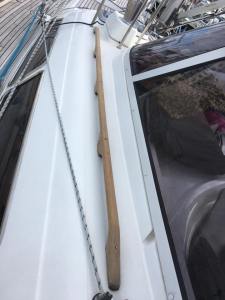
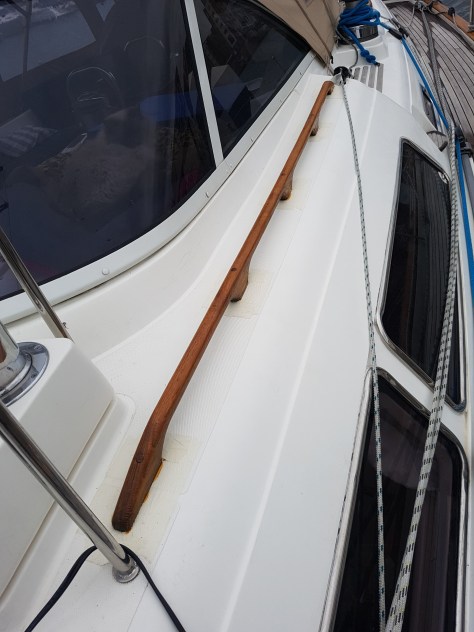
However, we were slightly unhappy with the existing state of the handrails, which hadn’t been touched for a couple of years.  In particular, these were not very smooth and had ridges all over them.  This caused problem for the woodskin too which didn’t go on evenly.  We decided that it would be best to take the handrails back down to the natural teak colour using scrapers and sandpaper.  working on handrailsThis would then give a smooth finish for the woodskin to soak into.  However, it is best to do this with your eyes open and not how I appear in the photo!

We had started the process at the back end of last season but hadn’t been able to complete it prior to the bad weather.  18403221_10155892586487069_680045513512033789_nSo I started this on the Friday and soon had the handrails back down to a finish that was more acceptable.  Having had issues with the woodskin getting onto deck, stainless etc as part of the application, I decided to use masking tape across the bases of each of the handrails.  This did take time, since I wanted to make sure that the tape was shaped around the curved handle and provided the protection needed.  By late on Sunday, after a glorious sunny day, I was ready for the first coats of the woodskin.  The plan would be to apply a minimum of four (light) coats but realistically as many as we can since the depth of colour and protection gets better with more coats.  The touch dry time is 4 hours and then 24 hours for it to be fully dry, so a reasonable week of weather and it will be done.  I apply the first coat on all four handrails and it looks great so I can settle down, relax and admire my handy work.  Five hours later, the first of the rain hits 😦 grrrrh!  Fortunately it looks like the woodskin was dry enough but we waited for everything to dry out before adding the additional coats.  So three coats down and it has consistently rained five to six hours after I have done them!

her is a link to our original work using wood skin: Exterior wood

20170515_150442

Pull on the green line. Which one, they are all green!

Sometimes you have these conversations with your wife and sailing buddy.  Then you realise it really is beyond the time to do what needs to be done.

For the last few weeks, I have been looking for my next role in work and this has meant that I have had more time than I usually get to do maintenance on the boat.  To that end, I have tried to keep busy by fixing minor problems that have been hanging over us for ages.

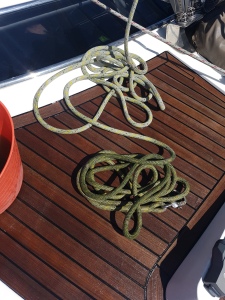
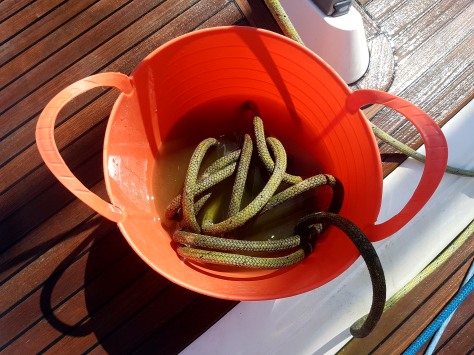
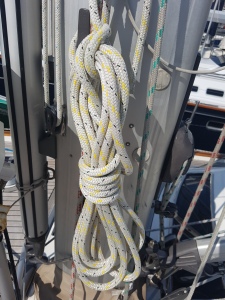
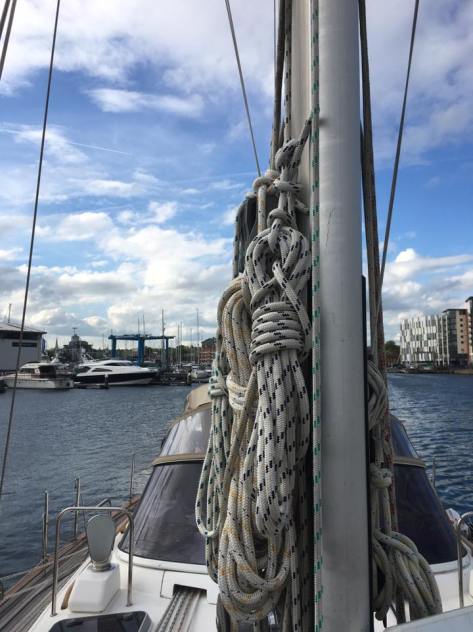
The vast number of lines on a yacht can get covered in sea water and dirt causing them to get very stiff and go green.  20170510_125913You know it is bad when you can’t tell what the colour the line was underneath the dirt!  The picture shows mid way through cleaning, the bottom green part of the line had already been soaked for a while and was a lot cleaner than when it started – although still disgusting!

A standard way that people do this is to take the lines off the boat and put them in a pillow case within a washing machine.  This is fine when it is your own washing machine, but our marina explicitly forbid this and we didn’t fancy trying it on at a 24hr launderette.  The other problem is that EVERY line on the boat needed to be cleaned and so unless you are going to take down all of the sails too, you need to come up with a way to clean them “in place”.  20170510_120059Our technique was to have a hot bucket of water with mild washing powder and fabric conditioner in it.  Spray down the line with a hose to start with and then immerse it in the bucket for some time. Having given the water some time to get into the rope, I then painstakingly went through each metre of line with a soft brush, cleaning off the dirt.  20170511_100742The final touch was to spray down the line with more cold water.  It is tedious, hard work but very rewarding when you see the difference at the end, with the lines looking like new.  They are also not stiff anymore so we should find that they work smoother and better than they did.

With in excess of twenty lines on Mariadz, this took a long time, but the added advantage of a metre by metre clean is that it gives you an opportunity to check every part of the line.  I am now aware of a couple of places where we have some light chaffing of the line that I will need to keep an eye on.

The lesson for us, don’t leave it so long! Some of these lines had clearly not been done for at least five years, so long before we got Mariadz three years ago. I suspect that it will not be the last time that we do it!

Some top tips though… Firstly, it is a very mucky job, the brush nicely distributes the “green” all over the person doing it and the boat.  So be prepared to get very dirty.  Secondly, when the lines are done, wash the boat down really well.  All that green has gone on the decks and the last thing you want is the teak or the lines that are on the deck getting all of the dirt!

clean ropes

Relaxing in Harwich

We had such a good time at Easter that we have been keen to get the boat back out again.  This bank holiday weekend coincided with the sad anniversary of the death of Maria’s Dad and so we decided we wanted to be close to Harwich where her step-Mum lives.IMG_5682
Early in the week, the weather prediction was for a light northerly, turning southerly on Friday.  We decided at that stage that Halfpenny pier or anchoring in the Stour would be our getaway this weekend.  We would hopefully be able to persuade Jean, Maria’s step-Mum, to come on the boat and possibly even go for a gentle sail down the Stour – it would be her first time on the boat and I believe her first time sailing. So our plan is to leave on Friday, go to Halfpenny Pier for the night, pick up Jean on Saturday morning and take her down the Rover Stour, anchor for lunch, little bit of fishing and a relaxing sail to back to Harwich. If it is too busy, we will anchor close and the next day, I will take her in on the rib bback to Harwich before heading back to Ipswich during Sunday.  This will be in time for Kristy, our daughter, to see us Sunday night and Matthew, our son, to come round on Monday. A sort of busy, relaxing family weekend if you know what I mean.

Whenever we go to the Stour, Maria wants to go fishing, and I don’t mean the dating app for any youngsters reading!  This normally means that I end up spending between £10-£20 on bait, we either don’t fish or don’t catch anything and end up feeding the crabs with the rest of the bait at the end of the weekend.  However, my cunning ploy for Easter weekend was to buy frozen bait! Maria didn’t fish at all that weekend but that means that I don’t need to buy more bait this weekend in a place she traditionally likes to fish.

During the week, we had Lindsay from Seapower over to review the engine after her weekend workout and also to discuss the next stage of our engine refurbishment – replacing the fresh water and raw water hoses which are original and have clearly had some heat through them (at least once by us when the fresh water system was inadvertently drained when the hot water boiler was changed).  This will be in a later blog post. Needless to say our Yanmar got a clean bill of health and we are confident that she is in good shape now (touch some wood) and will be even better when we have finished our fettling of her!

So, it’s Friday night and I return from an afternoon meeting for some frantic running around prior to getting through the lock and down to halfpenny pier. We are closing on low water which should mean the tide is reasonably slack when we arrive. 6174647216_IMG_3037We have a lovely sail down the Orwell as the sun reaches the horizon. 6174647216_IMG_3038In fact Bonnie is taking her “watch” very seriously keeping a look out for traffic and dangers. 6174647216_IMG_3040However, we are late and sunset, in our wake, is a full half hour before we arrive.
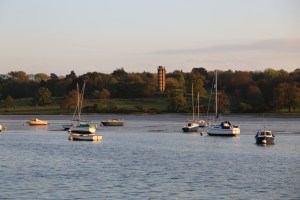
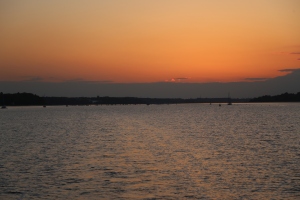
When I’d called earlier in the day, the pier was clear and I had been told that we should moor on the west end of the pier.  Now we arrive there is a 40 foot boat on the pier where we should be with two other smallish boats taking up the rest of the space. I am able to call out to the boat and explain the situation.  They tell me that they have also been told to moor here but I suspect that this is a bluff. We explain that will be fine and we will raft our 54 foot against their 40 foot boat! Alternatively they can raft up next to us, much more sensible.  They decide to come off the pier to raft up to us but eventually decide to occupy the ferry berth.  Since we are a little bit later than expected, we decide to approach the pier into the incoming tide, but with strong winds blowing us off the pier it is a tricky approach, especially in the dark. There is also a small yacht on the other half of the pier so we only have a smallish gap to aim at. Maria is taking her time, and the people from the other yacht come over to help us. They ask us to throw them a line and I am loath to until Maria has manoeuvred Mariadz nearer the pier but eventually throw a mid line with instructions to tie it to the bollard at the end of the pier so Maria can use it as a spring.  It gets tied off half way down the pier on a railing and too close to the other yacht to be of use, if Maria powered forward and relied on it to get her into the pier, she would hit the other yacht.  One of the other yachties asks me to throw a bow line which I do.  In retrospect I should have asked for that to be tied further down the pier so that we could use that as a spring but instead the yachtie gives an almighty pull on the bow and nearly makes us hit the pier.  Maria hears my call for the bow thruster and pulls the bow away from the pier.  Eventually, and it does take some time, Mariadz gets manhandled closer to the pier and I can get onto the pier and sort out how I think we get her in properly. I am able to bring a second mid line with me and I get this on and Maria can then use this to bring the stern in.  We are now on the pier and safe, with some tidying up to be done of the lines.  This is all done quite quickly and we are comfortable. It is late though, at nearly 9:30pm we are late. Too late to cook. We have been meaning to go back to the Thai on the Quai, which is excellent, but unfortunately they are refurbishing until mid-May 2017, so we decide on a Chinese, but that is a twenty minute walk away and for some reason, despite their website saying an 11pm close, they will not be able to fit us in unless we arrive in ten minutes.  So fish and chips it is then, since we are going to the Alma on Saturday.

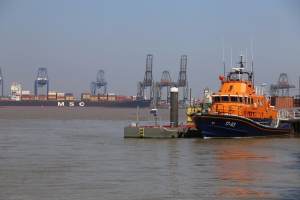
The next morning, I am up reasonably early and I get to spend a little time chatting to Mike, one of the harbour masters and also the person that I had spoken to the previous day about berthing on the pier.  6174647216_IMG_3063We mention what happened the night before but the other yacht has got away early and didn’t bother to pay, hmmmm the problem with the honesty system I discussed during our Easter trip. Mike remembers us from previous visits and reminds us to make sure the boat is locked with the keys away, not because of any crime issue in Harwich, just because he likes Mariadz and would be tempted to take her out :). Mike’s also part of the RNLI at Harwich which is one of the charities we always give to, hopefully not for selfish reasons! 6174647216_IMG_3062We hope we never need their help but what they do, and the bravery they show, is amazing. I mention to Mike our plans for the weekend with Jean and he says he will put out the “no mooring” signs so that our berth is protected if we go out.  The wind is blowing a southerly at 15-20 knots, perfect for a little sail down the Stour and back, but it will be Jean’s first time on the boat and we don’t want to run before we can walk.
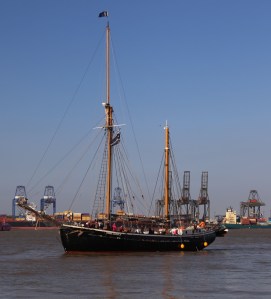
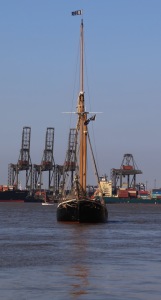
At lunchtime on Saturday, Jean arrives and begins to get acquainted with the boat, we’re having a pleasant time and so we decide to raincheck the day sail and do it another time. At this stage we are the only people on the pier.6174647216_IMG_3084 Toward the back end of the day Queen Galadrial, a Thames barge, takes her place on the outside of the pier.  Apparently she is normally at the west end but today she takes up the space between us and the ferry berth. 6174647216_IMG_3083As she is coming right at you with the battering ram that is her bowsprit, you hope that they stop before they hit you.  Needless to say there is nothing to worry about and she finishes a metre off of Mariadz’s bow.
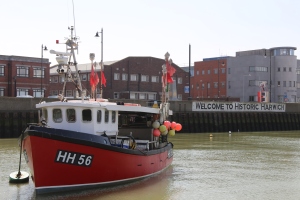
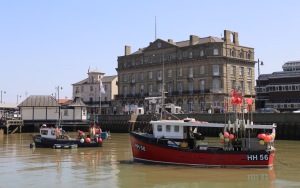
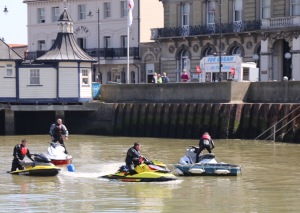
We always have a lovely time in Harwich, it is a wonderful old town with lots of back streets and pubs :), similar to Queenborough, that we visited a few weeks ago, or Yarmouth on the Isle of Wight. 6174647216_IMG_3055The local fisherman also come in with lobster and crab.  We are strangely conflicted here because the lobster will be amazing but when you are sailing you have to be very careful of the, sometimes poorly marked, lobster pots. 6174647216_IMG_3059So one minute you are celebrating the fishermen and at other times you are cursing them. On the whole though, the lobster is too good to miss out on, and the fishermen are always very good with their boat handling, so respect and gratitude is due. Today in Harwich, we had another “water-user” too. A group of jet-skis came in from the sea entrance. In common with a lot of things, there were two types of person in this group. 6174647216_IMG_3057The responsible, considerate person wearing a helmet and the idiot with the fountain of spray from their exhaust, that didn’t seem to notice or care, where their spray or wake went. One thing we have learnt is that this second type of inconsiderate person are always around, unfortunately. They go without causing too much noise or trouble but it is unusual to see the two types of person in one group, in an often criticised form of water sport. Other yachts, and passers by, come and go and we also have the regular 6174647216_IMG_3050ferry journeys to Felixstowe and Shotley. It is always interesting to catch up with these people and to understand their stories as well as discuss our hopes and plans. Around about lunchtime on Sunday, Jean has to go home, but we all agree it has been a nice time and a good first meeting with Mariadz.  Jean has promised to return and we will take her sailing and also get her behind the wheel.
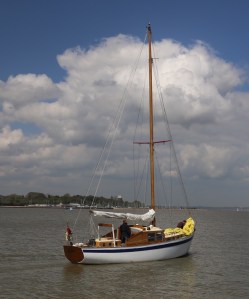
I had spoken to Mike earlier in the day, and it looked like the weather was going to get worse, no rain, but the wind was increasing. Maria and I 6174647216_IMG_3067decide we will leave early afternoon and sail up the river with the gusty south easterly behind us. However the winds are gusting well over thirty knots and so we decide that we will only have a third of the main and the headsail out, this means a little slower progress but also means that a strong gust will not overpower us. As we enter the River Orwell, we make the turn past Felixstowe towards Levington and the wind is nicely on our beam. Even with little sail, and no engine, we are bounding along at eight knots with just a little help from the river. As we go up river, the wind angle does present some challenges though. One of the things we have been taught, and learnt well, is to rig a gybe protector. This is required if the wind is behind you, because a relatively small shift of the wind can catch the other side of the mainsail, smashing the boom across the boat. This is dangerous for people – do not get your head in the way of a flying boom – and also for the boat, because of the power being thrown around and the potential impact on the rig. So we tie a line from the back of the boom tightly to the forward mid-cleat on that side which is enough to stop the boom crashing across if the wind shifts. Of course coming up a river with hills, trees etc, there are lots of wind channels that can throw the direction of the wind so we always rig this as a precaution.  We are having a lovely, and safe, sail up the river, in fact we are working quite hard, as we tack the headsail around from time to time, sometimes goosewinged, with the two sails on opposite sides of the boat, and sometimes sailing with both sails on the same side. Progress, since that first tack with the wind on the beam, is slower and we take a couple of hours to get up the river. Obviously not so slow that another cruising yacht overtakes us….Maria wouldn’t stand for that but still slower than we are accustomed.  As we approach the lock there is no let up in the gusts, which means that Mariadz is being pushed away from the pontoon in the lock, but Maria has it all under control.
During our time sailing we have listened to many people for hints and tips.  When seeing Queen Galadrial, the other day, I had seen a line from the bow being put on the pontoon cleats first (a bow spring), which then allows the helm to steer away from the pontoon, bringing the stern in while the bow is held close to the pontoon. This gives lots of time to get the other lines on irrespective of what the wind is doing.  I have seen this done before by many people and it avoids the problem of “losing” the bow, or stern, without the need for a bow thruster. This is a development on the technique we were taught early on of getting a mid-cleat line to shore first because it will limit the movement of the boat and act as a pivot point. It would also have helped us out with the mooring at Harwich earlier in this trip. I decide that I can test this technique without jeopardising our normal mooring technique.

We enter the lock, Maria has Mariadz positioned beautifully as we approach.  Unfortunately the line I chose for the test had a shock absorber, which is heavy rubber. This stops me being able to get the line on a cleat, so I quickly abandon the experiment and we moor as usual without any stress.

Today, because we have had a winter of using the generator, we have to fill up with fuel which means going onto the fuel pontoon which will have the gusting wind directly behind it. A second opportunity for a test :). As we come out of the lock, Maria is going slow so I can swap the lines and fenders to the other side.  I decide to experiment again but change the line to one that does not have a heavy rubber weight. As we approach the fuel pontoon, there is a large (50-60 foot) motor boat at the end which limits our space to approximately 60 feet, and we need that much just to fit on without hanging off the end. Again Maria is in control as we bring her in and the approach is nice and slow. I am able to step off the boat onto the pontoon and put the bow spring on. Unfortunately it is too long and would not stop us before we hit the motor boat but I have quickly put on the mid line, as usual and we are soon in and tied off, waiting for fuel. While we are waiting for fuel I review the length of our bow spring and adjust the length for our third and final attempt of the day. With an additional 470 litres of fuel on board (2/3rds of a tank), we pull off the fuel pontoon with help from Tim, who fuelled us, and Maria gets Mariadz away from the pontoon and ready for the approach to our home berth.

It is true that Maria may have “mentioned” two failed attempts to “try something new” and had raised whether it was sensible to be trying this on a gusty day with the wind blowing us away from our pontoon and onto our very nice neighbours boat.  People who know Maria will probably have an idea of how this was “mentioned”. That said, Linda and Peter next door, had set their fenders and had told us not to worry about laying alongside them while we sort ourselves out.  However, we don’t want to be in that position if we can help it and I know that the bow spring will help….if I can get it right. Maria approaches our berth and is perfectly positioned. One of our other friendly neighbours, Mark (we are lucky on B pontoon at Ipswich haven) comes to offer a hand. I give him the bow line while I step off with the spring and mid line. As Mariadz starts to get caught by the wind, I have the spring line on, and as previously discussed call for Maria to go forward and turn away from the pontoon. Magically, the boat moves closer to the pontoon and stops going forward as the stern comes in. The mid line is now on and I go to the stern to get the line to finish tying her off. We are in perfectly and haven’t touched our neighbours, despite strong 20+ knots of cross wind. We also have another new technique for bringing Mariadz in that we know works – I mark the line to make sure we know where it needs to go to get the manoeuvre right in future ;).

It is the end of the sailing for this weekend, and now for some family time 🙂