It is our intention to be insured while we are travelling around the world. However, nearly all insurers require that the rig is replaced every ten years and the rig on Mariadz was last done in 2010. So we have agreed to get the rig refreshed as one of the last tasks we do prior to leaving.
At the Southampton boat show back in 2015, I had spoken to a rigging company about doing this work. They claimed to have re-rigged a Moody 54 previously and were able to give me a quote….and it was eye-wateringly expensive. It made me realise that 10% or 20% off an already inflated price was no bargain! I was also not convinced that I wanted to go to the South Coast to get it done anyway and this helped with the decision.
On the East coast of the UK, there was a rigging company with a good reputation called Rig Magic but they apparently stopped trading late in 2016 and so we needed another alternative. I spoke to a number of people in the marina at Ipswich Haven and also spoke to the team at Spirit Yachts. They introduced me to Richard at Evolution Rigging who at the time had rigged several quality yachts in Ipswich and also rigged Spirit Yachts and Oysters! Maria has always had a view that if something is good enough for Spirit and Oyster then it would be good enough for us! I was always a bit fearful of the costs of this approach but it has worked out well for us in the past.
I spoke to Richard about our rig and he explained some of the things we would need to consider, ably demonstrating his helpfulness and knowledge. He also came back with a quote which was much more reasonable than the over-inflated boat show price from one of his competitors. As part of his offer, he mentioned that there was also an upgrade available that would be 30% stronger than the standard rig for the same weight and size of wire. This would cost an extra 20% on the quote but would give us more piece of mind. Can you imagine not going for this option and then losing the rig at some stage! It was a no-brainer for us.
As a first step he suggested for some of his team to perform a complete rig check, even though we know we will be replacing it in the next year or so. This would make sure we were safe in the interim. At the back end of August, this was performed and as expected a few things came up which need rectification but nothing that was a safety issue (so lots of amber and no reds). The check was very thorough and the written report backed up that we were safe enough for the moment and also identified some of the changes that they would recommend when we go for the full refit.
The other benefit we had here was watching the guys go up the mast. You can learn a lot from someone who goes up the mast as their day job. We noticed that the team didn’t lock off the line in the self-tailer but used the electric winch to help with the pull while pulling the line by hand. This made the process less jerky and uncomfortable for the person in the chair. A top tip for us, probably adding more comfort for me!
The deck organisers that help run the lines back to the cockpit were an issue. These had all jammed which caused friction in the use of these lines. We had noticed that the weren’t running as easy as usual but hadn’t linked this to the deck organisers. Using Corrosion-X , I was able to unjam these, although I did also need to take the headlining down in the saloon to access the bolts under the organiser, some of which were on a bit tight. Having freed these, it did make me think that we have more work to do with the rig and we will discuss replacing the clutches and organisers as part of the rig refresh over the next few years. There were also a number of other easy fixes i could do myself such as tightening up the lines across the gates. That was also being redone as we extended our pushpit.
We had also noticed that the block for the staysail outhaul was UV damaged and the plastic cover was shattering although the weight bearing metal elements of the block were still ok. We decided to replace the obsolete Lewmar 72mm ocean block with an upgraded block from the current range and after speaking to Lewmar this was the HLX block. These are stronger than the old ocean range and I was told to go down a size but, of course, this didn’t work for me because the attachment to the traveller track was 10mm rather than 8mm so I have gone back to the 72mm block which increases the safety margin even more. At the end of the day, I took the decision to change this and if, after consultation with the rig team, it was decided to upgrade this even further then we have a spare block available.
I have now gone throughout the entire rig, checking all blocks and using corrosion-X to free up any stiffness in the block. It was surprising how many were seized but also how easy they are to free. This work included the stanchion blocks that run the headsail and staysail furler lines. Interestingly, this seemed to have an immediate effect, in conjunction with lubricating the furler itself, and I have found these sails a lot easier to furl since doing this work.
So we now have confidence in our rig and a high level plan for its replacement which we need to finalise with Richard. I believe as part of this we will replace all of the blocks that we have in the rig. We also addressed a few things that will help to make it better in the short term and the thorough rig check was not expensive.
It has been a tradition that Mariadz goes to Burnham-on-Crouch for the carnival late in September. This coincides with a meeting of fellow Moody owners so an opportunity to catch up with friends. The marina also have a marque setup with lunch and a live band, Street Life, who we were lucky to have play at our wedding back in 2010 and we consider them to be friends. This also seems to be a traditional place where we meet new friends. We are invariably at the entrance to the marina and this seems to be a spot where you are seen. This has resulted in many good friendships being formed including Amanda and Mark when they first collected their yacht Serenity, Stig on Wild Dream 2 who seems to share the tradition of visiting Burnham for carnival and Martine who had a beautiful Hardy, called Kismet. Lots of reasons to head down the coast and into the Crouch then.
Maria and I decided we would get down to Burnham nice and early and have a few days there. With the communications setup we have with the boat wifi extender, a mifi and now an aerial booster for the mifi, we are always connected and Maria could continue to work as usual while I guided the boat. The journey to Burnham on Crouch from Ipswich is about 45 miles and it is ten miles to get to Landguard which is a cardinal buoy that we consider as the start of all of our routes. Maria was very keen to get to Burnham early in the day so that Mariadz (rather than Maria) could be tied up for the afternoon. Unfortunately this meant that the tides in the Wallet wouldn’t be ideal, and neither was the wind. It would also mean going across the shallow Spitway at Gunfleet on or around low tide. Mariadz is more than capable of handling the weather although it would mean that we would probably be a little slower than our usual passage planning speed of seven knots and we would be especially careful at the shallow sections. In order to offset this we decided to leave the night before and pick up a mooring buoy near the bottom of the Orwell which would gain us an hour. A nice early start the next day and all would be fine…..
The provisions were on board and we were pretty much ready to go but it is getting later. Maria gently pulled Mariadz out of her berth to head towards the lock and Mark from Motion took a pic for us. Shortly after the picture was taken we noticed that the satellite dish was still up, just ahead of the mast! Better get that in before we go too far down the river!
The trip down the river is uneventful with few craft on the river and within the hour we are approaching the mooring buoys but with a strong southerly wind in our faces. We discuss the approach and think that the wind is going to be stronger than the tide so to approach into the wind so that Maria can stop Mariadz easily. After a couple of failed attempts to pick up the buoy Maria suggests we approach from the other side. The buoys opposite Suffolk Yacht Harbour have a thick loop of rope and one of these had another thin long line attached to it, I assume to help with picking it up. That restricts the use of the bow thruster then, we don’t want a rope getting caught in there. I have our stainless extendable boat hook and I get a good grip of the line for the buoy, unfortunately the hook then decides to detach itself from the pole. It is ok though since it is still caught up in the thick line on the buoy. Go and get the other boat hook while Maria spins Mariadz round, pick up the line, grab the old hook, thread the line and we are all good! Maria does her part perfectly and has the buoy perfectly mid-ships where I can reach it. I start to lift the buoy and the hook is coming up and just as I reach out to grab it, it drops off and into the Orwell where it joins an identical complete stainless steel boat hook that we dropped there a few years ago! Oh well, another replacement hook required. Still I thread the line and tie us close to the buoy. Maria is a little concerned since we are lying quite close to the next buoy which has a catamaran on it but I agree that I will check it at the change of tide a bit later in the evening. In the end we remain far enough away from the catamaran despite the slightly different swing characteristics compared to Mariadz. It is a breezy evening but the next day is clear although we didn’t get started too early, no surprise there. Based on our later departure time, we are likely to reach the spitway shortly after low tide so at least we will be on a rising tide if we do find it too shallow. It’s 9am by the time we reach the Languard buoy, and we head towards Medusa while being on lobster pot lookout (this area is notorious for badly marked pots and fishing nets strewn across the channel). Progress is slow and there are very few other boats out. We are against tide and wind and we travel down the wallet quite slowly (for us). I’m not too worried since we will arrive at the Spitway at the bottom of Gunfleet sands after low tide as expected and it does give us a chance to get some good shots of boats coming the other way with the wind and tide.
I have also had the opportunity to tidy our fenders on this trip and eight of them fit perfectly on the two mast pulpits (granny bars). Martin, our yachtmaster and friend, would be proud that we hadnt left them on the deck!
We arrive at the top of the Spitway which is marked with a single buoy and a corresponding buoy at the other end. When we have no fears over water levels we will quite often cut the corner between the buoy and Gunfleet sands where the water is quite deep. This saves a bit of time and I have never had any shallow water issues but at this state of tide we are going to take the text book route. We are lined up and I am behind the wheel, unusually, but this will allow me to take over from the autopilot quickly if we have an issue. The water is smooth, which is helpful. At least I won’t need to consider the wave height when thinking of the depth of water but it is getting shallower.
Our depth instruments are set to actual depth of water rather than water under the keel. This means that the alarm goes off at three metres depth (over a metre under the keel)rather than nearly five metres which it would be if it was tuned to depth under the keel, and at five metres the alarm would always be going off on the East Coast. We have barely started the passage across the Spitway and the alarm goes off for three metres depth and the depth is still going down. It is now in the low twos for a long time but as we approach the middle of the Spitway the level goes below two metres. Mariadz is a shaol keel which means she only draws 1.8M, although she will draw the same if she is heeled. When calibrating the depth I had also added 20cm safety margin but when I see the depth touch 1.8M I am getting a little concerned. I recheck and we are directly between the buoys but this is less water than I was expecting. Fortunately this doesn’t last for long and soon the depth is increasing as we exit the Spitway. I am now wondering whether my usual “short-cut” route might actually be preferable and deeper. Certainly something to check the next time we go through.
We turn and head towards the River Crouch, going between the mud banks at it’s entrance. The River Crouch seems very long when it starts at the mud and it is not the most picturesque river but the advantage is the opportunity to see seals bathing on the mud. Today there are relatively few, we have seen nearly a hundred before but there was a nice group gathered for a coffee morning and chat. Soon after this we see an ocean rowing boat. We later discover that this is team Kung Fu Cha Cha who are intending to be the only Chinese team in the Talisker Whiskey Atlantic Challenge this year. They seemed to be doing pretty well on their warm up run up the crouch and the AIS track showed good speed :). We will definitely be following this team in the upcoming race.
There is quite a stiff breeze as we go up the river and we have put some sail out to provide better balance and a little extra speed. We see some other boats coming the other way,
This slideshow requires JavaScript.
as we negotiate the northern channel into the crouch adjacent to Buxey sands and everyone is exchanging friendly waves.
The cats are their normal relaxed selves, sitting in the cockpit being chilled as we motorsail in.
The wind is now blowing quite hard from the South and we start to think about the approach to Burnham. We intend to get the sails away before we get amongst the moorings at Burnham where the channel thins out which will give me lots of time to get the lines and fenders sorted out. It is now lunchtime and I call into the marina using the phone, we are too far away for the radio. Bruce answers and explains that the minor issue he had with a boat in our booked berth has been overcome and we are clear to take the hammerhead. Maria and I then discuss our approach. We are only a little after low tide and so there are shallow elements near the entrance of Burnham and we will need to be careful, no cutting the corners today! Maria realises that she will have to come in and as she passes between the entrance poles, she will have to turn hard to starboard and then let the wind push Mariadz onto the pontoon controlling her with the bow thruster and using the engine to line her up with the hammerhead. Maria is a little apprehensive in the twenty knot wind but she handles the boat well and I am confident that we will do fine if we communicate well. On the final approach into the marina, the water is shallow and the alarm goes off. For one second we are thinking we may run into the mud at the entrance and be stuck for some time waiting to be floated off by the tide – you know every man and his dog would have chosen that time to come into the marina – and you don’t want to be the gnome greeting everyone at the entrance! There are no such concerns as Maria negotiates the last of the approach and puts the wheel hard to starboard before starting to take the speed off the boat. A bit of straightening up with the bow thruster and minor adjustment to line up with the hammerhead and we drift gently into position. I step off and we are tied quite quickly. A little after lunchtime but Maria gets her afternoon moored or tied up….lucky girl.
The E/F pontoon hammerhead is our usual and favoured berth at Burnham but the pontoon feels shorter than we remember, we are therefore overhanging on both sides so we will need to think carefully about how we tie up. I catch up with Bruce who explains that another similar sized boat will come in the next day and could we make this easier by moving forward when they come in before returning to our normal position afterwards. We absolutely understand the issues with manoeuvring in the tight spaces and we offer to give them a hand when they arrive. Our friend Lisa has also come to stay for the weekend so the cats will get spoilt too.
Friday is a normal working day for Maria and, after job hunting an opportunity for me to get the boat cleaned up, we like her to look her best :). This takes several hours but by the end of it Mariadz is looking beautiful for all of ten minutes! This is an issue at Burnham. The marina is very nice, we have met some great people there and the carnival weekend is always excellent but there is an issue with birds – not Essex girls but Hitchcock level birds. They look lovely as they fly around and at one stage we saw thirty starlings on the spreaders and standing rigging of one boat which made it look like a Christmas tree. However, these birds seem to eat a lot of red and black berries…..so shortly after I have finished the deck, it looks like Prince’s mythical Purple Rain has happened. I have cleaned the windows and I am not doing that again, so we will put up with it until the end of the weekend when I clean Mariadz down after our journey.
Bruce returns to tell us that a 50ft ketch, Sweet Surrender, will be with us in the next thirty minutes. I set about moving Mariadz using the lines and the wind to push her forward. It won’t be that easy to get her back, we will need the engine, but I am able to move her forward without disturbing the girls, or the cats! Sweet Surrender arrives and John, the skipper, has her perform a flawless pirouette before putting her gently on the end of the long pontoon next to us. I am there to take lines if needed but she comes to lie so gently against the pontoon that we have all day to get her tied off. Maria can then start the engine of Mariadz and we can put her back to her old position with stern coming out as far as the boats on the long pontoon and the bow slightly overhanging the next entrance. We have a nice chat and later a few drinks with the crew of Sweet Surrender before coming back to Mariadz for a gorgeous home made fish pie, prepared by Maria but with top quality ingredients sourced (or sauced) by Adam. It’s going to be a long weekend so an early night is called for but not before Maria asks whether I can get the satellite dish setup so she can record some programmes over the weekend. Now in a domestic setup, a clever engineer, works out where to point the dish when the system is setup and you never need to think about it. On a boat or motorhome, every time you move you need to reposition the dish, and in a boat you need to make sure you are tied well or the dish will move and lose the signal. On one of our trips to a motorhome show, Maria had decided to get rid of the old standard dish and replaced it with a QuickSAT QS65 Portable Satellite System which doesn’t have an arm that can be broken. It also comes with everything you need to align the satellite…well, a mat, a rudimentary compass and a clever device to get the angle right – who needs a spirit level when you have that! At our home base in Ipswich, I know pretty much where to point the dish and generally get it set up well but I have not had such luck on our travels. Burnham is quite easy to work out as the river goes east-west and we are on the north bank, so I put down the mat and roughly align the dish while I go to get the compass etc. Before I get back I have a signal on the sky box! Excellent, now Maria can record X-factor…. 😉
Saturday is the major day of the Burnham weekend. It starts with the Tucker Brown cup, followed by the meal and great music from Street Life and the end of the day is the carnival itself with a funfair on the walk back to the marina. A busy day! We were asked if we fancied joining the race down the river but on this occasion we decline, I’m not sure if there is a handicap for having extra crew and Bonnie and Clyde aren’t really up for it. There also isn’t much wind and definitely not enough to get Mariadz moving well. Apparently running the engine, even in stealth mode with our dry exhaust would be frowned upon :). However, we are in a good position to take photos as they go past the Marina although the sun is a little bit of an issue, we are not going to complain.
This slideshow requires JavaScript.
We also get a chance to support a lovely Hallberg Rassy 352, with its crew of four including two cats. Unfortunately, the cats aren’t able to make the difference and they don’t win it this year! With the race finished the lunchtime entertainment is due to begin and the Moody Owners have reserved some tables so we can all sit together. These are near the food and bar and furthest away from the band. We have seen Street Life a number of times and booked them for the evening entertainment for our wedding. They are great with a mixture of old and new music. If you haven’t seen them, I often describe them as like the band from The Commitments film but without the obnoxious lead singer character, we love them to bits and always have a good time when they are playing. It also helps that Cliff is a keen sailor with his boat “Lusty Wench” (What a great name 🙂 ). The food is great, the drinks are flowing and we are spending time with old friends and new. I even finally got Maria up to dance towards the end. As the place clears there is an invite to a Moody Owners get together on a Jeanneau NC11 motorboat, not a Moody and not a yacht but we won’t hold that against them. It actually looks really nice and the thirty odd people seem to fit on it, although she does look like she is on the plane with all the weight in the stern. A couple more drinks and some nibbles before we head back to Mariadz to prepare for the evening’s entertainment. Most of this preparation seems to be inviting people on board and more drinking and chatting. Oh well 🙂
To be fair we missed most of the carnival, unusual for us, and then met up with other friends in one of the pubs before getting home late and rather drunk. Everyone seemed to have a good time and a very enjoyable taxi ride home – one to ask us about when you see us!
On Sunday we are due to return home. One of the reasons that the event this year was a little less well attended than usual was the weather prediction for Sunday and the rest of the week. Strong winds being expected from the South although this should work to our advantage and push us home nicely. It also combines perfectly with the tides with a not too early departure. That was a stroke of luck! However, in the morning we are not quick to rise and it is 10am before we have seen Lisa off and have the boat ready. Just before we go there is a little excitement as one of the ocean rowing teams, not our Chinese friends, is brought in by the RNLI. There is a little concern at how bad it is out there but Mariadz can take it so hopefully we wont be needing the RNLI services later.
There is a 20knot southerly wind pushing us onto the pontoon and Maria is a little concerned that this may push us onto the bowsprit of Sweet Surrender but we have agreed to spring off from the bow which take us away at 30 degrees from the pontoon. All the fenders are in place and we have a little help from our new friends. This was a little fortunate as I hadn’t moved the bow spring far enough back onto the pontoon but we were able to pause the manoeuvre, move the line and start again. We come off fine so although not exactly text book, everything is good. Maria then takes Mariadz astern and with a hard starboard turn we are through the exit and into the river. This gives me the opportunity to stow the fenders on the mast pulpits (granny bars) again. Unfortunately our departure coincides with a yacht race down the Crouch so Maria slows down and we follow the race down river. There is some minor concern as the racers approach their turn and we momentarily think that the course may return directly back down the river and straight at us but they pass on our port side presenting some good photo opportunities.
After this excitement, the river is very quiet today which is something we quite often find. There have been any number of occasions when we have looked at each other and realised that we are the only “mugs” out here! We always keep a watch out on channel 16 when on passage and at 11am we heard a new weather warning. Having swapped to the correct channel we hear that there are gale force winds expected “soon” which is maritime speak for the next six to twelve hours. This means it could be when we are out there. This wouldn’t be the first time that we have experienced force 8/9 winds since we had this experience returning from Dunkirk (The return from Dunkirk (part 2 of 3) – pan pan). This would be our first time in Mariadz as a Moody though. So we will need to be careful. Originally, the expectation with a good breeze behind us was that we would fly up the wallet (lucky we have that spoiler on the back now!). The reality was that the wind was variable and gusty with one minute there being 10 knots of wind and the next 35 knots of wind. We decided that we would be taking no risks and started off sailing with half the main, the staysail and a third of the yankee headsail out. As we came out of the Crouch we saw the only other sailing boat that we would see all day coming back in under ominous black clouds. At this stage, even with much reduced sail, we are flying along at 8.5knots with the wind on the beam. Soon we will be turning towards the Wallet and over the Spitway, which this time has lots of water over it. As we turn, I take advantage of the change in the wind angle to take in the headsail, the other two are easy to get in if we need to and those clouds could be accompanied by even more wind. To be fair the reduced sail didn’t harm our speed much and we still bumbled along at a good seven knots for the whole journey but it gave us piece of mind. First though the Wallet, which is affectionately called “vomit alley” was incredibly rolly, with waves going across our beam but at least the tide and wind were in the same direction.
It is much worse when they are against each other although Mariadz is big enough to plough through these rather than bouncing up and down like Captain Pugwash’s Black Pig. However, it is a little rolly which with a couple of hangovers isn’t ideal.
We have travelled up the Wallet quite a few times and when you have a following wind, there can be a problem as you turn to port into Medusa to head toward Felixstowe. The wind changes from being behind you, to be on your beam and what seemed like a gentle breeze can seem much worse and make the boat heel a lot. We are always very careful before making this turn. On this occasion there is enough south in the wind for it to remain astern of us and so we just needed to control the gybe as the wind passes from one side of the boat to the other. We always use a gybe preventer whenever the wind is behind and this can also help us to control the main when we turn so the manoeuvre is quite smooth. After completing the turn we seem to be sailing very nicely at exactly the same speed as the waves, it is smooth and not rolling at all while we still travel at seven knots. We still haven’t seen another boat since we left the Crouch! It seems no time at all till we are at Landguard and into very familiar waters. We decide to keep sailing up the Orwell because the wind should be perfect. Actually, it is even more variable as we are intermittently shielded from the wind by trees and hills on the shore. It is now late Sunday afternoon on the Orwell and the river is completely empty, there must have been real concerns over the weather because normally the river is busy at this time. We head up but lose a bit of time because of the variability of the wind, we are not too bothered and by this time Maria has put the roast dinner in the oven so it will be ready when we arrive in Ipswich.
Despite there being twenty knots of wind Maria gets Mariadz into the lock perfectly even when we had to move her forwards because another boat is approaching (where did he come from !!). It is then through the lock and into the wind for a bows-to mooring in our berth which goes seamlessly.
Thirty minutes after being tied up, dinner is on the table!
We’ve caught up with our friends and made some new ones, the sailing has been great and Mariadz has performed perfectly. All round great weekend!
Everyone has some things they like and dislike about their boat. There are probably two things that I can think of on Mariadz. The first is the wheel size compared to the gap in the cockpit. The only way around the wheel is to go up on the cushions as there is no leg-width gap between the wheel and the seat. The second is the amount of exterior storage in lockers etc. This is minimal to the say the least and a lot less than we were used to on our previous Dufour 455.
In fact the outside storage space is the chain locker and the lazerette. We had previously partially addressed this by moving the life raft from its dedicated locker above the aft stateroom to a rail mount. This gave us some space for the storage of flares, lines etc. Now clearly you cant go around randomly making new lockers on an old boat so we needed to get imaginative or more precisely steal others people’s imaginative ideas. One of these we saw on discovery yachts. A number of these have Fortress anchors as their kedge anchor setup, and after some research I had decided that this sounded the most sensible way for us to have a setup that could work for us with a twenty five tonne boat at cruising weight. On the discovery boats, the kedge anchor was rail mounted which meant that it was mostly out of the way but also available quickly if needed. The advantages were offset by the fact that you had a sharp, hard anchor that you could easily fall into but is this much worse than the pushpit rail?
However, the standard Moody 54 doesn’t have much pushpit space with two liferings, a danbuoy and, for us, a life raft already on there. With the davits also restricting options and two two aft seats taking up more room, it is a little tight to say the least.
Another issue related to safety which was that the pushpit stopped before the clutches for the head sail and staysail. This meant that you were adjacent to the lifelines when you wanted to use these clutches. A more solid barrier would be safer. Maria and I agreed to extend the pushpit by four feet to the next stanchion which gives us more room and a safer aft area. This would also provide more rigidity to the pushpit when combined with the reinforcement we put in the stern section previously when we added braces from the davits to the pushpit. The final item we needed to think about was the repositioning of the ensign required by the new solar panels. This was also intended to be rail mounted although I was keen to go back to a wooden pole rather than the stainless one we had previously.
Once again, East Coast Stainless were asked to do this wotk and once again this needed to be fitted in amongst a lot of other work that they have. I guess that is the problem when you are good and reasonably priced. We are happy to wait and very pleased with the result.
Unfortunately, the work was a bit more than moving an angled stanchion and joining in a couple of tubes. This was because we found some old damage on the stanchion itself which had a large dent. This wouldnt be easily repaired and we knew that we would always notice the damage if we had just tried to repair it. To be fair the cost of shaping a longer piece of metal rather than joining to the existing curved stanchion was reasonably similar anyway. The finished job looks like it has always been there, just waiting for safety lines to be adjusted so that we can finish this part of the job. The best part is you cant see the join between the new and old elements of the pushpit, very happy with the workmanship again!
So what will we do with all the space created? We already need to attach the ensign and putting it on the toe rail would probably cause issues with the lines running to the stern cleat so this is mounted to the pushpit. We also have the anchor setup for the fortress and finally we have agreed, read Maria has decided (!), to add a holder for our Lotus grill so that it can be rail mounted. This will be an adjustable mount that will allow us to stow it and then fix it for when we are having a BBQ. More pictures to follow as these get fitted.
In early 2016, we discovered a hydraulic leak from the rams that deploy and stow the swim platform. After a time, this stopped the swim platform working and we knew we would need to do some work to get it fixed, as a long term fix rather than a short term bodge. Immediately after it happened we thought we wouldn’t be able to use the swim platform and this meant that on one occasion I abseiled down the stern on the passerelle line to get to the rib, and back up again when we returned. Shortly after this we discovered that you could open the swim platform and close it by hand, which is difficult because it is heavy but not impossible – D’oh! You do have to remember to open the valve in the hydraulics, or you cant do it at all, and reduce the resistance, or it is incredibly difficult.
For the next year, we opened the swim platform by hand when it was required while I worked out how to fix it. I had searched the internet and spoke to the manufacturers of the original hydraulic rams, Bennetts in America. After sending various pictures and measurements, they were able to find the rams I needed (HL12CDA). I then had to wait for the next available transport to the UK, unless of course I wanted it delivered airmail which would be double the cost the of the rams themselves! I waited. The rams arrived and were ready for fitting and then I discussed with Lindsay when we could go about fitting them and getting the system working again. In the interim, Matt, a marine engineer and very good friend of ours, was visiting and I picked his brain. He persuaded me to do the ram swap myself and actually this transpired to be a lot easier than I imagined. I then needed to add hydraulic fluid (automatic transmission fluid) into the reservoir and bleed the system by using it and adjusting the flow to eliminate any air left in the system.
Unfortunately this uncovered another slight issue. When the steering binnacle electrics had been changed, we couldn’t test the swim platform switching due to the failed rams and it seems that no matter which direction the switch was pressed the platform moved in the same direction. However, you wouldn’t have thought that would be too hard to overcome!
Shortly afterwards though I was forced to recall my fathers advice – never put a new engine into an old car. The stress of the super efficient new parts causes other items to fail further down the drive train – gearbox, clutch etc. We were having similar problems with the hydraulic pipes after they had been re-bled with the new rams. Most of the pipes are metal sheaved flexible pipes but there is one copper pipe and unfortunately the (olive) joint was faulty and hydraulic fluid was squirting out of it and making pretty patterns in my lazerette. I took a look at this with Lindsay at Seapower and we discussed how to resolve the problem. The sensible decision was to replace the copper pipe with a new stainless steel flexible pipe. I went to the local specialists, Pirtek. After one false start, when i pressurised the system and the new joint failed spraying hydraulic fluids everywhere, we were able to pressure test the remade pipe and get the hydraulics sorted. I was back to being able to lift the platform but not drop it. Most importantly, after nipping up a couple of joints, we don’t leak even a drop of hydraulic fluid.
In the interim, Maria and I had been speaking about how we can deploy the swim platform and had decided that a remote “garage door entry” would be useful for security when we are at anchor. We had also discussed about how to get on to the boat in the dark and although the spreader lights provide excellent light, we had decided to add lighting for the swim platform and the aft section onto the solar panel gantry. Again the courtesy lighting for the swim platform would be controlled remotely so that we could stay safe and secure, as much as possible. The remote control was linked to some lighting work we were having done at the stern. This meant a four button remote and a little bit of clever electronics since we also wanted to be able to switch these manually using buttons on the davits, similar to the ones that control the davits themselves. Ollie was booked to fix the switch wiring and also to fit the remote. Step one was identifying that two of the wires were incorrect at the switch and a quick swap around and these tested fine. The remote was also a little more complex since we wanted it as additional to the switches. We chose a bright LED light similar to our spreader lights for the swim platform and a softer light for the aft deck and we were in business. We can now approach the boat, lower the platform and switch on lighting remotely.
So in the space of a week all of these issues were addressed. It just took eighteen months to get to that week!
post blog note: I am outraged….I have been conned….betrayed by the woman I hold dearest!
Let me explain, Maria once mentioned that she would quite fancy underwater lights for Mariadz, similar to some of the larger motor boats. I refused. We are talking another hole in the hull (there are already 20!) and I don’t think it is a good idea anyway. Little did I realise that when Maria ordered her spot light on the stern it had a dual purpose. Firstly it provides a light to help you get back onto the swim platform. However, Maria suggested that we could “see what the light looks like if the swim platform is up…it will light up the water…..just like I wanted….” the sneaky so and so has got her own way (again!) 🙂
Having been caught in a storm in the English Channel previously (The return from Dunkirk (part 2 of 3) – pan pan), we are very conscious of safety and making sure that the crew are never put in unnecessary danger. I know some people think this is overkill but our view is that if one the decisions we have made saves us once then they were justified.
At times, you will have to work at the mast, as well as go up it from time to time. On the standard Moody 54, you are quite exposed at the mast, well as much as you can be on a big boat with good deck space. We wanted to have something that you could brace yourself against, for when you are working at the mast. Although with in-mast furling, you do spend less time at the mast than you would with the lazy jack system we had previously. An added advantage would be that this could also be somewhere that we could store our fenders, rather than on the pushpit or along the decks. We looked at a few designs and were keen to have something that we could hold ourselves against while still being able to reach the mast and also use the winch on the mast if necessary. It would also provide a useful hand hold when walking along the deck. I noticed this when I was walking back when they were placed there for show and naturally grabbed it for support. 🙂
Working with East Coast Stainless, we designed a frame that was in keeping with the rest of the boat. We wanted to match this to the protective frames for the dorade vents (ventilation funnels). The picture above shows them prior to fixing to the deck.
Once again we were very happy with the professionalism of East Coast Stainless making sure that the design worked for us and that they were fixed appropriately for safety. Particularly with the fixing through the decks which at one stage looked like it would come through the deck exactly where the bulkhead was located. We were lucky and the positioning that allows us to reach the mast puts the legs in places where they could be bolted through from the inside.
We now need to make a decision on whether we add anything to these for fender storage…..
Lots of people brag about how fast their boats are and most of the time it is light hearted banter. We have such a conversation with our friend Stig, since we chased his boat Wild Dream 2, up the Wallet when returning from Burnham on Crouch one time. We gave them a one hour head start before catching them up and it has been a joke shared ever since. It is only recently that we admitted motor-sailing 🙂
So it has often been said (by us 🙂 ) that Mariadz is a fast boat (she’s not really but don’t tell her that!). However, like a formula one car the problem with this speed is the potential for lift at the stern and therefore downforce is important if we are going to make sure that the rudder stays in the water 🙂 . Clearly the last thing you want is the stern to come out of the water when she is going really quickly! Reason number one for the work we have had done.
An alternative reason is that you have the davits at the back of the boat with your nice rib hanging from them and if the boat is your home then your rib is really the equivalent to your car. Ideally you would want your car to have a garage or car port to protect it from the elements? So Maria may have wanted a “rib port”, a little shaded area where the rib goes and is protected from the sun like a car port protecting it from UV damage. Reason number two.
You will have seen on some of larger yachts a helipad so the billionaire can get to the boat by helicopter. Now clearly Maria is not going to have these gin palaces having something she can’t have on Mariadz, so does the top of this structure have a large H on it for landing the Chinook? Reason number 3.
Mariadz is also famous for its parties and high alcohol cocktails and the aft deck is a perfect place for a little soiree. Is this the high level drinks tray so that the drinks don’t get knocked on the deck? Reason number 4.
The final alternative is that if you are cruising long term you need to be self-sufficient for power, or as close as is feasible, so you need to look at wind and/or solar power. A lot of boats create a stern arch on which solar panels can be mounted but these can look quite ugly and intrusive. We currently have davits, rated at a high weight capacity, and these are attached to the stern with a large number of heavy duty fixings. We therefore decided to fit a solar frame above the davits because of the chance that this area will be unshaded and hence give good power and it is out of the way. We are fortunate that because of the size of the boat, our davits are fairly wide apart which provides a good solid base for the solar and also allows us to have three large but lightweight (240W) panels which were Panasonic – HIT N Series 240W Black Solar Panel. We think this is a sensible amount of solar for a large, power-hungry boat although we will be also be looking at further ways to reduce our consumption. An alternative would have been to have a small wind turbine fitted to the boat. You will see this on a number of cruising boats but to get a good charge you need some wind, normally in excess of 20knots for any meaningful contribution. Maria and I discussed this and decided that we would generally prefer to be in an area sheltered from wind if possible. The other disadvantage of wind turbines is that they are quite noisy and are also likely to cast a shadow over solar panels that would impact the solar performance so a mixed solution may also not be great. So it was agreed we would go with a solar array matched in Watts to the amp hours of our batteries (720W and 880Ah of battery power). Reason number five and the best reason! although I quite like the helipad idea……
When designing the frame, we were keen to make sure that we still had access to the boat from the stern using the passerelle. This would mean that we would need to have a certain amount of headroom and the frame couldn’t be mounted directly on top of the davits even if we had wanted that. Another reason it needed to be raised would have been the console on the rib which sits proud above the level of the davits. These reasons, and aesthetics meant we wanted to have something that felt balanced with the boat. We worked with East Coast Stainless on the design and came up with a design that we think works. One of the design questions was about being able to tilt the mechanism, which is more efficient for solar (and creates more downforce, returning to a previous train of thought 😉 ). However, we had concerns that this would be cumbersome, heavier and fail over time as the combination of salt water and stainless welded the tubing to itself. We had exactly this experience with a telescopic boat hook that wouldn’t budge after it had been immersed in the sea and left for a few months. As part of this work we lost the Neptune’s fork that used to be mounted here but we had already moved or replaced most of the aerials that were on this and we didn’t want this to still be in place and potentially shade the panels. Some of the aerials were better mounted on the mast anyway. A few were left over which are mounted on plates to the side of the panels, providing a little shading but hopefully not impacting our solar output too much. When the fork was removed the davits suddenly looked naked until the frame went on, it was strange.
Finally on the exterior, we have added some lighting to provide a “welcome” light for the swim platform, a courtesy light for the aft deck where we quite often eat in the summer and finally relocated our aft navigation light to the far side of the solar panel.
Electrically, the work was again done by Olly at Seapower bur most of the solar power work was done when we did our refit last year. We had looked at how the power went into the batteries and had agreed with Olly on an MPPT controller which maximises the power going into the batteries by being very clever (please tell me if I am being too technical!). It takes a high voltage as an input and then converts this to the lower voltage required by the batteries. We went with the blue solar set up which is supplied by Victron since we had other Victron equipment and this gets great reviews. It also comes with a Bluetooth communications module which will allow us to monitor the solar array in its own right. All of our on board monitoring would give us a nett effect after any load had been subtracted, unless of course we switch off everything on the boat….so the ability to check the solar in isolation is useful. But it is also useful to know whether your batteries are being charged after considering the current load as a baseline.
I will update the blog with some real world figures in differing conditions but since we will be generating our own power, we are expecting our electricity bills to also come down because of the solar array. With just one panel connected up and with rain water on the panel, which impacts efficiency, we were getting 4A going into the batteries which is all electricity we don’t have to buy off the marina or fuel for the generator. Now you even get money-saving tips from Mariadz 🙂
So a few weeks later and having had the three panels giving a total of 720W fully working for a week, I can now see how well solar will work for us. During the week we changed our orientation to the pontoon, facing South rather than North but I haven’t seen any noticeable drop in yield based on this move. The other key factor is the state of charge of the batteries, clearly if they are full we will not get a fair representation of how much power was available. I have been able to ensure that the panels are in bulk charge mode most of the time by switching additional load on when necessary, mostly the immersion heater or a kettle.
One thing I have noticed is that I now think of our electrical capacity differently. We are a 24V boat with some 12V and obviously some 240V, and like the Victron I have been working on KWh since that is easy to consider irrespective of what I am looking to use. So our 880A of 12V batteries is 10KWh of battery capacity and this means we have effectively 5KWh of power available to use from the batteries before charging.
The maximum power we have had from the panels was 668W, nearly 28A at 24V and 93% of capacity. Over a full day we have had a maximum of 2.5KWh… in the UK, in September which I think is pretty good!). However, our average is 1.75KWh since we have had some cloudy and dull days. These represent the panels giving between 22% and 31% of their rated wattage each hour. All of this gives me confidence though that we have sized our array well. As we get into warmer waters, the sun is better positioned and it is brighter, I would hope that we would do better than a September’s day in the UK, possibly twice as good but that is one for the future.
This is also one of the last major projects that we need to do to the boat as preparation for the big trip, so apart from rig and sails she is close to being ready to go 🙂
Before I start, I should say that Maria is a London girl rather than an Essex girl! That said our three daughters and our feline daughter were all born in Essex but this also doesn’t refer to them 🙂
The last summer bank holiday of the year saw a very still and warm forecast and with Maria having worked very hard particularly in the last month we agreed we would get out and have a relaxing time. Earlier in August, we had anchored in Osea Island and, apart from the pretty good late night music and water skiers in the morning, it was very tranquil and we probably didn’t spend as long there as we would have liked.
So it was decided that we would head down to Osea on Friday, Maria could work while I drive :). The prediction for the whole weekend was for winds in single digits and Mariadz needs mid-teens to really get going so we expected that we would be motor-sailing most of the way. We also intended to get out quite early, at low tide in Ipswich, which would mean we would have the tide with us for the whole journey. That plan was stopped when I had to go and sort a few things out for the boat and Maria had calls so it wasn’t until lunchtime that we left (several hours later than we had hoped). We motored down the river with the wind on the bow and as we pass Wolverstone we are hailed from the shore, are we going too fast? Is there a problem with the boat that we haven’t seen? Neither, just some friends who recognised us but as I said to Maria, I have gorgeous bikini-clad women shouting and waving at me all the time, so I didn’t think anything of it. We also get buzzed by the red arrows as they fly over the Orwell, just another day on the river…. We have now decided to leave the sails until we are out to sea since the last turn toward Felixstowe and through the Medusa channel is due South and would be dead into the wind, and we’re not tacking up the river today when we are later than we should be already! We pass the two large containers unloading on the newest docks at Felixstowe, each over 1,000 feet long and we are gently motoring towards the wallet and the gunfleet windfarm. The southerly wind is in our faces but we know the turn to south west into the Wallet will give us the opportunity to get some sail up and motorsail at the very least. So a couple of hours into our journey and we are ready to get some sail up and with little wind, it’s gonna be all the sail -main, yankee and stay sail! Even against the tide we are making reasonable progress down the Wallet, which is incredibly busy giving an opportunity to get the camera out and take action pics of the boats.
The Clacton air show was on the Thursday and Friday of this week so we will be catching the latter part of this as we drift past Clacton.
This slideshow requires JavaScript.
Several boats are returning to port having spent the day at the air show but now we are approaching an awful lot of moored yachts and motorboats at Clacton. From a distance this almost looks like a pop-up Marina but as you get closer you can see there are quite big gaps between the boats. We have friends anchored off and other friends watching from the beach so hopefully they all saw us as well as the planes! We are on the look out for other friends amongst the anchored boats but I think they must be a sniper in camouflage since they were able to get a shot of us but I couldn’t see them. I later find that there had been more bikini-clad women waving to me, sorry to at I missed it this time. 🙂 We keep going at a reasonable pace with the intention of getting to Osea at about 7:30pm, a little late if there is a problem anchoring or the anchorage is full but we have been here a few times and never had a problem before. As you negotiate the gap at Colne bank, you can see the Bradwell Nuclear Power Station in front of you and it is another couple of hours down the blackwater, against the tide, to get to Osea. The river is quite quiet this evening and we make good progress, still motor sailing but with the wind having shifted slightly to South Easterly giving us some assistance from the sails as we progress down the river. We go past Radio Caroline, which I didn’t realise was still broadcasting, one time we will have to try and get it on the radio when we go past! We arrive at Osea at the time we expected and start setting the anchor, I have remembered to attach the anchor float so that we know where the anchor is, the snubber is attached and holds the chain below the waterline which helps with keeping the anchor and boat comfortable and protects our top sides from the chain. Finally, the anchor ball goes up and the anchor light is on so we are ready to settle down for a quiet evening as Bradwell gentle glows in the distance behind us 😉. Having lived in Tollesbury, on the other side of the river, for six years, I guess I shouldn’t worry too much about the Bradwell glow! We are up on deck quite late enjoying the tranquility so no music for us or Maria belting out tunes! She must be tired. Maria’s actually in bed by ten but that probably isn’t a bad thing and means that she will be rested for the weekend.
The next morning, Clyde comes to wake us at about 8am being a demanding cuddle cat. That’s fine though since we don’t want to waste the day away. The morning is magnificent, sunny and still, at least until the water skiers turn up mid morning! We decide that before everywhere gets too busy we will move to a better spot. The place we chose last night meant at low tide we were within seven metres of one of the buoys, Maria doesn’t like that so we move further down the river where it is a little shallower but with more room. The move is uneventful and we are settled back down with the float out, snubber on and anchor watch application keeping an eye on us.
We’re planning our day and a rib trip down the blackwater sounds a good option, leave three hours before high tide and come back about the same afterwards and we should be fine….or we will be waiting until the early hours for the tide to come back in.
Getting the rib set up is easy and we have the garmin navigation and the hand held VHF so we are safe enough. It takes about 30 minutes to get round to the Heybridge lock and then another ten minutes round to Maldon. Before we go we take a few pictures of Mariadz looking regal in the river. And we’re off. It’s actually quite a nice trip on a rising tide although the garmin keeps telling me this would be shallow normally, but with the tide we are fine. However, we are being very careful, as always, and stay to the channel in the centre. This is quite ridiculous as we find when we get to Maldon. Our rib, Connie, probably needs about 30cm of water, compared to the 180cm of Mariadz. As we arrive in Maldon, we see a lot of the Thames Barges that we see in the Orwell! Maybe I didn’t need to worry about the depth…. having lived in Tollesbury for so long and spent a couple of years driving through Maldon to get to work – I didn’t know anything about the riverside area at all and it looks really nice. My first experience is to go to the two pubs on the waterfront, having left the rib on the small visitors pontoon. This works well as we arrive to an empty pontoon, but soon after the world and his wife have decided to come to Maldon, so I had to keep going back to make sure that little Connie didn’t get crushed by anybody and to move her so that others could squeeze in. We all work together and by moving things around we get everyone into the pontoon. This includes some new friends on a small yacht who made contact with land a couple of metres short of the pontoon! We waited a few minutes for the tide to lift them from the mud and then could bring them into the pontoon rather than being stuck out there 🙂 later we saw them sailing back up the blackwater “refreshed”.
Having had a bite to eat and a couple of liquid refreshments, it’s time to get back to the boat and cats. We head back on the rib and see some really pretty beach huts on sticks (sorry no pics) just north of heybridge. We then decide it is time for our first circumnavigation …of Osea island – pah that wasn’t difficult! Maria is feeling proud having got that under her belt. We’re back in time for sunset, a lovely BBQ and some time with the cats who have missed us. Sunset is amazing with the sky turning a deep red, I promise there is no filter on the photograph. Then as we are finishing dinner, a couple of guys from an adjacent boat are pottering around in their inflatable and come to say hi, I suspect that we will be chatting more tomorrow…. especially as we can hear them laughing and joking on their boat anchored nearby!
Sunday is a very still day again, morning Clyde, is it attention time already? Anyway with a sunny day forecast and nowhere near enough wind to get Mariadz going, it will be a relaxing day listening to music, sunbathing and chilling – just what Maria needs. But first, the boat looks untidy and needs a clean. Another advantage of the liveaboard life is that when your home needs tidying up, you can do it when your anchored rather than cutting the weekend short to return to your house to do your chores. Anyway, 30 minutes later and we are all clean and tidy. Now the real work of sunbathing and relaxing can begin. Oh and maybe a cheeky glass of wine. Our new friends in the anchorage pop up river for a sail, there isn’t any wind though 😉, and on their return we invite them onto Mariadz to properly introduce ourselves before hitting the beach later for a barbecue. For one of the crew, it is her first time on water, and she is not comfortable doing the ride to Mariadz in their inflatable. I offer to pop over in the rib to collect her and come back nice and slowly so as not to worry her. I throw the line back to Mariadz but the combination of my poor throw and a missed catch means that the rope is in the water. Instinctively, I reverse back so that I can retrieve the line, why did I do that! The line gets nicely wrapped around the prop of the rib and the engine stops. After switching off the ignition, I lift the engine and unwrap the line as we drift slowly down the river. Lowering the engine and restarting works fine and we can try and do a better job of it this time! We get my passenger safely on board and we can add another unique experience to our boating life. To be fair it was quite quick to resolve the issue and if it hadn’t have been, I would have been able to deploy the anchor quite quickly too while I solved it (or ended up rowing back to Mariadz…. with one oar…. against a stong tide). Let’s just be grateful that no damage was done!
The drinks are flowing and Maria is making up her innocent-tasting, wicked cocktails – these four are about to be Mariadz-ed! After several hours of drinking, we need to go to the beach if we are going to eat more than nibbles. The anchorage is now getting busy too but we have been here a night already so hopefully the other boats will anchor in a way that doesn’t cause us any problems. Not that is an issue for us, we like to have access to the decks and so we deploy our fenders which has the added benefit of giving the cats a way to get back on board if they did fall in. It must look strange and unnerving though when you anchor close to a boat that has their fender deployed, not much confidence in anchoring ability being demonstrated there!
Anyway, everyone gets their stuff together for the beach party and we ride into shore in three dinghies to set up camp, having been joined by another couple from a small motor cruiser from Maldon. We are now on a falling tide with low tide scheduled to be about 11pm but we are not worried about such things…..yet. Maria goes off “hunting for wood” but it must be hiding because she comes back with only a small twigs. It is ok though as we all go off and forage for wood for the fire and soon with some liquid help it is roaring, a little like us! Maria’s brought some music and a speaker, although thankfully not the full karaoke setup, so music is playing and it is a lovely evening. We are eating quite late but everyone is having a good time.
After sunset and dinner, four of our party decide to head back to their boat but the rest of us are continuing chatting. However, some time later, there are some shouts from the yachts anchored closest to shore. These are not ABOUT us but apparently someone is stuck in the mud so we are needed to go to their assistance. We discover that one of the girls decided to get out of the tender as they were returning to their boat. Apparently the swim to shore was fine but then, because of the low tide, she was wading through exceptionally grippy mud. We rush over and find her up to her waist in mud and unable to move. One of things I noticed here was that there seems to be two consistencies of mud here which I guess depends on how long it is exposed to air. The mud towards the top of the bank is quite hard and easy to walk on. But as low tide approaches and you get closer to the water, the mud becomes like quicksand. It took a few minutes to extricate her, and ourselves, from this thick mud and then we got her to the fire to keep warm. Maria and I go down to the rib to see how far away it is from the water and it is still 30 metres. We start to lift, push and pull 150kg of rib and engine down the beach but we then get to the thick mud. Having seen what this can do already tonight, we agree to leave the boat here and wait for the tide to come in. As we return to the camp fire, having deployed the anchor just in case, we have to explain the decision to the mud-encrusted girl who is now very keen to get back to her boat. In the fullness of time, the tide comes in and floats Connie and we can all start to get in with all of our stuff from the beach. We are covered in mud. We drop off a mud-caked young lady at her boat and return back to Mariadz. We have to do some cleaning straight away on the bathing platform with the really useful shower, hurrah something that worked and I haven’t had to fix! The main clean up will be tomorrow, so all of the mud caked clothes are left in the cockpit and we go to have a proper shower on board.
The next morning I am awake early despite it being a late night. There are quite a few boats that have left already. It is a beautiful morning and I get the opportunity to survey the scene of devastation on Mariadz. Well alright there is some mud, empty drinks etc. I notice that we have a few bags from our new friends and also some things missing which I assume they have, so when I see life on their yacht I get back into the rib to return their stuff. They seem to have the last things that we are missing and I return to Mariadz as Maria gets up to tell me there is another bag! So it’s back in the rib and delivering more stuff. All this is done and over the next hour or so, Maria and I tidy up the boat for our return to Ipswich and lift Connie back up using the davits and secure her. The tides are not really in our favour and there is barely any wind, and certainly not enough to drive Mariadz without some help from the engine but it is a glorious day and will be a pleasant trip home. We send our farewells by text and start our journey home.
The trip up the Blackwater is as calm and still as you would expect. Although I do have sail up eventually, we do have to switch the engine on as we drift along at a couple of knots. We can’t spend a whole day on the return. Lots of people are trying to take advantage of the glorious day but are similarly challenged to go at any speed but everyone is showing willing.
This slideshow requires JavaScript.
I get to take quite a few pictures of the other boat up the Wallet and the Orwell. The highlight of which was seeing a porpoise and her young swimming in the Wallet, although I will admit it isn’t the best picture in the world! Maria became an excited school girl when she saw it! Really sweet as she spontaneously bursts into tears.
As we pass Felixstowe Maria pops the roast into the oven so that it will be ready soon after our arrival. We arrive in time for freeflow at the lock and so it is quickly through and tied up, Maria doing this a little quicker than she would normally, apparently because she needed to see to the potatoes 🙂
Its been a wonderful few days and really felt like a holiday in the Med or the Caribbean. Maria has had a good break and we have made some new friends..
One of the final jobs of our lift out was to clean up the hull, superstructure and deck. As part of this we identified a few things that needed to be addressed. Although cosmetic, this work adds some finishing touches and makes Mariadz look even prettier 🙂
The hull polish went very well and is a quick job because the surface is mostly flat. She came up beautifully. The gold vinyl stripe, which we intend to change next year to a painted stripe, is looking fine despite having been in place for over four years. So we can survive another year of that without doing anything major.
The superstructure needed some work and in fact we had some areas that needed a lot of work. Particularly on the aft deck where the raised “sun-bed” area, meets the deck. The GRP at this point was “crazing”. We were concerned that this would need a new layer of gelcoat to resolve but speaking to our local GRP specialist, Terry Clarke, we discovered that this needed very fine sanding with 400 and then 1000 wet and dry sand paper…… very gently! The dark crazing was removed and, after polishing, this area looked like new which was refreshing considering this had been a bugbear of ours for a few years.
The final job was the teak which was cleaned and brightened to give it the brown look that Maria loves, lets see how long that lasts! Unfortunately, as we went round the boat we discovered that the teak seating in the cockpit area is 0.5mm thick in places. Although it would be possible to do some minor patching and fix the caulking, this would only be short term. So we have decided that we need to do this properly and will replace the teak in the cockpit. I spoke to Watts and Sons in Northampton to get a quote which didn’t seem unreasonable so we haven’t repaired the cockpit and will do the job properly when we have the chance.
In between the polishing and the teak work, we had a weekend and went sailing to Osea Island. I got into trouble on my return for not cleaning down the hull well enough and leaving a layer of salt on the beautifully polished hull. Sorry Terry, I promise it won’t happen again 😦 and Maria now has her watchful eye on me to make sure I don’t fail again :). The final point is how do we keep her looking good….. regular washing with a car shampoo will be our technique, definitely no using Fairy liquid which would strip the wax off very quickly and make her dull. Hopefully that will help Mariadz stay pretty for another year.
So inspired by a video on facebook for a very posh dock box and with Maria’s upcoming birthday on the 16th August, necessity became the mother of invention and I decided to MAKE Maria’s present this year.
Firstly, like any parent, Maria will have had presents made for her by the girls when they were very young, I am hoping that my attempts achieve the quality level that she is used to…..
In the video, some flat pack wood miraculously unfolds into two steps with a lid to a box for shoes (or more likely junk!). The steps look very stable as she hops onto her low freeboard yacht….does she really need steps at all?? In the comments to the video there were some questions raised as to how much such a box would cost and the answer had come back as $3,000! I have to say the box does look beautifully made but if you are willing to pay that for it, I would like to introduce myself and discuss potential charitable donations or personal investment opportunities.
So there has to be another way….. and please read to the end to see an unbelievable offer!
Mariadz, as a Moody 54, doesn’t have exceptional freeboard for her size but it is still well over a metre to the water line and nearly a metre from a floating pontoon to the deck. Maria and I are a little vertically challenged too, which meant when I snapped my Achilles Tendon or tore Cruciate ligaments, it was tricky to get on board – in the end you have to sit on the rail and swing your legs round.
But do we need this? At the moment we have a throne on the pontoon. This is a huge wooden staircase to the boat that works really well but will be left when we start our travelling. So potentially we would need something for when we are travelling and Maria had taken a shine to this video when it came out. Surely I can work something out and put it together for less than that!
I have been fortunate to have Pete and Linda as neighbours for the last two years and one of the things I have noticed as they fit out the beautiful Haven Voyager is that Pete designs a lot in cardboard before making it or buying it. This gave me the inspiration to mock up the steps prior to buying any wood or hinges! I can also thank my son Matthew for drinking the cider that made this all possible.
The model worked really well from the wood perspective but didn’t give me a great view of the problems I was likely to have with hinges. You need two types of hinge for this design a flush fitting hinge which helps with anything that goes out to 90 degrees and a butt hinge for joints that go out to 180 degrees.
So, here he we have the Mariadz designed Magic Pontoon Steps (patent pending 😉 ),
{drum roll please}
So what do you need to make these fine pieces of modern design?
The measurements below are based on producing steps that are 60cm tall (Height) with a first step at 30cm. The depth (thickness) of the wood is key and I have assumed 12mm (woodwidth) but will also explain below how the sizes are made up so that people can adjust as necessary. Dimensions are Length x width and all measurements and I have rounded up the woodwidth to 15mm for calculations for ease of cutting and also because this gives a little space which the hinges are likely to require anyway.
Wood – (B&Q do a fantastic cut to size service which is very accurate)
The back – 60cm x 60cm [(Height) x (height)]
The concertina sides (4) – 60cm x 28.5cm [(Height) x (Height/2 – woodwidth)]
the top 1 – 60cm x 10cm [(height) x (width*7 + a bit?)] – the width is what provides the top part that closes the pack and so you want to be too much rather than too little.
the top 2 – 60cm x 50cm [(height) x (height – top 1 width)] – best that the top is cut from the same sheet
Steps (3) – 30cm x 60cm [(height/2) x height)]
small step sides (2) – 30cm x 30cm [(height/2) x (height/2)]
top bars (2) – 45cm x 45 cm [(height – top 1 width – wood width*4) x (height – top 1 width – wood width*4)]
hardware – (I chose 50mm brass hinges)
10 Butt hinges
14 flush hinges
12mm screws (100) – check that the hinges don’t come up with 16mm screws, or you are through the wood!
16mm “ish” screws (6) – these need to be less than (2*wood width)
magnetic catches (2)
anti slip tape
Considerations/Steps
There are basically three types of joint in the design. The outside of the box requires a joint that forms an L so that the top of the box is supported on all sides for stability. This means that the flush hinges need to be brought in by the width of the wood and recessed into the wood to provide a flush finish (I would now recess these differently to the picture with the larger part of the hinge being recessed but I did the first as in the picture and wanted to stay consistent at least on the inside of the box). Two of the concertina sides are joined to each side of the back using this method and the other two are joined to the top step in the same way, I used two hinges for each joint irrespective of size. Having built the U of the back and two sides and the same U shape for the front, we can join these together with the butt hinges. You now have a box with one end which is only half covered and has the front of the top step. We can now fit the top step itself, which is the top of the box, by fitting two flush hinges onto the top edge of the back on the outside and then the smaller top piece can be fixed. The larger top piece is then attached to the smaller with two butt hinges (on the inside). Our top step is taking shape. Now to avoid any unfortunate accidents it is a good idea to attach two bars on the underside of the longer part of the top step. These will stop the concertina collapsing inwards. They should be mounted a wood width from the outside edge and have at least a wood width on the outside edge at the front.
Now to do the bottom step. We already have the facing for the top step on the box so we need to make an L shape with our two remaining step pieces of wood using flush hinges and again positioning the hinge so that it forms an L when opened. Now we can join this L to the bottom edge of the top step which forms part of the box, , using the flush hinges, which should allow the entire step area to fold up to the top of the box. The next step is to attach the small step sides to the bottom of the box under the steps so that they fold in and then come out under the steps. In order to ensure that the bottom step sides stay in place, I used magnets on the inside of the small side pieces to lock it into the back of the bottom step. My steps are untreated so far but the plan is to get this done too since they will be outside a lot of the time.
Finally, put anti-slip tape over the steps and top, we don’t want any accidents. At the end, you should get the following..
You can see the video was done before the protection or anti-slip was applied, I’m just a little premature I guess….. A month later, I have used International Paints Woodskin to waterproof and protect the wood, Anti Slip Strips to stop any accidents and the boat name in gold, which isn’t too clear with the wood colour unfortunately. The final element is a weathermax bag for it to go in, and I’ll probably throw some silicon sachets in there.
So the steps are done. The size works well for us since we have 90cm above the pontoon to the deck and it means three same sized steps and you are on board, probably useful that they are all the same size in case someone isn’t concentrating. As an alternative and nearer to the example from the original video, the steps could have been a little smaller, since the overall dimensions of these steps are 60cm x 60 cm x 12cm. It is quite easy to have the height at 40cm or 50cm, and hopefully the explanations above will help to explain how to do that.
So now for the unbelievable offer. So anyone seeing the original video of the deck box will know it costs $3,000 (but it is a beautiful piece of art, the Rolls Royce of deck boxes). I would be happy to make the Magic Pontoon Steps to the quality you have seen in the videos, to an agreed, realistic size, for £300 + delivery (feel free to email us at mariadz@mariadz.com).I know, I know, I am robbing myself. Clearly Maria’s special steps cost four times this, they are a present after all! For those who prefer to go it alone, I hope my instructions above help.
With the boat back in the water and Maria’s upcoming workload as her projects go live, we had worked out that the only opportunity we had to get out for a few weeks was going to be the first weekend of August. It had also been a long time since Lisa Jones had been with us and so we made arrangements to all get together. Lisa took Friday off work to come to the boat with the intention of getting out early for a nice weekend away.
The weather forecast was a little changeable with an element of Westerly in the wind prediction for most of the weekend. Although the temperatures looked pretty good there was also some rain expected over the weekend so it was more with hope than expectation that we prepared for the weekend. As usual, Maria wanted me to go to the fishing tackle shop and buy her some worms so that she go fishing over the weekend. I may have mentioned before that this is a common request from Maria and most times there isn’t much fishing being done. The result is I feed a lot of worms to the crabs and would have had better value for money at the fishmonger rather than the fishing tackle store! All of the other provisioning has been done, including unloading lots of stuff from the motorhome, and the boat is ready to go.
The girls are both very keen to go to Burnham or Osea Island but I am trying to tempt them with heading North for the first time. Maybe Lowestoft or Great Yarmouth would be good destinations to try out?
Unfortunately, Maria is incredibly busy at the moment with a go live on her projects at the end of the week and so there is no let-up in her work. So Maria is going to have to work on the Friday. However, if she can get a free thirty minutes, we can get through the lock and she can continue to work while I sail Mariadz down the river. We can then tie up at Halfpenny Pier in Harwich, anchor in the Orwell, moor on a buoy at Levington or start heading to our destination depending on the time. Maria doesn’t get ten minutes to herself all day so we are stuck in our berth waiting for a window in her workload. By 6pm, we can leave. The first stage of the plan will therefore be a stop down the river. We decide that a mooring buoy sounds like the best plan and head down the river at a gentle pace following a new large Fairline motor boat on its way to Southampton. In just over an hour we are tied up to a mooring buoy, the Prosseco has been broken out and the girls are starting to relax. We settle down to watch the sunset over the River Orwell as our pork chops cook in the galley. At the age of 72, Adam’s Dad has discovered Facebook. His regular posts on the recovery of Adam’s Mum from a stroke in March, help us all understand the progress and the difficulty of these long term recoveries. It is clear from his latest update that today has been a hard day and we agree to facetime him to have a face-to-face chat over the internet. Two hours later, dinner has been switched off, alcohol has been consumed and we are all still chatting but Dad is in a better place and his favourite daughter outlaw (in joke I’m afraid) is now past eating. A few more drinks and a bit more chatting and it is time for bed before we head to Osea Island the next day – I never get my own way 🙂
We are up at a reasonable time the next day but inexplicably seem to have run short of milk so I have to deploy and hop in the rib to pop to the shops before we can go anywhere. Fortunately, the chandlery at Levington has a small selection of food and drink including milk so I don’t have to go too far and I am back on board and rib stowed before the girls have finished getting the rest of the boat ready for sailing.
I have an easy way to remember the tides in the North Sea, where the area fills from the North and empties to the North. That means that prior to high tide the flow is south and after high tide it is North as the water levels lower. We are ready to leave at pretty much high tide in the morning so we will be fighting the tide all of the way. However, the wind seems to be staying North Westerly so at least we will have some wind helping us even if it means we are slightly wind against tide with the issues with nasty waves that can be a result. We are also getting a little more wind than the 8-10knots that we were expecting with the wind getting up to the high teens. We are keeping the engine on and motor-sailing to ensure that we can continue to make sensible progress and will arrive early evening rather than near to sunset. Our friends in motorboats don’t suffer from the tides like we do. When you average seven knots, adding or subtracting up to two knots can add a lot of time to your journey. This isn’t quite the same at 20 Knots where the impact is 10%. We have found before that a journey that can take a couple of hours with the tide, can take four against it so we are always very watchful of the tides and try to have them in our favour whenever possible.
It doesn’t take long to get out of Harwich when you start at Levington, and we are soon heading South towards the Gunfleet windfarm and the wallet, the stretch of water between Gunfleet and the land. We are making good progress with a full mainsail out, the staysail deployed and the running backstays setup to ease any stress on the mast. Mariadz is sitting comfortably in the water as we progress through the wallet heading towards Brightlingsea. Its about lunchtime and we have a perfectly serviceable meal from the previous night, thanks Dad! Maria heats and freshens it up and the pork chops swimming in gravy come out with mash and veg. It is wonderful.
As we approach the Colne Bar, the clouds are getting a little more menacing and they are some squals in the air. One of the squals is a little too close. The rain and wind come suddenly and the wind strength rapidly goes to 40+ knots, not comfortable at all. We try to point the bow to the wind using the autohelm so that we can take the power out of all of the sails since we still have a lot of sail out but we are heeling over quite a lot as we get there. The self tacking staysail is the problem since it adjusts itself to get the wind unless you are pretty much pointing at the wind. As we get close to the wind direction, I free the staysail outhaul so that I can go and reel it in. In the time it takes me to get to the stern to pull it in the leech of the sail (the edge of the sail furthest aft), has thrashed itself against the outhaul line and torn the ultraviolet protection strip. Not a disaster but annoying and will need a repair. The main goes in a little messily but is reefed in safely and we are back under complete control and safe. A lightening bolt and a huge clap of thunder are very close to us but this misses us by half a mile and so not a problem for us or the couple of other yachts that we can see nearby. Then as quickly as it came onto us, the squal is gone and the wind is back to how it was. We had been a little bit complacent about Mariadz’s capability and not as observant as we should have been but the boat had handled it fine (and safely) and we had a minor repair to remind us of our mistake. On checking down below, all is good, so we must have stowed everything away well enough to handle a lot of movement, and the cats are not too worried.
After this bit of excitement, it takes a little time for us to get the confidence back to put more sail out again and for the rest of the trip we are very careful with a watchful eye on the sky. There are no further surprises and we can get back to enjoying the trip. At Mersea island, we have a choice of whether to anchor in Pyefleet Creek which goes around the North of the Island or head the two hours further down the River Blackwater to Osea Island. We agree to push on through since it is likely we will be arriving at the anchorage prior to 6pm. If it is full, it can be very popular, then we can head back to Pyefleet. This may also be difficult with the Brightlingsea festival on this weekend but we will see.
The River Blackwater is a lovely wide river at this point which is better for avoiding other boats than the Orwell which can be quite thin with a number of options where people could tack. In the Orwell there have been a number of occasions when I have had to alter course multiple times to avoid a boat tacking towards me when they have tacked at unexpected points. This is not a problem on the Blackwater where the courses are quite predictable and there is less traffic. Although there are quite a lot of buoys that are not on the charts so you need to stay observant or you will find one going past within a few metres…..
When sailing, we always observe a radio watch on a local channel if required but also one channel 16. This can be fun when you hear people saying “over and out” (one or the other please 🙂 ). Some of the boats calling each other can be quite amusing too, “this is ocean dream calling St. Tropez, over”……. off the Essex coast on a bit of a dreary day! But you also hear other calls, a pan pan because someone is stuck on a sand bank but not in immediate danger and another boat that has lost their mast and rig. A busy day on the radio and you are constantly chaning channels to see what is going on, and also to offer help if you can 🙂
Further down the River Blackwater as we make progress past Bradwell power station and Mersea island, there is a ship anchored with a red hull and a large radio mast. This is the Ross Revenge which is the boat that used to broadcast Radio Caroline in the North Sea during the Eighties. This was after the first Radio Caroline ship, Mi Amigo, had sunk which is remarkably similar to the story for the “The Boat That Rocked”, although apparently this is a coincidence! So a little bit of history to enjoy as you sail past. There are then a large number of moored boats before you get to the anchorage at Osea Island. We arrive shortly before 6pm, right on low water, and with only five other boats spread around the anchorage find a good spot and start to drop anchor. In one respect arriving at low water has the advantage of simplifying the calculations for the anchor chain although it does mean that we did not benefit from the tide at any stage!
We anchor in a shade over three metres of water with another three metres being added for high tide. We deploy about twenty five metres of chain and our long snubber although on this occasion I forget to attach the anchor ball to the anchor to help with location and retrieval in an emergency. Time to relax again, as the sun goes down and out comes the Prosecco and the raspberry gin – hmmm, theme developing here. Our friends are at Brightlingsea listening to music and send us a video, the singing doesn’t sound the best if we’re honest and doesn’t compare to the band we can hear on Osea Island where there must be a wedding or large summer party. It’s a lovely, still, warm evening as we settle down. For the second night, the fishing rods are shut firmly in their carrier and my Dad FaceTimes us and we talk for ages and Bonnie chills on deck.
Later that evening, Clyde is practicing his party trick. Maria has taught him to do a high five for treats, he likes to practice this a lot and he has the girls wrapped around his little paw! He gets treats.
It is an earlier night since we had a late one the previous night and lots of sea air and we are falling asleep long before midnight, although Clyde is now being a bit cheeky and trying his “come to bed” eyes on Lisa!
The next morning is clear with very light winds, which is pretty much as expected. It looks like we will have to motor-sail most of the way home. Leaving at a similar time as the previous day means we will gain the full benefit from the tide in the wallet, although we are keen to get away a little earlier so in the river we will still be fighting the tide. The wind has picked up a but and we have a quite useable 15knots of wind which will be directly behind us as we go up the wallet. So the plan is to motor-sail up the Blackwater, tiptoe around the Colne Bank before switching off the engine and sailing all the way home.
We set off and are accompanied by jetskis for the first part of our journey, this is one of the disadvantages of the anchorage as well as the water skiers, but they don’t do it for long and it just spoils the tranquility for a short time. We are making good progress and arrive in the wallet as the tide turns. For a short period the water is confused and fighting both itself and the wind but it soon works it all out and with engine off and tide with us we are sailing up the wallet at 7+ knots. There are a few boats around us and Maria is not a racer by any means but similar to Gandalf – “You shall not pass” – when she is sailing. There is one boat behind us with their coloured cruising chute out but they are falling behind as we start to catch up with a couple of smaller boats ahead of us. We travel up the wallet passing Walton, Frinton and Clacton which all look very different from the sea.
We are starting the turn towards Felixstowe and the wind is now directly behind us which gives an opportunity to get the sails out on both sides and sail goose winged. We always have a gybe preventer on our main if the wind is behind at all. This stops the boom smashing across the boat which is dangerous for the crew and also not healthy for the rig. It is something we were taught early on and it is now a habit that we have got into. We are still going past boats and Maria is smiling and waving, she does enjoy a nice relaxed sail. The channel from the wallet to Felixstowe is Medusa and this is pretty much due North to the entrance. The wind has picked up and with another change of course is now more on our beam. I had seen this coming and had reduced sail substantially because we had noticed that the wind had been growing during our sail up the wallet. It is now blowing between 25-35 knots which doesn’t feel so bad when you are running in front of it but after turning you suddenly feel the full force and after yesterday’s fun and games, no risks are being taken. We are bobbing along nicely with half our main out and about the same from the headsail as we are being crossed by several boats going towards the wind, a lot more uncomfortable, bouncy and heeling over with lots of sail up. We’re grateful that we don’t need to worry about that for the rest of this journey but as we enter Felixstowe harbour, my mind does start to wander to an hour and a half away when we could be trying to get into our berth with a gusting 25-35 knot wind! One to worry about closer to the time. This is also the time that Maria likes to get the roast dinner on, a couple of hours later we will be ready for it…
There is a large modern Southerly yacht, trying to catch us as we gently sail up the Orwell but Maria is having none of that and we hold them off until they take their sails down to go into one of the river marinas. Its a lovely sail up the river with the wind starting to die but we are able to keep the sails up until we get close to the Orwell bridge. Some people get frustrated at the time it takes to get through the lock and into your home berth but we find this all part of the fun and there is no major delay although we are asked to let one of the commercial boats, Orwell Lady, go into the lock first. They must be more worried about hitting us than us hitting them :). The two boats are the only ones in the lock and the wind has died down completely now so I had nothing to worry about. I also clearly didn’t have anything to worry about as Maria completes the turn towards our berth and brings Mariadz home nice and gently. I am able to get the lines on easily and the engine is off very quickly.
With the boat tied, tidied up and everything settled down, I dropped the worms over the side and fed the crabs …… again 😦
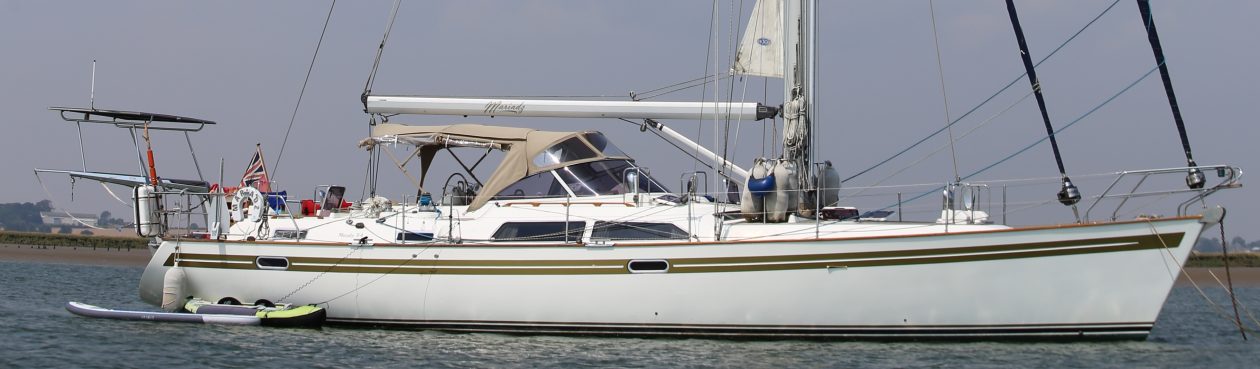

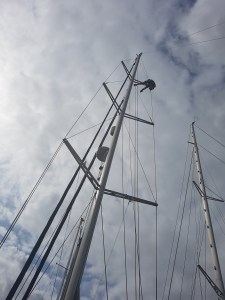 check, even though we know we will be replacing it in the next year or so. This would make sure we were safe in the interim. At the back end of August, this was performed and as expected a few things came up which need rectification but nothing that was a safety issue (so lots of amber and no reds). The check was very thorough and the written report backed up that we were safe enough for the moment and also identified some of the changes that they would recommend when we go for the full refit.
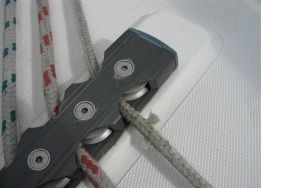 although I did also need to take the headlining down in the saloon to access the bolts under the organiser, some of which were on a bit tight. Having freed these, it did make me think that we have more work to do with the rig and we will discuss replacing the clutches and organisers as part of the rig refresh over the next few years. There were also a number of other easy fixes i could do myself such as tightening up the lines across the gates. That was also being redone as we extended our pushpit.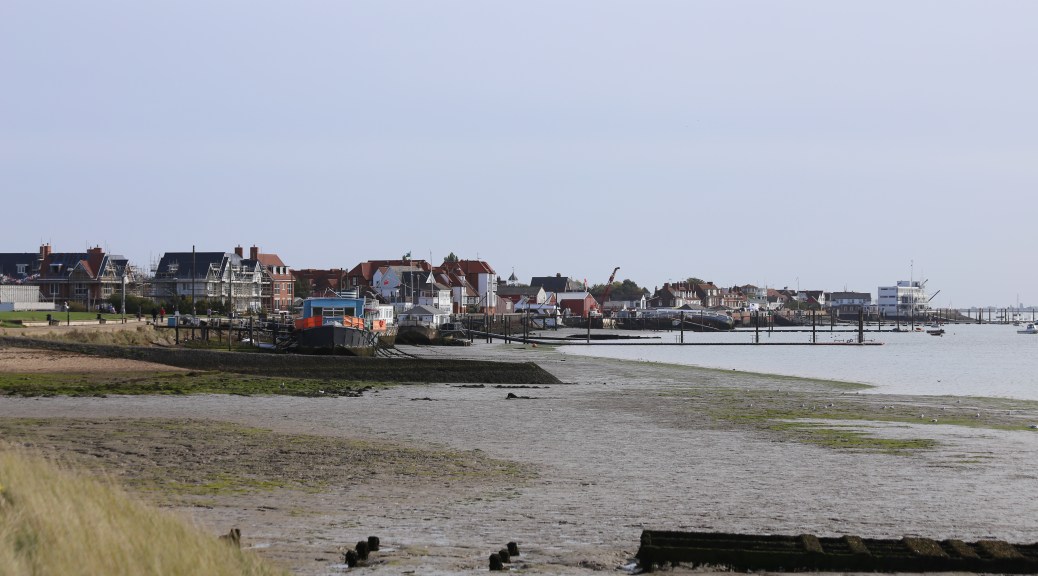
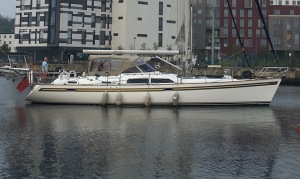 Maria gently pulled Mariadz out of her berth to head towards the lock and Mark from Motion took a pic for us. Shortly after the picture was taken we noticed that the satellite dish was still up, just ahead of the mast! Better get that in before we go too far down the river!
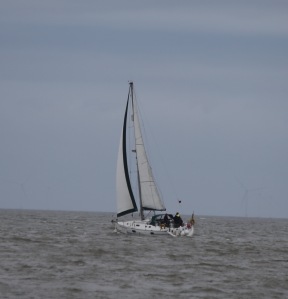 Progress is slow and there are very few other boats out. We are
 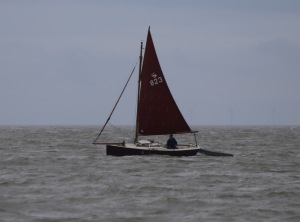 against tide and wind and we travel down the wallet quite slowly (for us). I’m not too worried since we will arrive at the Spitway at the bottom of Gunfleet sands after low tide as expected and it does give us a chance to get some good shots of boats coming the other way with the wind and tide.

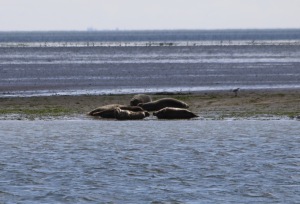 the opportunity to see seals bathing on the mud. Today there are relatively few, we have seen nearly a hundred before but there was a nice group gathered for a coffee morning and chat. Soon after this we see an ocean rowing boat. We later discover that this is team Kung Fu Cha Cha who are intending to be the only Chinese team in the Talisker Whiskey Atlantic
 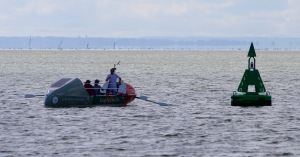 Challenge this year. They seemed to be doing pretty well on their warm up run up the crouch and the AIS track showed good speed :). We will definitely be following this team in the upcoming race.

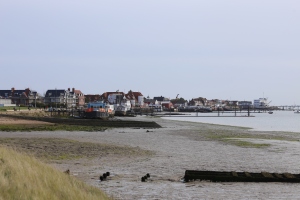 and we will need to be careful, no cutting the corners today! Maria realises that she will have to come in and as she passes between the entrance poles, she will have to turn hard to starboard and then let the wind push Mariadz onto the pontoon controlling her with the bow thruster and using the engine to line her up with the hammerhead. Maria is a little apprehensive in the twenty knot wind but she handles the boat well and I am confident that we will do fine if we communicate well. On the final approach into the marina, the water is shallow and the alarm goes off. For one second we are thinking we may run into the mud at the entrance and be stuck for some time waiting to be floated off by the tide – you know every man and his dog would have chosen that time to come into the marina – and you don’t want to be the gnome greeting everyone at the entrance! There are no such concerns as Maria negotiates the last of the approach and puts the wheel hard to starboard before starting to take the speed off the boat. A bit of straightening up with the bow thruster and minor adjustment to line up with the hammerhead and we drift gently into position. I step off and we are tied quite quickly. A little after lunchtime but Maria gets her afternoon moored or tied up….lucky girl.
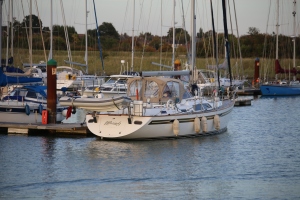 The E/F pontoon hammerhead is our usual and favoured berth at Burnham but the pontoon feels shorter than we remember, we are therefore overhanging on both sides so we will need to think carefully about how we tie up. I catch up with Bruce who explains that another similar sized boat will come in the next day and could we make this easier by moving forward when they come in before returning to our normal position afterwards. We absolutely understand the issues with manoeuvring in the tight spaces and we offer to give them a hand when they arrive. Our friend Lisa has also come to stay for the weekend so the cats will get spoilt too.
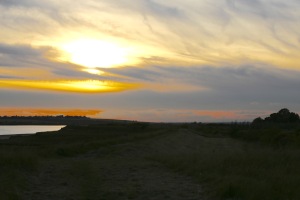 This takes several hours but by the end of it Mariadz is looking beautiful for all of ten minutes! This is an issue at Burnham. The marina is very nice, we have met some great people there and the carnival weekend is always excellent but there is an issue with birds – not Essex girls but Hitchcock level birds. They look lovely as they fly around and at one stage we saw thirty starlings on the spreaders and standing rigging of one boat which made it look like a Christmas tree.
  However, these birds seem to eat a lot of red and black berries…..so shortly after I have finished the deck, it looks like Prince’s mythical Purple Rain has happened. I have cleaned the windows and I am not doing that again, so we will put up with it until the end of the weekend when I clean Mariadz down after our journey.
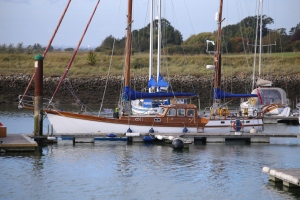 I am there to take lines if needed but she comes to lie so gently against the pontoon that we have all day to get her tied off. Maria can then start the engine of Mariadz and we can put her back to her old position with stern coming out as far as the boats on the long pontoon and the bow slightly overhanging the next entrance. We have a nice chat and later a few drinks with the crew of Sweet Surrender before coming back to Mariadz for a gorgeous home made fish pie, prepared by Maria but with top quality ingredients sourced (or sauced) by Adam. It’s going to be a long weekend so an early night is called for but not before Maria asks whether I can get the satellite dish setup so she can record some programmes over the weekend. Now in a domestic setup, a clever engineer, works out where to point the dish when the system is setup and you never need to think about it. On a boat or motorhome, every time you move you need to reposition the dish, and in a boat you need to make sure you are tied well or the dish will move and lose the signal. On one of our trips to a motorhome show, Maria had decided to get rid of the old standard dish and replaced it with a
  which doesn’t have an arm that can be broken. It also comes with everything you need to align the satellite…well, a mat, a rudimentary compass and a clever device to get the angle right – who needs a spirit level when you have that! At our home base in Ipswich, I know pretty much where to point the dish and generally get it set up well but I have not had such luck on our travels. Burnham is quite easy to work out as the river goes east-west and we are on the north bank, so I put down the mat and roughly align the dish while I go to get the compass etc. Before I get back I have a signal on the sky box! Excellent, now Maria can record X-factor…. 😉
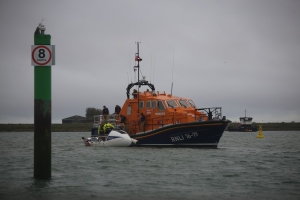 Just before we go there is a little excitement as one of the ocean rowing teams, not our Chinese friends, is brought in by the RNLI. There is a little concern at how bad it is out there but Mariadz can take it so hopefully we wont be needing the RNLI services later.
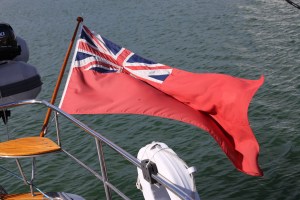 concerned that this may push us onto the bowsprit of Sweet Surrender but we have agreed to spring off from the bow which take us away at 30 degrees from the pontoon. All the fenders are in place and we have a little help from our new friends. This was a little fortunate as I hadn’t moved the bow spring far enough back onto the pontoon but we were able to pause the manoeuvre, move the line and start again. We come off fine so although not exactly text book, everything is good. Maria then takes Mariadz astern and with a hard starboard turn we are through the exit and into the river. This gives me the opportunity to stow the fenders on the mast pulpits (granny bars) again. Unfortunately our departure coincides with a yacht race down the Crouch so Maria slows down and we follow the race down river. There is some minor concern as the racers approach their turn and we momentarily think that the course may return directly back down the river and straight at us but they pass on our port side presenting some good photo opportunities.


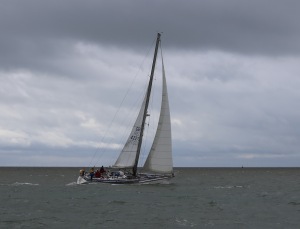 As we came out of the Crouch we saw the only other sailing boat that we would see all day coming back in under ominous black clouds. At this stage, even with much reduced sail, we are flying along at 8.5knots with the wind on the beam. Soon we will be turning towards the Wallet and over the Spitway, which this time has lots of water over it. As we turn, I take advantage of the change in the wind angle to take in the headsail, the other two are easy to get in if we need to and those clouds could be accompanied by even more wind. To be fair the reduced sail didn’t harm our speed much and we still bumbled along at a good seven knots for the whole journey but it gave us piece of mind. First though the Wallet, which is affectionately called “vomit alley” was incredibly rolly, with waves going across our beam but at least the tide and wind were in the same direction.
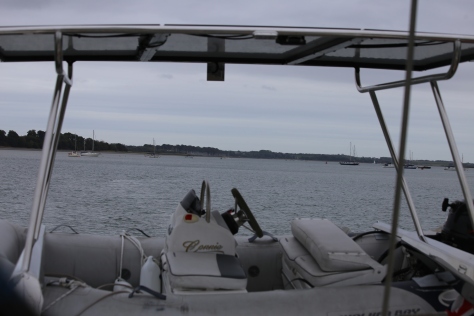 completely empty, there must have been real concerns over the weather because normally the river is busy at this time. We head up but lose a bit of time because of the variability of the wind, we are not too bothered and by this time Maria has put the roast dinner in the oven so it will be ready when we arrive in Ipswich.
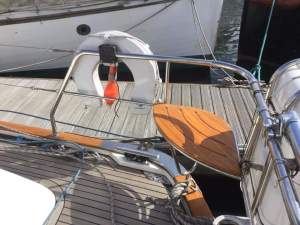 However, the standard Moody 54 doesn’t have much pushpit space with two liferings, a danbuoy and, for us, a life raft already on there. With the davits also restricting options and two two aft seats taking up more room, it is a little tight to say the least.
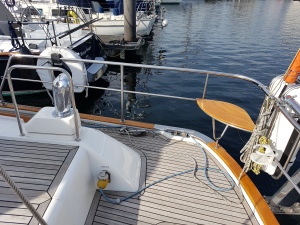 which gives us more room and a safer aft area. This would also provide more rigidity to the pushpit when combined with the reinforcement we put in the stern section previously when we added braces from the davits to the pushpit. The final item we needed to think about was the repositioning of the ensign required by the new solar panels. This was also intended to be rail mounted although I was keen to go back to a wooden pole rather than the stainless one we had previously.
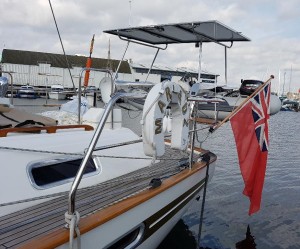 The finished job looks like it has always been there, just waiting for safety lines to be adjusted so that we can finish this part of the job. The best part is you cant see the join between the new and old elements of the pushpit, very happy with the workmanship again!
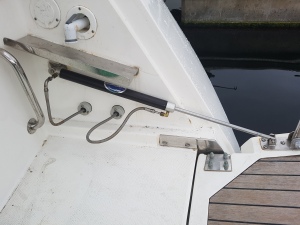 original hydraulic rams, Bennetts in America. After sending various pictures and measurements, they were able to find the rams I needed (HL12CDA). I then had to wait for the next available transport to the UK, unless of course I wanted it delivered airmail which would be double the cost the of the rams themselves! I waited. The rams arrived and were ready for fitting and then I discussed with Lindsay when we could go about fitting them and getting the system working again. In the interim, Matt, a marine engineer and very good friend of ours, was visiting and I picked his brain. He persuaded me to do the ram swap myself and actually this transpired to be a lot easier than I imagined. I then needed to add hydraulic fluid (automatic transmission fluid) into the reservoir and bleed the system by using it and adjusting the flow to eliminate any air left in the system.
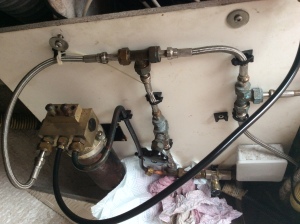 Most of the pipes are metal sheaved flexible pipes but there is one copper pipe and unfortunately the (olive) joint was faulty and hydraulic fluid was squirting out of it and making pretty patterns in my lazerette. I took a look at this with Lindsay at Seapower and we discussed how to resolve the problem. The sensible decision was to replace the copper pipe with a new stainless steel flexible pipe. I went to the local specialists, Pirtek. After one false start, when i pressurised the system and the new joint failed spraying hydraulic fluids everywhere, we were able to pressure test the remade pipe and get the hydraulics sorted. I was back to being able to lift the platform but not drop it. Most importantly, after nipping up a couple of joints, we don’t leak even a drop of hydraulic fluid.
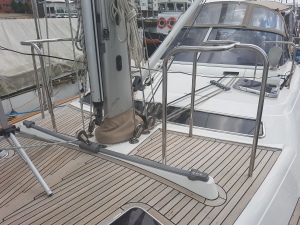 We wanted to have something that you could brace yourself against, for when you are working at the mast. Although with in-mast furling, you do spend less time at the mast than you would with the lazy jack system we had previously. An added advantage would be that this could also be somewhere that we could store our fenders, rather than on the pushpit or along the decks. We looked at a few designs and were keen to have something that we could hold ourselves against while still being able to reach the mast and also use the winch on the mast if necessary. It would also provide a useful hand hold when walking along the deck. I noticed this when I was walking back when they were placed there for show and naturally grabbed it for support. 🙂
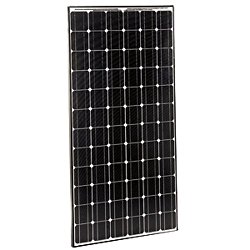 solid base for the solar and also allows us to have three large but lightweight (240W) panels which were
  . We think this is a sensible amount of solar for a large, power-hungry boat although we will be also be looking at further ways to reduce our consumption. An alternative would have been to have a small wind turbine fitted to the boat. You will see this on a number of cruising boats but to get a good charge you need some wind, normally in excess of 20knots for any meaningful contribution. Maria and I discussed this and decided that we would generally prefer to be in an area sheltered from wind if possible. The other disadvantage of wind turbines is that they are quite noisy and are also likely to cast a shadow over solar panels that would impact the solar performance so a mixed solution may also not be great. So it was agreed we would go with a solar array matched in Watts to the amp hours of our batteries (720W and 880Ah of battery power). Reason number five and the best reason! although I quite like the helipad idea……
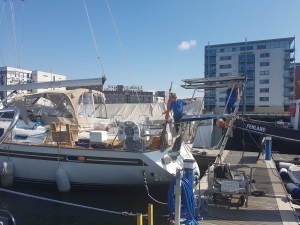 This would mean that we would need to have a certain amount of headroom and the frame couldn’t be mounted directly on top of the davits even if we had wanted that. Another reason it needed to be raised would have been the console on the rib which sits proud above the level of the davits. These reasons, and aesthetics meant we wanted to have something that felt balanced with the boat. We worked with East Coast Stainless on the design and came up with a design that we think works. One of the design questions was about being able to tilt the mechanism, which is more efficient for solar (and creates more downforce, returning to a previous train of thought 😉 ). However, we had concerns that this would be cumbersome, heavier and fail over time as the combination of salt water and stainless welded the tubing to itself. We had exactly this experience with a telescopic boat hook that wouldn’t budge after it
 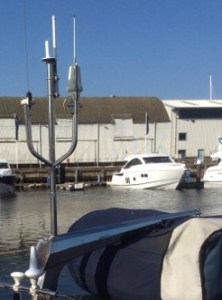 had been immersed in the sea and left for a few months. As part of this work we lost the Neptune’s fork that used to be mounted here but we had already moved or replaced most of the aerials that were on this and we didn’t want this to still be in place and potentially shade the panels. Some of the aerials were better mounted on the mast anyway. A few were left over which are mounted on plates to the side of the panels, providing a little shading but hopefully not impacting our solar output too much. When the fork was removed the davits suddenly looked naked until the frame went on, it was strange.
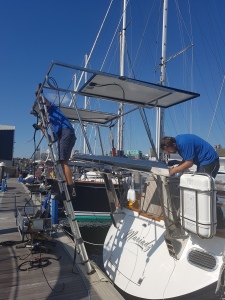 had looked at how the power went into the batteries and had agreed with Olly on an MPPT controller which maximises the power going into the batteries by being very clever (please tell me if I am being too technical!). It takes a high voltage as an input and then converts this to the lower voltage required by the batteries. We went with the blue solar set up which is supplied by Victron since we had other Victron equipment and this gets great reviews. It also comes with a Bluetooth communications module which will allow us to monitor the solar array in its own right. All of our on board monitoring would give us a nett effect after any load had been subtracted, unless of course we switch off everything on the boat….so the ability to check the solar in isolation is useful. But it is also useful to know whether your batteries are being charged after considering the current load as a baseline.
 ith just one panel connected up and with rain water on the panel, which impacts efficiency, we were getting 4A going into the batteries which is all electricity we don’t have to buy off the marina or fuel for the generator. Now you even get money-saving tips from Mariadz 🙂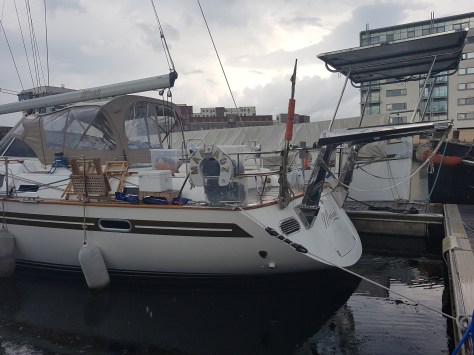

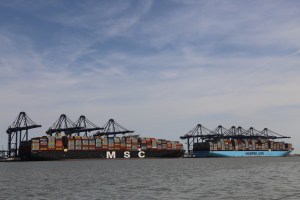 We pass the two large containers unloading on the newest docks at Felixstowe, each over 1,000 feet long and we are gently motoring towards the wallet and the gunfleet windfarm. The southerly wind is in our faces but we know the turn to south west into the Wallet will give us the opportunity to get some sail up and motorsail at the very least. So a couple of hours into our journey and we are ready to get some sail up and with little wind, it’s gonna be all the sail -main, yankee and stay sail! Even against the tide we are making reasonable progress down the Wallet, which is incredibly busy giving an opportunity to get the camera out and take action pics of the boats.
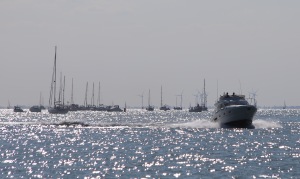 awful lot of moored yachts and motorboats at Clacton. From a distance this almost looks like a pop-up Marina but as you get closer you can see there are quite big gaps between the boats. We have friends anchored off and other friends watching from the beach so hopefully they all saw us as well as the planes!
 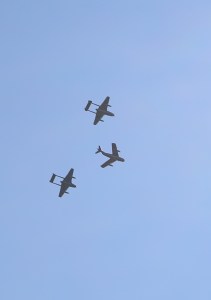 We are on the look out for other friends amongst the anchored boats but I think they must be a sniper in camouflage since they were able to get a shot of us but I couldn’t see them. I later find that there had been more bikini-clad women waving to me, sorry to at I missed it this time. 🙂
 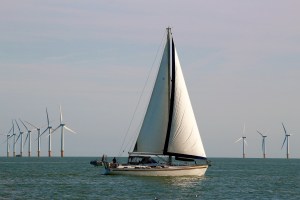 We keep going at a reasonable pace with the intention of getting to Osea at about 7:30pm, a little late if there is a problem anchoring or the anchorage is full but we have been here a few times and never had a problem before. As you negotiate the gap at Colne bank, you can see the Bradwell Nuclear Power Station in front of you and it is another couple of hours down the blackwater, against the tide, to get to Osea. The river is quite quiet this evening and we make good progress, still motor sailing but with the wind having shifted slightly to South Easterly giving us some assistance from the sails as we progress down the river. We go past Radio Caroline, which I didn’t realise was still broadcasting,
 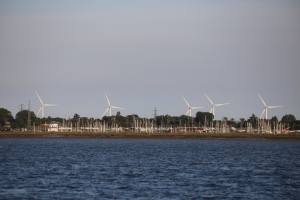 one time we will have to try and get it on the radio when we go past! We arrive at Osea at the time we expected and start setting the anchor, I have remembered to attach the anchor float so that we know where the anchor is, the snubber is attached and holds the chain below the waterline which helps with keeping the anchor and boat comfortable and protects our top sides from the chain.
  Finally, the anchor ball goes up and the anchor light is on so we are ready to settle down for a quiet evening as Bradwell gentle glows in the distance behind us 😉. Having lived in Tollesbury, on the other side of the river, for six years, I guess I shouldn’t worry too much about the Bradwell glow! We are up on deck quite late enjoying the tranquility so no music for us or Maria belting out tunes! She must be tired. Maria’s actually in bed by ten but that probably isn’t a bad thing and means that she will be rested for the weekend.
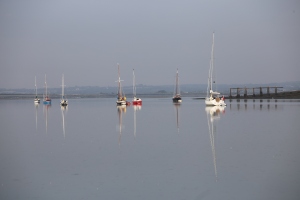 The morning is magnificent, sunny and still, at least until the water skiers turn up mid morning! We decide that before everywhere gets too busy we will move to a better spot. The place we chose last night meant at low tide we were within seven metres of one of the buoys, Maria doesn’t like that so we move further down the river where it is a little shallower but with more room. The move is uneventful and we are settled back down with the float out, snubber on and anchor watch application keeping an eye on us.
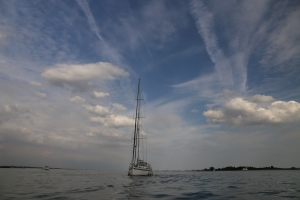 Before we go we take a few pictures of Mariadz looking regal in the river. And we’re off. It’s actually quite a nice trip on a rising tide although the garmin keeps telling me this would be shallow normally, but with the tide we are fine. However, we are being very careful, as always, and stay to the channel in the centre. This is quite ridiculous as we find when we get to Maldon. Our rib, Connie, probably needs about 30cm of water, compared to the 180cm of Mariadz.
 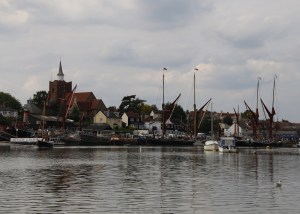 As we arrive in Maldon, we see a lot of the Thames Barges that we see in the Orwell! Maybe I didn’t need to worry about the depth…. having lived in Tollesbury for so long and spent a couple of years driving through Maldon to get to work – I didn’t know anything about the riverside area at all and it looks really nice. My first experience is to go to the two pubs on the waterfront, having left the rib on the small
 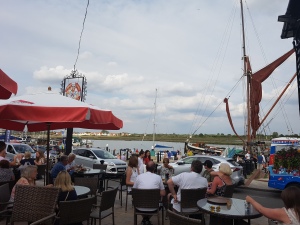 visitors pontoon. This works well as we arrive to an empty pontoon, but soon after the world and his wife have decided to come to Maldon, so I had to keep going back to make sure that little Connie didn’t get crushed by anybody and to move her so that others could squeeze in. We all work together and by moving things around we get everyone into the pontoon. This includes some new friends on a small yacht who made contact with land a couple of metres short of the pontoon! We waited a few minutes for the tide to lift them from the mud and then could bring them into the pontoon rather than being stuck out there 🙂
  later we saw them sailing back up the blackwater “refreshed”.
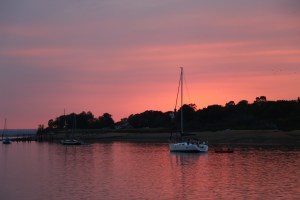 We’re back in time for sunset, a lovely BBQ and some time with the cats who have missed us. Sunset is amazing with the sky turning a deep red, I promise there is no filter on the photograph. Then as we are finishing dinner, a couple of guys from an adjacent boat are pottering around in their inflatable and come to say hi, I suspect that we will be chatting more tomorrow…. especially as we can hear them laughing and joking on their boat anchored nearby!
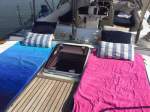 Anyway, 30 minutes later and we are all clean and tidy. Now the real work of sunbathing and relaxing can begin. Oh and maybe a cheeky glass of wine. Our new friends in the anchorage pop up river for a sail, there isn’t any wind though 😉, and on their return we invite them onto Mariadz to properly introduce ourselves before hitting the beach later for a barbecue. For one of the crew, it is her first time on water, and she is not comfortable doing the ride to Mariadz in their inflatable.
  I offer to pop over in the rib to collect her and come back nice and slowly so as not to worry her. I throw the line back to Mariadz but the combination of my poor throw and a missed catch means that the rope is in the water. Instinctively, I reverse back so that I can retrieve the line, why did I do that! The line gets nicely wrapped around the prop of the rib and the engine stops. After switching off the ignition, I lift the engine and unwrap the line as we drift slowly down the river. Lowering the engine and restarting works fine and we can try and do a better job of it this time! We get my passenger safely on board and we can add another unique experience to our boating life. To be fair it was quite quick to resolve the issue and if it hadn’t have been, I would have been able to deploy the anchor quite quickly too while I solved it (or ended up rowing back to Mariadz…. with one oar…. against a stong tide). Let’s just be grateful that no damage was done!
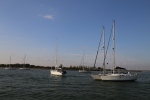 The anchorage is now getting busy too but we have been here a night already so hopefully the other boats will anchor in a way that doesn’t cause us any problems. Not that is an issue for us, we like to have access to the decks and so we deploy our fenders which has the added benefit of giving the cats a way to get back on board if they did fall in. It must look strange and unnerving though when you anchor close to a boat that has their fender deployed, not much confidence in anchoring ability being demonstrated there!
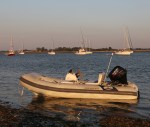 We are now on a falling tide with low tide scheduled to be about 11pm but we are not worried about such things…..yet. Maria goes off “hunting for wood” but it must be hiding because she comes back with only a small twigs. It is ok though as we all go off and forage for wood for the fire and soon with some liquid help it is roaring, a little like us!
 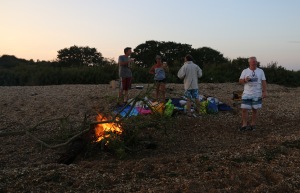 Maria’s brought some music and a speaker, although thankfully not the full karaoke setup, so music is playing and it is a lovely evening. We are eating quite late but everyone is having a good time.
 although I will admit it isn’t the best picture in the world! Maria became an excited school girl when she saw it! Really sweet as she spontaneously bursts into tears.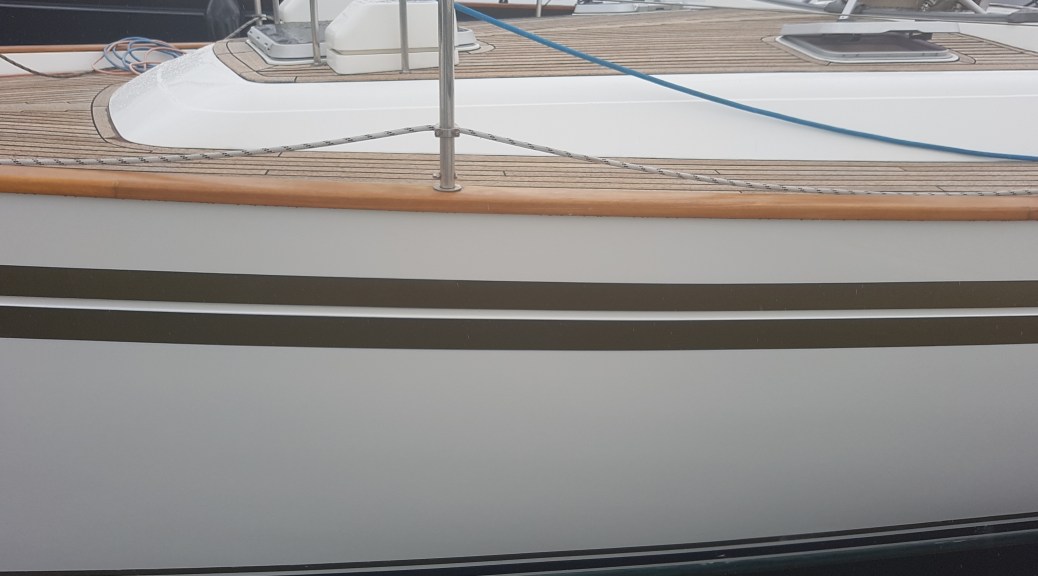
 The hull polish went very well and is a quick job because the surface is mostly flat. She came up beautifully. The gold vinyl stripe, which we intend to change next year to a painted stripe, is looking fine despite having been in place for over four years. So we can survive another year of that without doing anything major.
 we discovered that this needed very fine sanding with 400 and then 1000 wet and dry sand paper…… very gently! The dark crazing was removed and, after polishing, this area looked like new which was refreshing considering this had been a bugbear of ours for a few years.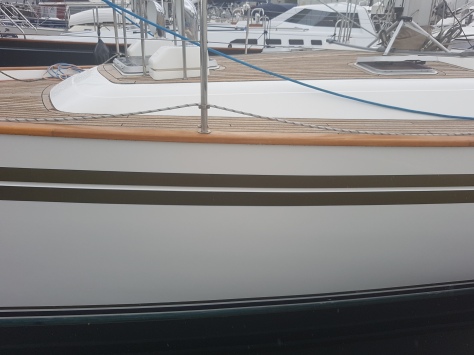

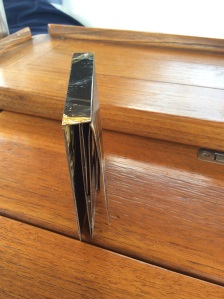 I have been fortunate to have Pete and Linda as neighbours
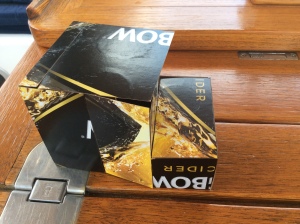 for the last two years and one of the things I have noticed as they fit out the beautiful Haven Voyager is that Pete designs a lot in cardboard before making it or buying it. This gave me the inspiration to mock up the steps prior to buying any wood or hinges! I can also thank my son Matthew for drinking the cider that made this all possible.

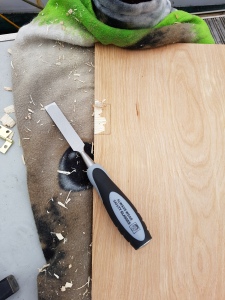 There are basically three types of joint in the design. The outside of the box
 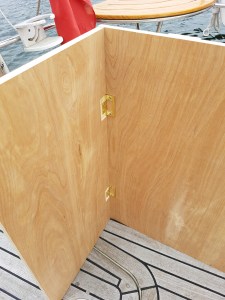 requires a joint that forms an L so that the top of the box is supported on all sides for stability. This means that the flush hinges need to be brought in by the width of the wood and recessed into the wood to provide a flush finish (I would now recess these differently to the picture with the larger part of the hinge being recessed but I did the first as in the picture and wanted to stay consistent at least on the inside of the box). Two of the concertina sides are joined to each side of the back using this method and the other two are joined to the top step in the same way, I used two hinges for each joint irrespective of size. Having built the U of the back and two sides and the same U shape for the front, we can join these together with the butt hinges. You now have a box with one end which is only half covered and has the front of the top step. We can now fit the top step itself, which is the top of the box, by fitting two flush hinges onto the top edge of the back on the outside and then the smaller top piece can be fixed. The larger top piece is then attached to the smaller with two butt hinges (on the inside). Our top step is taking shape. Now to avoid any unfortunate accidents it is a good idea to attach two bars on the underside of the longer part of the top step. These will stop the concertina collapsing inwards. They should be mounted a wood width from the outside edge and have at least a wood width on the outside edge at the front.
 to waterproof and protect the wood,
  to stop any accidents and the boat name in gold, which isn’t too clear with the wood colour unfortunately. The final element is a weathermax bag for it to go in, and I’ll probably throw some silicon sachets in there.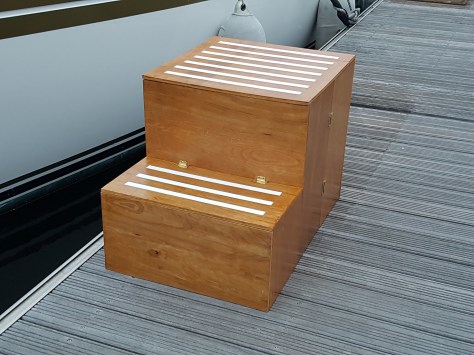

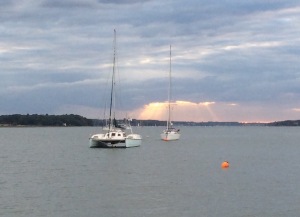 In just over an hour we are tied up to a mooring buoy, the Prosseco has been broken out and the girls are starting to relax. We settle down to watch the sunset over the River Orwell as our pork chops cook in the galley. At the age of 72, Adam’s Dad has discovered Facebook. His regular posts on the recovery of Adam’s Mum from a stroke in March, help us all understand the progress and the difficulty of these long term recoveries. It is clear from his latest update that today has been a hard day and we agree to facetime him to have a face-to-face chat over the internet. Two hours later, dinner has been switched off, alcohol has been consumed and we are all still chatting but Dad is in a better place and his favourite daughter outlaw (in joke I’m afraid) is now past eating. A few more drinks and a bit more chatting and it is time for bed before we head to Osea Island the next day – I never get my own way 🙂
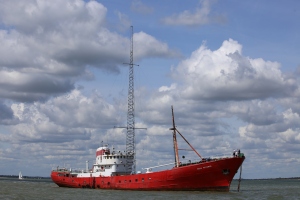 This is the Ross Revenge which is the boat that used to broadcast Radio Caroline in the North Sea during the Eighties. This was after the first Radio Caroline ship, Mi Amigo, had sunk which is remarkably similar to the story for the “The Boat That Rocked”, although apparently this is a coincidence! So a little bit of history to enjoy as you sail past. There are then a large number of moored boats before you get to the anchorage at Osea Island. We arrive shortly before 6pm, right on low water, and with only five other boats spread around the anchorage find a good spot and start to drop anchor. In one respect arriving at low water has the advantage of simplifying the calculations for the anchor chain although it does mean that we did not benefit from the tide at any stage!
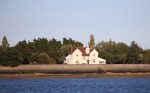 although on this occasion I forget to attach the anchor ball to the anchor to help with
 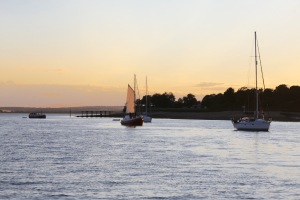 location and retrieval in an emergency. Time to relax again, as the sun goes down and out comes the Prosecco and the raspberry gin – hmmm, theme developing here. Our friends are at Brightlingsea listening to music and send us a video, the singing doesn’t sound the best if we’re honest and doesn’t compare to the band we can hear on Osea Island where there must be a wedding
 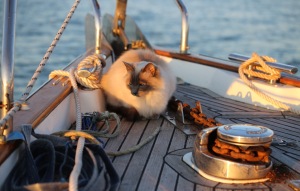 or large summer party. It’s a lovely, still, warm evening as we settle down. For the second night, the fishing rods are shut firmly in their carrier and my Dad FaceTimes us and we talk for ages and Bonnie chills on deck.
 Maria has taught him to do a high five for treats, he likes to practice this a lot and he has the girls wrapped around his little paw! He gets treats.
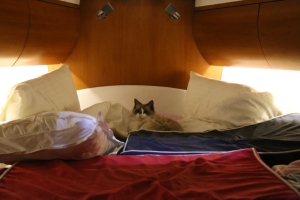 Clyde is now being a bit cheeky and trying his “come to bed” eyes on Lisa!
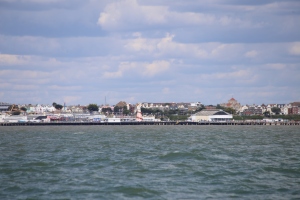 they are falling behind as we start to catch up with a couple of smaller boats ahead of us. We travel up the wallet passing Walton, Frinton and Clacton which all look very different from the sea.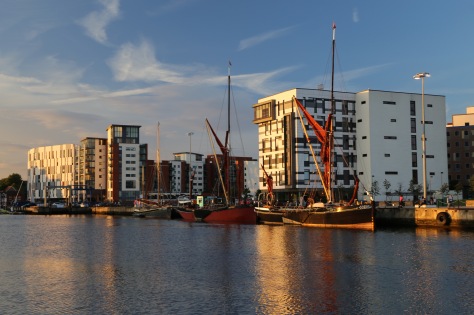
 Mariadz