This is not the story of one of the tele-tubbies (if you don’t get that ask your parents/grand parents) but the story of how it almost went wrong and the lessons we learned.
Eventually, it is getting time for us to leave Dunkirk having had a lovely couple of days and we decide that we will return via Ramsgate. We check the weather, South/Westerly wind around twenty knots – just about perfect for a return journey to Ramsgate or Harwich. We check our engine and fuel, half a tank – should be fine especially as we will be sailing all the way. So with everything set perfect for our return we decided to leave early on Easter Sunday.
Flushed with confidence around the call on the way in, I overthink the exit. We will have a spring line (rope for non yachties) to hold us a set distance from the end of the pontoon and stop us going too far over to the other side in the tight Marina, when Mariadz straightens up on the exit route we will release the spring line and bring it back in before we leave. Simple. We start to head out and the spring line is working perfectly holding the Mariadz in position while the stern comes round, she is almost straight when I release one end of the line and start to pull the line in while Maria edges her forward. As the line passes through the cleat, it develops a twist and locks itself on the cleat. It won’t budge. We are now in the middle of the marina aisle with a line ashore that won’t budge. It’s early in the morning and we are not being quiet. I have to let go of the line or I will remain a fixed distance from the pontoon while Mariadz keeps moving so I have now lost a line. A kind Frenchman pops his head out from a yacht and sees what is happening. He goes to retrieve and tidy our line for us. He offers to leave it there for us to collect when we return to our berth…..No, no, we’re leaving now….can you come to the end of the pontoon and throw us the line please. Our kindly Frenchman agrees and all is good. We start to head out parallel to the sea wall as Lisa and I gather together the lines and fenders. One of the fenders drops…by the time we notice it is too late and it is in shallow water so we can’t retrieve it. Oh well, we could have lost a line too, look on the bright side.
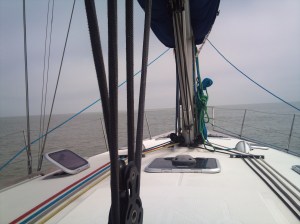
The first few hours are uneventful, the wind is as predicted and because of various sand banks we have to have the engine on for a while as well as a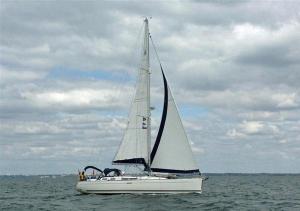 little bit of sail until we can turn and make a course towards Ramsgate. Within half an hour, the wind changed – previously we had enjoyed 15-20 knot winds from the south/west, now it turned to the North, pretty much on the nose, and was getting stronger (it peaked at 45 knots). I said “oh dear”, or something along those lines, my memory fades 🙂 We immediately reduce sail to the absolute minimum, apparently it is always a good idea to have some sail left up because it helps to balance the boat.
We’re already wearing our life jackets and, as the wind rises, Maria goes below to get the lifelines to make sure we are attached to the boat. I am stood at the aft steering position manually steering because we do not believe that the autopilot can cope with the conditions and we would prefer to not find out for sure.
We’re getting thrown around quite a bit at this stage, Lisa is asleep in one of the aft cabins. The waves are now four metres tall and Mariadz is gamely trying to make progress but is getting nowhere fast against the wind and the onrushing water. Now Mariadz is 45 feet long (13.5 metres), the waves have a short period (they are close together) so think final scene of the Perfect Storm every couple of seconds (a little exaggerated but that is how it felt). Still nothing from Lisa’s cabin.
We had a fair bit to drink the previous day and nothing to eat that morning, Maria is sat in the cockpit area and being thrown about a lot. For the first time since we have been sailing, she feels queasy. Unfortunately she is sitting on the windward side (the side where the wind is coming from). The next bit happened in slow motion, Maria looks a little panicked as she realises that she is not going to be able to hold back. She turns. I shout, “no – go to the other side” but it is too late, there is no going back as what can only be described as a shower of vomit leaves Maria and comes flying back across the boat carried by the wind. Right to where I am stood. I have enough time to turn my face away as it hits me, it’s ok, it’s there for seconds before the next wave crashes and washes me clean again. The water is coming so fast that not only the vomit is wiped away but also the sunburn weakened skin from the end of my nose, the only exposed flesh under my wet weather gear. This will be a source of some fun for friends over the coming weeks as the target on the end of my nose slowly heals.
Then something worrying happened, the engine started to stutter. That is the last thing we need and we have no idea what the problem is and we are in an evil 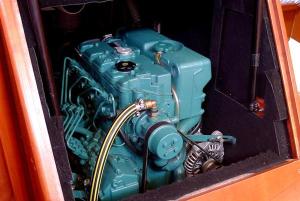 sea with limited knowledge or spares to repair it if it goes wrong. We agree that we need to tell people how we are doing but that we are still in control at the moment. You can’t hear anything in the cockpit so the remote for the radio is useless. One of us has to go below to radio the coastguard to find out what has happened to our perfect weather forecast and call in a pan pan (not an emergency like a mayday but that we have a problem that could deteriorate and we are making them aware). Going below when the boat is being thrown about is likely to make someone unwell and we can’t afford both (in)experienced skippers to be suffering from seasickness. Maria volunteers to go below, what a girl. She is on the radio and speaking to Thames Coastguard. Once she gives our position, they realise we are on the French side and so need to talk to the French Coastguard. Now, Maria often recalls this bit as speaking to “mooli, mooli, mooli, French Coastguard”, she is quickly able to convince them that she doesn’t speak French :). At this stage, Lisa finally stirs. Maria is on the radio and Lisa is as happy as you like, wanting a chat and maybe some of those lovely roast potatoes from yesterday. Maria is beyond caring and Lisa sits on the stool in the saloon
 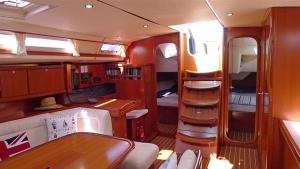 slowly eating a few potatoes before gamely suggesting that she will join us in the cockpit. Mariadz is then hit hard by a wave which rocked her, Maria and Lisa go flying – Maria still holding the radio and Lisa still holding her potatoes. They pick themselves up and Maria continues to talk to the French Coastguard. The incredibly brave coastguard offer to send a boat to us to transfer someone on a line to help us, we quickly decide that it is far too dangerous in the sea we are in and we are not in any danger……yet. Maria says she will speak to me and come back to them and they agree that we should call in every half an hour to give an update and confirm that we are still ok and don’t need help.
Maria then comes up to speak to me having suggested to Lisa that she is probably safest in the tumble dryer that is her room. Maria has been down below for a while and is feeling a little worse again. Now, Maria is a great cook but she had no choice and started making pavement pizzas! Maria made three and then the take-away service of a large wave whipped them all away. We get rocked by another wave and this knocks Maria off her seat and onto the cockpit floor smashing herself on the cockpit table. She stays down. I am calling to her asking if she is ok, is anything broken. After what seems an age when I have considered putting the autopilot on to check on her she rises and says she is ok. This isn’t fun anymore.
After half an hour we don’t seem to be making any progress, on the update with the coastguard, Maria asked if we were getting through the weather. The French coastguard confirmed that it was set for a few hours and in our situation recommend that we return to France. On her return to the cockpit, she tells me the plan and I am worried.
The reason is that boats are in the most danger from waves when the height of the wave is more than the amount of boat it is crossing. Mariadz is 4 metres wide and the waves are more than four metres tall. If one of these waves “broke” over Mariadz half way through her turn, it would knock her flat – the top of the mast would hit the water. Now, as all sailing boats, she would right herself but it would be a terrible thing to happen and very dangerous. People could fall overboard and it would be no fun for Lisa below decks.
In order to go back we are going to have to make a 180 degree turn between these tall waves that are hitting us frequently and try not to be side on when one of the waves comes along. Tricky! We agree to go for the turn and Maria warns Lisa about what is about to happen. The boat is continually being hit hard and we choose the point to turn, on the back of a wave and hopefully before the next wave hits. Mariadz is as agile as always, and completes the turn as we get into the trough between the waves. Never in doubt!
Life is now completely different. Before we were making no headway and being stopped as big waves hit us and with the weather hitting me and Mariadz full in the face. After the turn, we are surfing at 10-11 knots (very fast for our boat and never achieved again), it seems a lot calmer because we are going in the same direction as the wind which makes the wind seem less. We fly back covering the distance it had taken us twenty minutes one way in a minute on the return. However, we are still experiencing the engine stuttering although it seems to be getting a little better and we have power more often than not. Maria also has the sight of me with a large wave towering over me as we are in the trough, before the next wave picks us up and takes us surfing gain.
In no time at all we are back approaching Dunkirk. We see two fishing boats heading straight towards us, probably wondering what the hell a yacht is doing out in that weather, they pass us very close but don’t communicate with us or ask us if we are ok. Next a large ferry is about to cross our path, we don’t want to go in front of that in our current predicament. Then they make a turn and head straight at us hundreds of metres in front of us (I.e. Close!). We steer a course to avoid them and the little bit of sail pulls us out of the way beautifully and we are now past the ferry and getting close to Dunkirk.
Maria speaks to the harbourmaster who suggests that we go to a different Marina on our return, it’s bigger and has better facilities if there is a problem with the boat.
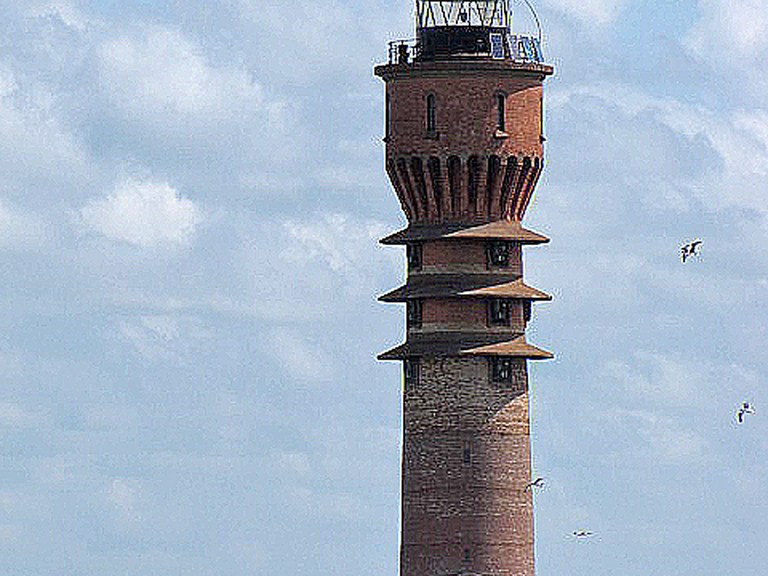
We recalled from a few days previously that the entry to Dunkirk has a very nice three banded lighthouse 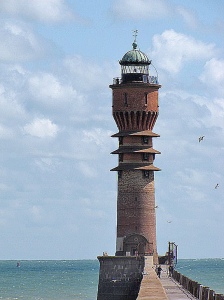 on one side of the entrance and what can only be described as the most famous sea wall in history on the other (where the Allied troops were evacuated from in 1941). I can see the top of the lighthouse and just about see the bands, but there is nothing but sea on the other side of the entrance. Now I know they haven’t moved the wall in the couple of hours we have been away! We try to remember how wide the entrance was and go for the right hand side of what we think is centre.
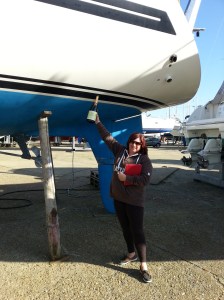
Now, Maria can go back to the coastguard and explain that we are crossing into Dunkirk harbour and out of harms way. However the waves are still crashing and we are having to turn to go towards the marinas. We now see why we couldn’t see the wall from outside…the waves are breaking over the top of it! As we get further into the harbour the waves are having less of an impact and the water is calmer. As we are approaching the marina, Maria takes control of Mariadz and Lisa and I start to set up the lines and fenders. We arrive at the fuel pontoon that we have been allocated to find a small crowd of people there ready to assist. They pull us in but unfortunately a little to enthusiastically and scrape the hull against a gantry used to lower disabled sailors onto their boats. It was a shame but we decided it could have been a lot worse and they were trying to help.
As we are finishing with the lines, the people ask why we left this morning, 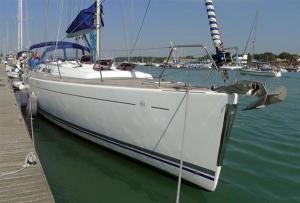 had we not seen the weather forecast? I showed the one we had looked at and they explained that they all used the Meteo France forecast which had predicted terrible weather and so they all stayed put. We vow to always check multiple forecasts from different sources rather than believing the first one that we saw that gave us the forecast we wanted.
But what was wrong with the engine? We go to the Volvo engineers on site and find that they would not be available until at least Wednesday. So no help there. We were clearly a little low on fuel and we are on the fuel pontoon and so we decide to fill her up anyway. She’s treated us well and looked after us so it is the least we can do. The Dufour has a 250 litre tank and we put over 200 litres in! Clearly our half tank wasn’t quite a half tank. That also starts to explain the engine problems: the fuel tank would have been three parts air to one part fuel. With the way we were being thrown about the engine was being fuelled in that proportion so no wonder it kept losing power. We ran the engine for an hour after feeling to see if it was ok and it ran like a dream.
We rested!
But knew we would have to get home somehow since we all had work on Tuesday. Now would the weather be ok for a passage on the Monday…….
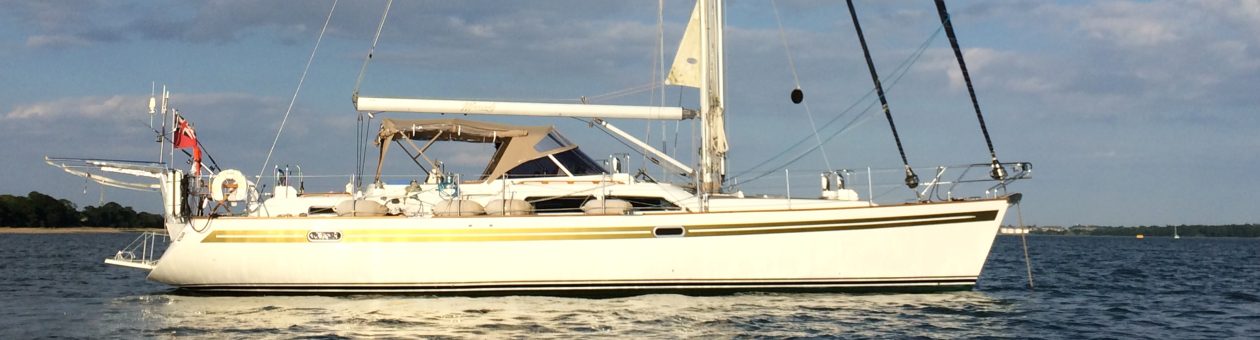

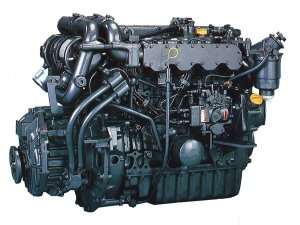 have a full engine survey, and with hindsight this would have been money well spent, on an engine with 3,000 hours on it. Our surveyor did his initial review of the engine both out and in the water and didn’t report anything amiss.
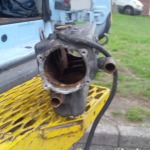 With apologies for the poor quality of the pictures, Travis reported a disaster on both the generator (another story) but also on the engine. The picture shows an extensive amount of corrosion in the heat exchanger which means that the entire unit needed to be replaced and we were lucky not to have caused serious issues when using it. At the same time it was clear that the “recent service” that had been done would have identified these issues and if detected early, the problem we now found could have been avoided. I had the receipt for the most recent service which had been an oil and filter change. I compared this with the Yanmar recommended checklist for a 3,000 hour service….clearly there had been some mistake.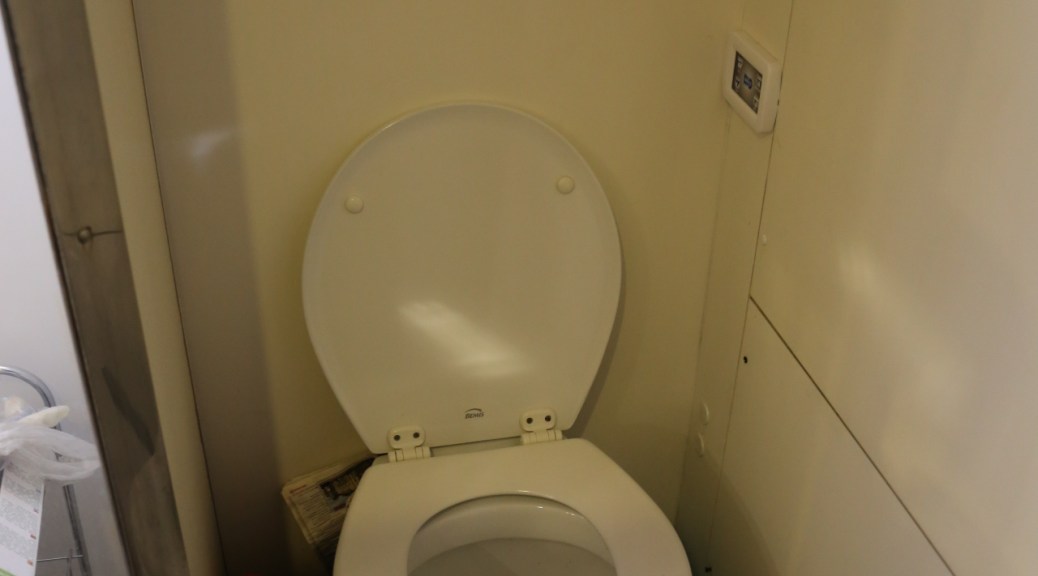
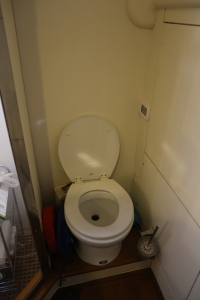 In most marine toilets, you have enjoyable, and fitness enhancing pump action where you first fill the toilet with water before evacuating it into the pipe work, finally cleaning with another few pumps. On Bavarias and Dufours, six pumps three times was adequate. With the Moody and its unique, read very long, pipe work you would be best at around about twenty times three unless you would like to leave something in the pipe work to react with sea water and return us to the fine mess we had started with. This would then involve thrashing again, and this time I imagine a) i could be the recipient and b) I would be certainly doing the messy bit on my own since Maria had done her stint and knew how gross it was! The advantages of an electric toilet are many. Firstly, it is likely to have a macerater built in which chops up everything going into the pipe into small, easy to digest (for the pipe work) chunks so no mess 🙂 Secondly, there is a pump for the water so no hand cranking sixty times, massively improving upper body strength but no fun.
 that means that you have lovely warm towels after a shower. I suspect this will be more important in an English Winter than a Bahamian Summer.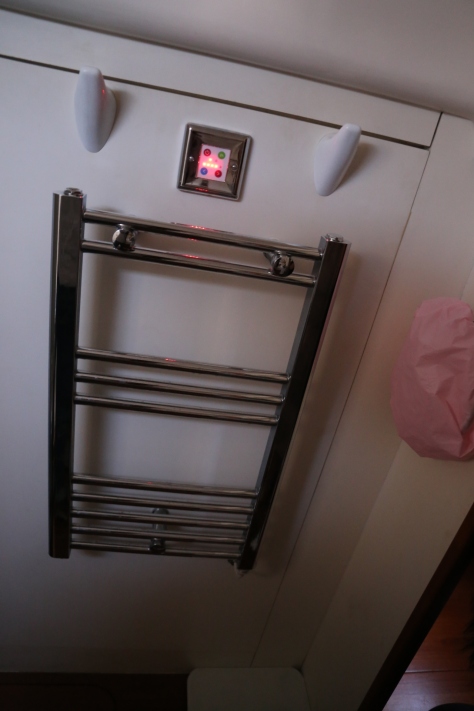

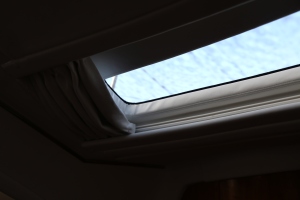 not a difficult fix to reseal all of the windows. we sealed the outside of the windows with
  . The inside of the windows is accessible if you take down the headlining but initially we decided to just do the outside to start.
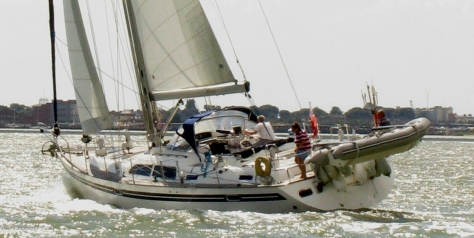 She was itching to show what she could do and even with limited sail we were sailing beautifully balanced at nearly 9 knots. At this point I should mention that the speed limit on this part of the river is 6 knots….under power 🙂 happy days. We passed

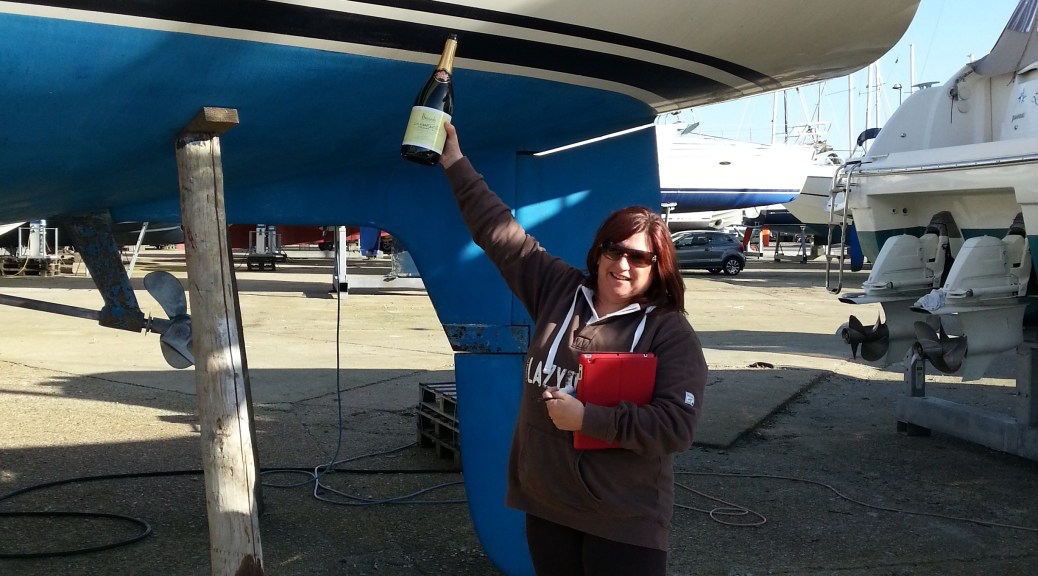
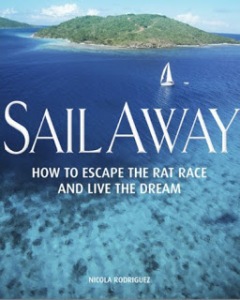
 We then found out that John is Nicola’s husband and so it immediately felt that we knew him since we had read so much about their sailing adventures. We have found John incredibly friendly and knowledgeable and are proud to consider him a friend. One disadvantage is that John is very persuasive and every time we see him he tells us we have to set off now and not to leave it any longer! He is a very bad influence 🙂
 The owners of the Moody were keen to have a deal and were prepared to take the Dufour as part exchange. With a little negotiation on price we were able to come up with a deal subject to surveys and finance. We were ecstatic.
 ou can start to see the first signs of the bad weather coming in. We race up the river at the speed limit (6 knots) trying to get in before the wind picks up. As we approach the lock, Maria takes over so that I can help Lisa prepare the boat. We come into the lock and Clive the lock – keeper is friendly as always. “You wouldn’t believe our weekend, we didn’t think we were going to get back!”. We tie up on B pontoon and everything is tidied up. Five minutes before the heavens opened. This was always a talent that the Dufour had, she could get in just before the rain. Every time.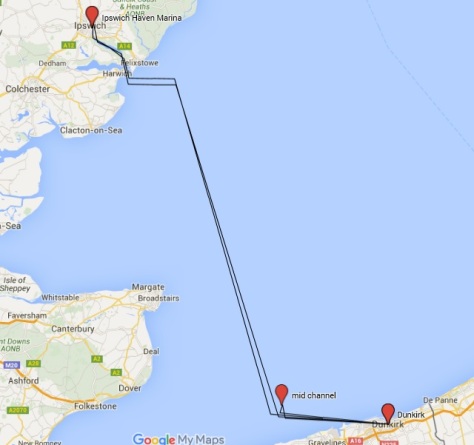

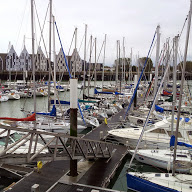 We will be coming in astern and so I suggest that Lisa owns the bow line and I will deal with the stern and mid line. Firstly though, we have to find our berth. This is easier said than done, the marina is very tight for a 45 foot yacht although I am guessing the theory is that if you have something that large then you should have learnt how to use it. We cruise slowly down the aisle that we have been assigned looking for berth 6. They are not well marked (and that will be Lisa and my defence til our dying day!). We find a gap between the finger pontoon and another yacht, the only gap we have seen, and both Lisa and I look at it and we see a six. Job done – “Maria, it’s this one”….then we look again. Looks a bit tight…..he definitely said a six…..it must be this one! I go towards the stern, my station as we are about to come in, as Maria stops Mariadz in her tracks. I get to the cockpit and Maria whispers to me “Ad, how am I going to get it in there?”
 Mariadz