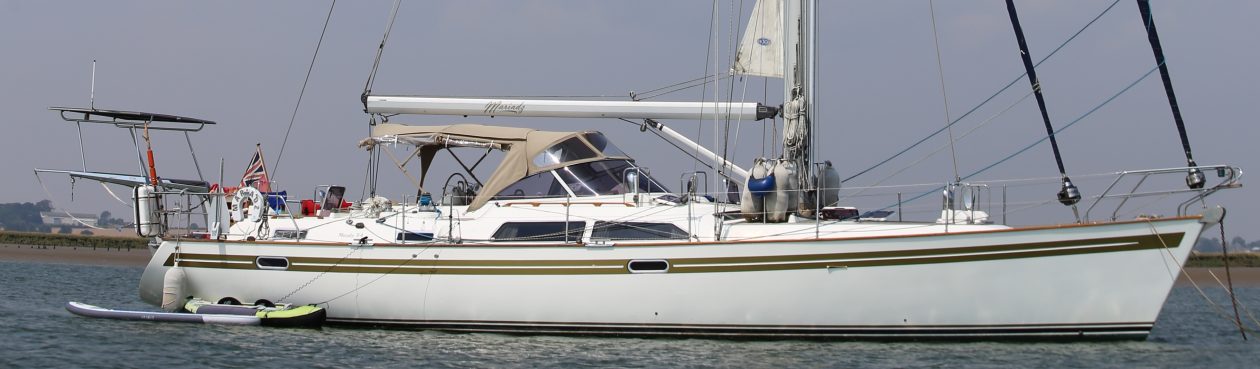
We have spent the last two weekends away, firstly in Lymington, attending a seminar about blue water cruising and then to Italy to pay taxes, speak to builders and check out the house. We therefore decided that we would have a weekend away somewhere quiet and decided that a few nights in the River Stour would allow us both to relax and chill. It would also work out because we were expecting to see my son, Matt, over the weekend and it would be easy to pick him up from Harwich. Maria still had to work on Friday but we decided to leave on Thursday since our setup allows her to work from home wherever we are.
It’s a beautiful evening as we head down the River Orwell and start to discuss where to stop. We can either pick up a mooring buoy at Levington or anchor either at the bottom of the River Orwell or the top of the River Stour. We decide to keep going to the anchorage opposite Harwich Parkeston Quay at the top of the Stour adjacent to Shotley. The trip down is mostly uneventful except Maria starts to think the engine doesn’t sound “right”. I go below and notice on the electrical panel that we are charging the batteries intermittently. This is changing the tone of the engine which is what Maria heard. I start to investigate and everything seems to be ok as we continued but I recognise that we will have a job to do when we return understanding why the charging is not consistent.  As we pass Shotley we notice our good friends the Thompson family from Ipswich, coming back up river. They have taken on an amazing project and are living aboard while they renovate their boat before going off travelling. It is an ambitious project but they are committed and we are really pleased to think of them as friends.
 We anchor in a familiar spot and have a quiet evening.
 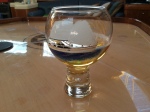 The traditional arrival drink, a beer, is ready and this time in our new hand painted glasses! We also got some good news about a potential new role for me so all is right in our world as we settle down to a dinner of steak.
The next day starts well from a weather perspective and I am checking over the boat as Maria works.


I even break out the hammock that we have had for eighteen months and think about how to rig it. Maria has always been worried about the pressure on the headsail of rigging it to there, which we have seen a number of times previously. I had noticed that Simon Thompson had rigged a spinnaker line to take the vertical pressure from this setup and thought by using two spinnaker lines and a cleat I could rig this so that both the horizontal and vertical pull was held by two different lines, sounds perfect in principle.  The other end could be held on a masthead cleat and I have been able to set up the hammock in a way acceptable to her majesty, siting on her throne at the chart table.
Between work calls, I am able to distract Maria enough to get her to try out my new setup (having checked it first, can you imagine the trouble I would be in if it failed!). Maria agrees to give it a go. I have video evidence. I also seem to have a court order which bans me from sharing said video evidence.
Anyone who has read about our rib will know one of the main issues we were trying to address was to allow Maria to get in and out with some decorum since she seemed to spend most of her time in an inflatable lying on her tummy with her bum in the air! She also struggled to get out of the Lotus Elise when we had it, with a common outcome being a loud thump and Maria picking herself up off her hands and knees….in front of a packed pub garden. Cool. So with much noise Maria gets into the hammock and we are all good…the camera is still rolling….she starts to get out. Let’s just say that the first thing to hit the floor was her left hand, and she tried to get out on the right hand side. The final shot of the video that you are not allowed to see is Maria reversing back to the camera as she stands up….. close up and fade to black! I don’t think the court papers specifically excluded a description of the events. If they did my next blog will be from a police cell.
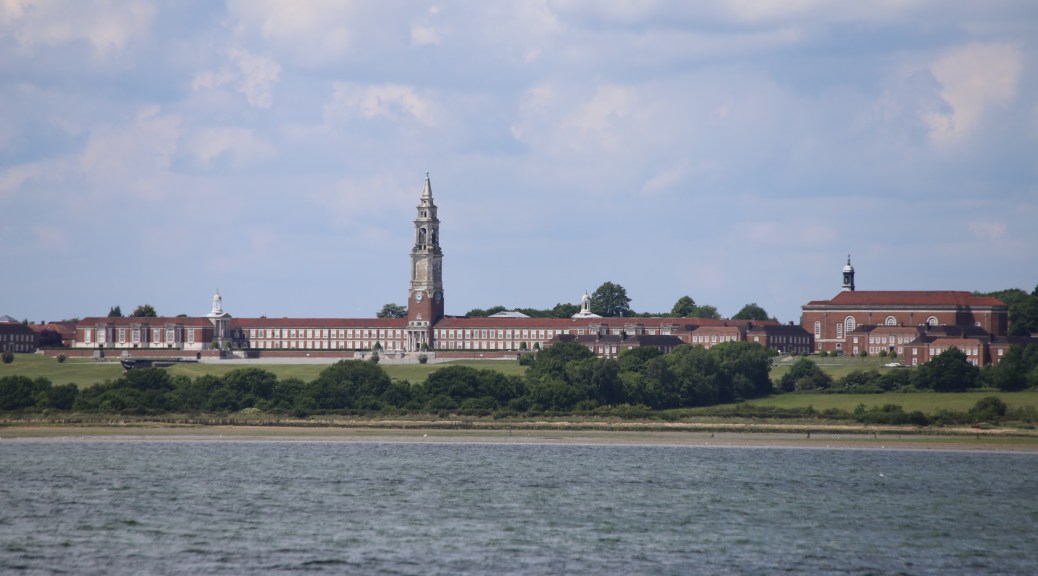
It gets towards the end of the day and Maria is finishing work. The anchorage is nice but is opposite a commercial port with ferries coming in and out infrequently. if we head down the river, it is very quiet under the Royal Hospital School. It’s been a glorious day but some clouds are to the west of us where we are heading. Maria points out that they look pretty evil but I check the wind direction which is gently blowing towards these clouds and point out that unless they are going against the prevailing wind direction, we’ll be fine….. 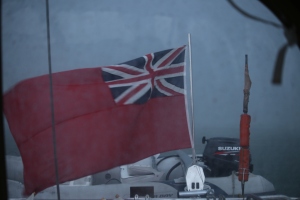 Maria is not one to say I told you so but within ten minutes the rain is lashing down, the wind has turned and it is blowing over 30 knots. Not the best weather to go on the foredeck and put out the anchor. We decide to float around while the thunderstorm passes, Maria also points out that where we were is still bathed in sunshine and it wasn’t her idea to move! She points this out quite vociforously. With limited visibility, I take over the boat and decide to check out exactly where we will be anchoring when the weather improves.
 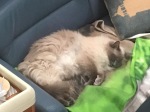 Quite a few people ask us about how the cats are on the boat,
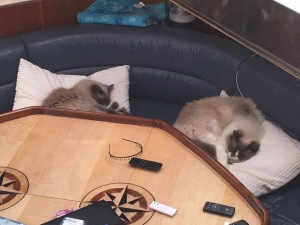
 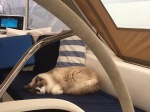 particularly when we are doing longer journeys or the weather isn’t good. Bonnie and Clyde have grown up around boats and are very relaxed, on passages they will generally be in the cockpit with Maria and I or asleep downstairs. You can see how stessed they were at the height of the storm. It isn’t long before the thunder stops, well after three storms roll through, and the weather starts to improve and Maria takes over so that i can set up our anchor gear.
We have to reset the anchor because we weren’t quite where we wanted to be and at low tide it gets a bit shallow in the bay under the hospital school. Finally we are set up, anchor float attached to the anchor with a line that can be used to retrieve the anchor. Ten metre snubber line to ease 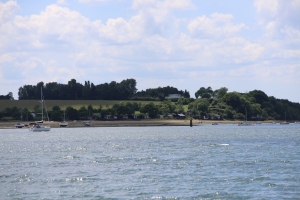 the strain on the boat and anchor, and several other snubbers making sure that even if we have a problem the windlass is never exposed to the yank of the chain. Anchor ball up and we are ready for our evening. When the rain was lashing down earlier, we had taken a look at our BBQ food and thought we may be in trouble here! With
 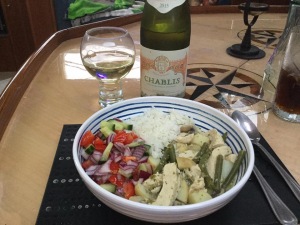 the change in weather we decided to have a Thai dinner rather than cooking in the rain and wind.
We settle down down for a quiet evening, Mariadz style… it was probably around 11pm when Maria decided she wanted to listen to music. Oh dear! The Louisa Johnson song where she laments that it was only ten how did it get to three, could have been written for Maria…..obviously three is just the start and if Louisa wanted accuracy she would probably have gone for five or six! This night is no exception and despite a couple of attempts to get her to go to bed, it is “just one more song” until 5am when Maria makes egg and bacon sandwiches before going to bed as most of our (sensible) friends are starting to wake up. 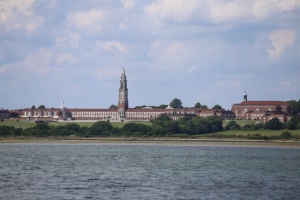 Later that day, we are “hanging”. It’s a lovely day, but a bit breezy. However, my hangover is not shifting and I go back to bed for a little while. While I am asleep, Maria chats to Amanda Furber, and agrees that we should all get together – I just need to pick them up from Harwich (4 miles away) in the rib like I am a taxi! I’m still not in a great state but I am sure the river ride will sort that out! While deploying the rib, there is a momentary stutter from the Davits as the motor stops and just clicks. But it comes back, so another one to put on the list of things that need to be checked. Just before leaving, Maria asks me how we are doing for fuel. On the rib, we have the main tank that feeds the engine and a reserve five litre can which is always full. The wind is blowing down the river towards Harwich and there is quite a swell. This doesn’t bode well for the return journey but getting there should be fine. We have only done a few miles so I’m sure the fuel is fine…..of course I get a mile downriver and the engine cuts out as the main tank is empty! so it’s lift the seats get the two cans out and transfer fuel from the reserve to the main tank, all while being rolled around, beam onto the waves.
 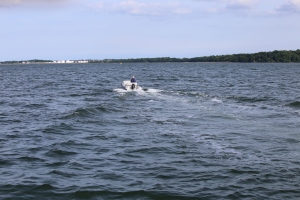 Refuel complete, I can restart the engine and get to Halfpenny pier to pick up my fare. Amanda and Mark are waiting on the pier when I arrive. I throw the rubbish into the bins and am ready to go. But Mark has a cunning plan, he will drive the car to Wrabness, slightly up river from us and I can get him there, it will be a shorter journey. Amanda joins me in the rib and we start to head off back to Mariadz. I may have mentioned that it was blowing 15-20 knots and the waves are quite deep, probably a metre from the tip to the bottom. We are making progress but it is not particularly comfortable. On the way to collect Amanda, I had remained dry for the entire journey, that wasn’t the case on the return. Amanda acted as a good water and wind break but I still got wet. Her back was also aching from the constant banging up and down and together we arrived at Mariadz wet and tired. Reading that last sentence back I should probably reiterate that this was a journey in the rib and nothing rude! I drop off Amanda and call Mark to find out where he is. He is on the far side of Wrabness with the beach houses and the mooring buoys. He has waded out to knee height as I approach and climbs in and we have a comfortable ride back to the boat with the wind and waves at our backs. On return to Mariadz, we go to the stern and decide to lift the rib back onto the Davits to avoid the rib banging the back of the boat overnight. We are clipped on but the stutter we had previously seems to be here to stay and the davits wont work. The rib is up enough for overnight and we decide to check it out in the morning.
I can now do the barbecue we have been 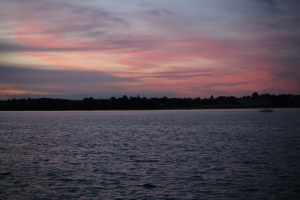 promising ourselves and we all settle down to a lovely evening in the cockpit chatting, eating and drinking. Mark is quite tired and bails responsibly early, i.e. before midnight, but Amanda has the bit in her teeth…. and a few drinks in her tummy. It is 3am (again) when we eventually all decide it is time for bed – someone will be feeling a little worse for wear tomorrow. The next morning we are up reasonably early since we need to get Mark and Amanda back to Wrabness. At this stage, Mark and I are beginning to think that since I added the 5 or 6 litres of fuel into the tank we have travelled six miles to and from Harwich and a couple of miles return to Wrabness which is now being repeated. It should be fine…. and I will fill up both tanks when I return to Ipswich. We get enough from the davits to drop the rib again but they are still playing up. It is a bit calmer for the journey back to Wrabness and I am able to drop them off quite close to the beach at high tide and they wade back in.
Now for the return journey to Ipswich. We are still getting nothing from the davits which appears to be an electrical problem, potentially something shorting out. I have checked in the control box and everything seems fine in there, no loose connections and voltage where I would expect it but I am no expert. Maria and I decide that we will have to tow the rib back and work it out over the next few days. We hardly ever tow a rib so we have a large mooring line to do the tow and two back up lines…a bit belt and braces, especially when the mooring line also has a shock absorber built in!
I go to lift the anchor, having previously checked that the davits electrical problem wasn’t impacting the windlass. This is reasonably uneventful and the anchor comes up surrounded by approximately a two foot ball of mud and weed! 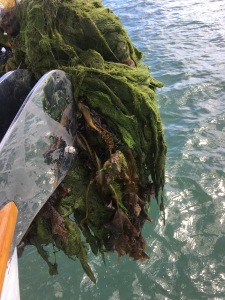 It is a sight. I call Maria to come and take a look with Mariadz on autopilot and tracking down the middle of the Stour. As we return from the bow, Maria notices more white smoke than is usual coming from our exhaust. We check the temperature of the engine and it is above the normal working temperature. We reduce revs as I go down below to check out what is going on in the engine room. I am greeted by quite a warm engine room. At the best of times the engine room is a “no shirt zone” and this was hotter than usual. The water strainer on the aft bulkhead is completely green inside and it seems obvious that this is blocking water getting through to the engine. I explain the situation to Maria and we decide to get some sail up quickly and switch the engine off while I try and fix it. The clear lids on water strainers on Marine engines are great things, they allow you to see exactly what is going on. However, they do have a tendency to stick fast, especially if there has been any heat. Needless to say I can’t budge it.
I phone every chandlery along the Orwell to see if they have the specific devise designed to remove these covers but none have it. Our friends on facebook, where Maria had updated, are trying to make suggestions: hot water over the top of the cover to make it easier to shift, wd40 under the lid to try and budge it and a wet cloth to get a better grip. Nothing is working. Since there is no water in there, perhaps a vacuum has formed so loosen the feeder pipes and let the vacuum out before trying all of the above again. still nothing working. On Cliff Elgar’s advice, I try to wrap a line around the lid with a view to pulling and twisting the lid off. Again I am unsuccessful. By this time, Mark and Amanda have called us to offer some assistance and some tools! We agree that Maria and I will go along to Levington, pick up a mooring ball and meet them there. After 45 minutes of eventful sailing, a regatta of 50 odd boats was coming the other way and not really thinking about how we were going to pass between them, we arrive at Levington. Maria approaches the buoy perfectly with me midships as her spotter calling down the distance and angle of approach. In fact she sits Mariadz there so perfectly I could have had a cup of tea while I threaded the line and took it back to the bow to tie off. Once settled, I get in the rib and head to the marina to meet Amanda and Mark. They have stopped at Halfords and bought various tools that should give us a grip. They also have their dog, Milly with them, and most importantly a new 5 litre can of petrol for the rib! The four of us head back to Mariadz so that we can start to fix the problems.
Unfortunately the water strainer is being stubborn, none of the tools that Mark had brought were shifting it and we decided to review the rope technique again. With one minor adjustment, suggested by Mark, we had a better grip and the top started to move. In the end we had a loop in the end and the other end passed through this, this was then placed around the edge of the lid with the loop on the left hand side. The pull would then tighten and then move the knot anti-clockwise. With both of us pulling we start to budge the lid. We can now see the jumble of weed that is in the strainer, we clear this out, put everything back together and are happy that we have fixed the problem. Engine start and check the flow of water……negligible. oh dear, engine off. We should probably check the impeller. On the yanmar engine, in common with a lot of marine installations, the impeller is in a very awkward place where I have to unscrew panels to access the impeller and even then I am going under the engine and reaching up to the vertical plate. Our new lighting in the engine room is great but doesn’t get to this area which is still quite dark and you cant actually see it anyway because of its location. So you are groping around in the dark and you have to feel your way (as Olivia Newton John would say). It’s four bolts so release those, catch them so they don’t fall in the bilge (virtually inaccessible if they fall), as the last one goes, remember to catch the plate (similar bilge access issue!). I have the plate off and a firm grip of all the parts so we can see the impeller, it looks fine and moves as it should. Lets put it back together then. Plate in place, don’t drop anything, hand tighten four bolts and then tighten with the spanner, 1, 2, 3, snap! Now that’s unfair, one of the bolts has sheered but at least the other three are on tight which should stop any leaks. Another job for when we are back in our berth.
So we have established that the engine is trying to draw water in, and the problem has to be at the other end where the water comes into the boat. We decide we need to check the through hull. Take off the two jubilee clips and lift the pipe off the through hull….nope. That aint moving either! We have applied heat from Maria’s super hairdryer but still no progress. Eventually and with a rolling hitch we have successfully attached my trusty, water-strainer-lid-remover rope to the pipe and it does it’s magic! With the pulling of two of us we are able to get the pipe off the through hull. Now lets see if we have any water coming through the through hull or whether the problem is in the pipe. Open the through hull, just for a second, we don’t want to sink… a dribble of water comes out. We could leave this open for weeks before we would need to worry about the boat sinking. So there is a blockage on the though hull outside of the boat. So two techniques, firstly, wire hanger to clear any hard objects and the large brush under the boat from the rib to scrape away any weed. 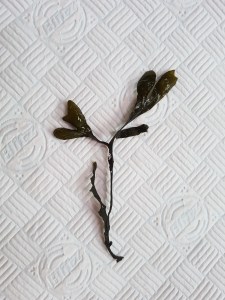 We test the engine and we have flow and a six inch piece of weed goes straight into the strainer! At least we know what happened. Having removed this, the lid comes off without the threat of “the rope”, and put everything back together again we’re ready to go.
I drop Amanda, Mark and Milly back at the marina so that they can go for a walk and return to Mariadz for the last part of our epic journey home. We start up and everything is looking good, but within 200 metres the temperature is starting to rise and again we need to slow the engine down. By staying between 1,000 and 1,500 revs we can keep the temperature under control, less than 100, and we limp back to Ipswich slowly. This gives Maria time to cook a roast dinner for when we arrive – an advantage of having a great cook for a wife!
Coming into the lock is interesting, Maria has the boat well placed but, after she has stopped, I have to move the rib out of the way before I can bring the stern in. Everything is tied off, including the rib. Coming into the berth, one of our neighbours, Peter, offers to help and I throw him a bow line and ask him to tie it to the end of the pontoon so that we can use it as a spring to keep the boat under control while I tie her off. We’re in and safe and Maria has the engine off before I have finished tying us off, she has confidence in her man!
We can now inspect the damage over the next few days and fix everything….but first time for a lovely roast dinner.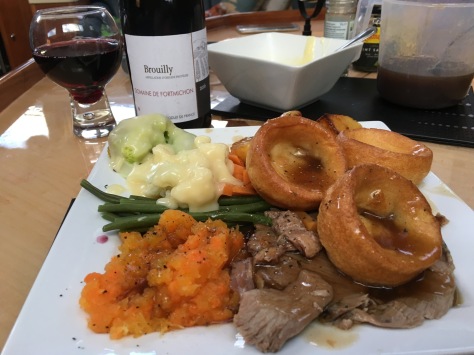

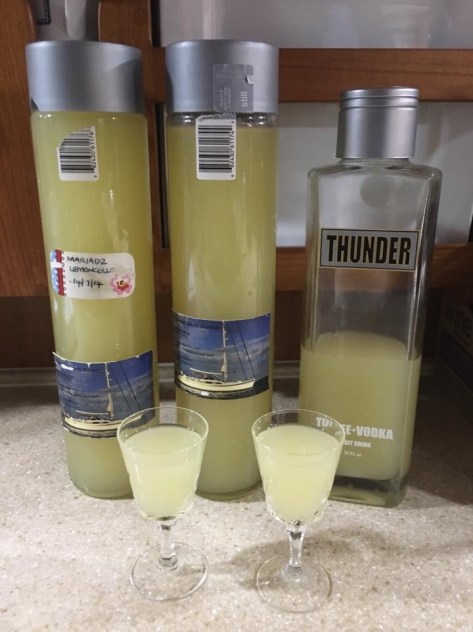
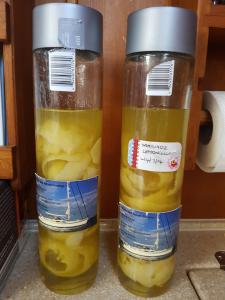 Now leave it on the side for two weeks shaking and turning it each day.


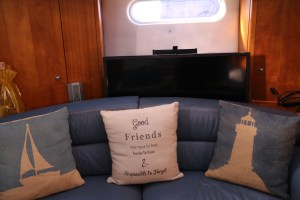
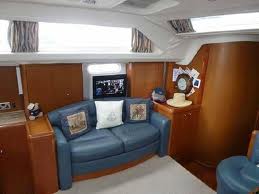 now we like watching TV sometimes but a) how will you see that from the other side of the room and b) who would want the TV on display the whole time anyway! When we had viewed the Moody 49, Mornin’ Gorgeous, prior to buying ours, we had admired the simple setup that hid the TV safely behind the seating.
 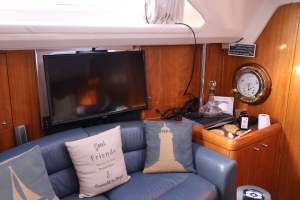 That was now our solution and it would allow us to have a large enough TV that we could both see and watch films on.
 So we looked at lifting cages with remote controls that would achieve the same goal, somewhat more stylishly. These cost more than the TV :(. But work really well and are more stable – quite useful for a boat 🙂 In the end we went for the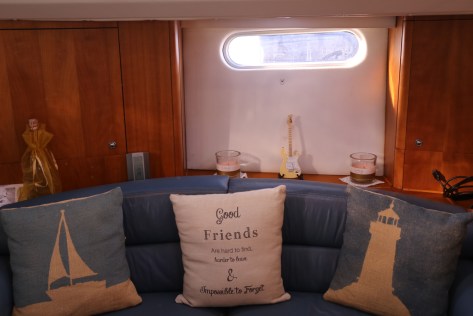
 ) and I had also bought an
  for our bedroom. These are very good quality TVs with excellent resolution, a built in HD Freeview and satellite tuner. I have also been very impressed with the customer service throughout the three year warranty period which has the TV collected and then returned by courier within a few days. I decided to go for the
  . Unfortunately, the original fitter for the lifter had kept the bars that allowed the larger TVs to be mounted so I needed to get some stainless bars made up by East Coast Stainless to help with the mounting. We are very pleased with the result, in fact the earth loop, the buzzing noise from the speaker, also does not happen with the Avtex – that was getting a little annoying!
 on some of the teak on board. This is a varnish-like finish that allows the wood to “breathe”. It also doesn’t need quite as much preparation as varnish with only a light sanding needed to get additional coats on. Once we are away, we will be doing this on a six-monthly basis to protect the wood and keep it looking good.
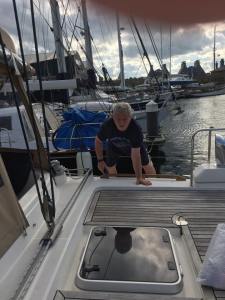 This would then give a smooth finish for the woodskin to soak into. However, it is best to do this with your eyes open and not how I appear in the photo!
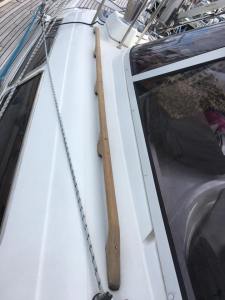 So I started this on the Friday and soon had the handrails back down to a finish that was more acceptable. Having had issues with the woodskin getting onto deck, stainless etc as part of the application, I decided to use masking tape across the bases of each of the handrails. This did take time, since I wanted to make sure that the tape was shaped around the curved handle and provided the protection needed. By late on Sunday, after a glorious sunny day, I was ready for the first coats of the woodskin. The plan would be to apply a minimum of four (light) coats but realistically as many as we can since the depth of colour and protection gets better with more coats. The touch dry time is 4 hours and then 24 hours for it to be fully dry, so a reasonable week of weather and it will be done. I apply the first coat on all four handrails and it looks great so I can settle down, relax and admire my handy work. Five hours later, the first of the rain hits 😦 grrrrh! Fortunately it looks like the woodskin was dry enough but we waited for everything to dry out before adding the additional coats. So three coats down and it has consistently rained five to six hours after I have done them!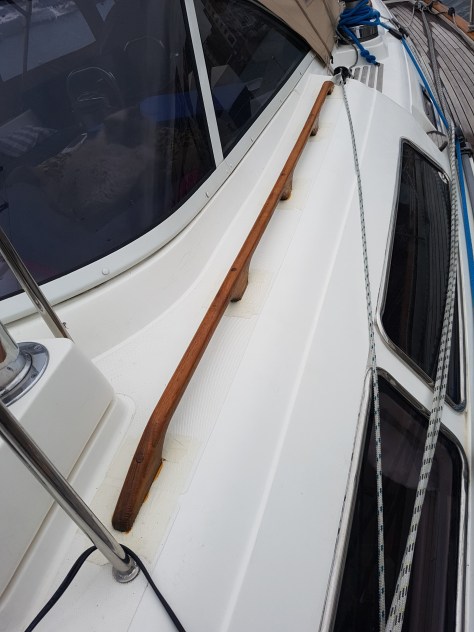

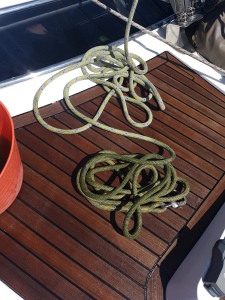 You know it is bad when you can’t tell what the colour the line was underneath the dirt! The picture shows mid way through cleaning, the bottom green part of the line had already been soaked for a while and was a lot cleaner than when it started – although still disgusting!
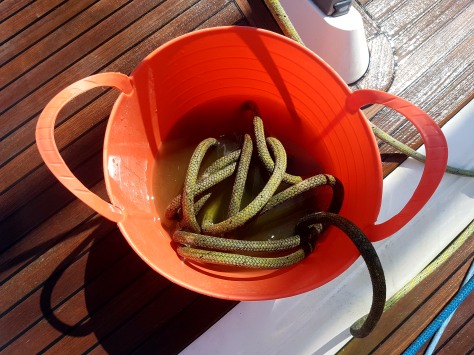 Our technique was to have a hot bucket of water with mild washing powder and fabric conditioner in it. Spray down the line with a hose to start with and then immerse it in the bucket for some time. Having given the water some time to get into the rope, I then painstakingly went through each metre of line with a soft brush, cleaning off the dirt.
 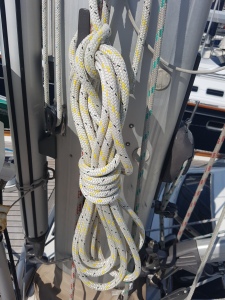 The final touch was to spray down the line with more cold water. It is tedious, hard work but very rewarding when you see the difference at the end, with the lines looking like new. They are also not stiff anymore so we should find that they work smoother and better than they did.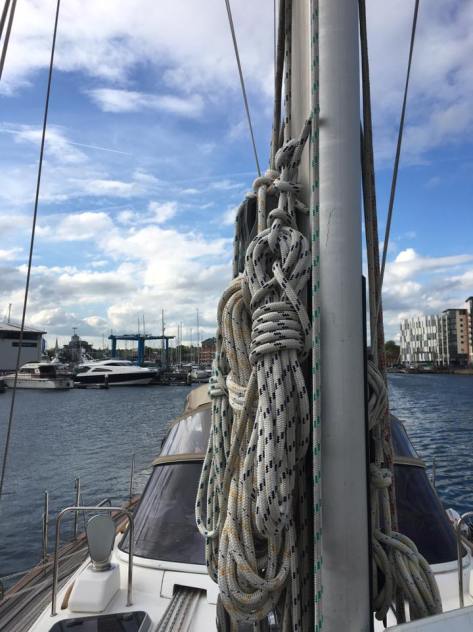

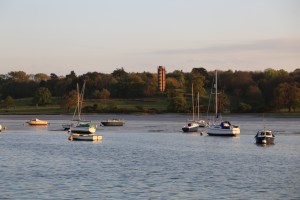 We have a lovely sail down the Orwell as the sun reaches the horizon.
  In fact Bonnie is taking her “watch” very seriously keeping a look out for traffic and dangers.
 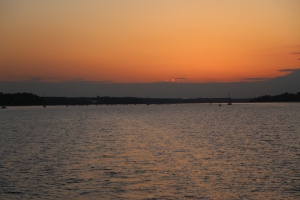 However, we are late and sunset, in our wake, is a full half hour before we arrive.
 We mention what happened the night before but the other yacht has got away early and didn’t bother to pay, hmmmm the problem with the honesty system I discussed during our Easter trip. Mike remembers us from previous visits and reminds us to make sure the boat is locked with the keys away, not because of any crime issue in Harwich, just because he likes Mariadz and would be tempted to take her out :). Mike’s also part of the RNLI at Harwich which is one of the charities we always give to, hopefully not for selfish reasons!
 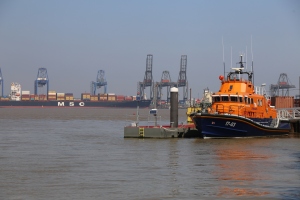 We hope we never need their help but what they do, and the bravery they show, is amazing. I mention to Mike our plans for the weekend with Jean and he says he will put out the “no mooring” signs so that our berth is protected if we go out. The wind is blowing a southerly at 15-20 knots, perfect for a little sail down the Stour and back, but it will be Jean’s first time on the boat and we don’t want to run before we can walk.
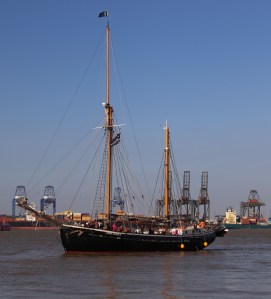 Toward the back end of the day Queen Galadrial, a Thames barge, takes her place on the outside of the pier. Apparently she is normally at the west end but today she takes up the space between us and the ferry berth.
 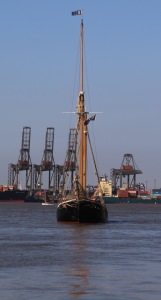 As she is coming right at you with the battering ram that is her bowsprit, you hope that they stop before they hit you. Needless to say there is nothing to worry about and she finishes a metre off of Mariadz’s bow.
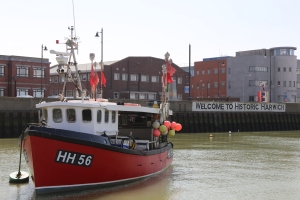 The local fisherman also come in with lobster and crab. We are strangely conflicted here because the lobster will be amazing but when you are sailing you have to be very careful of the, sometimes poorly marked, lobster pots.
 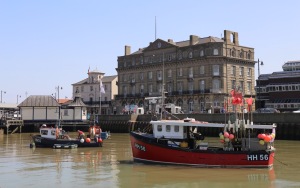 So one minute you are celebrating the fishermen and at other times you are cursing them. On the whole though, the lobster is too good to miss out on, and the fishermen are always very good with their boat handling, so respect and gratitude is due. Today in Harwich, we had another “water-user” too. A group of jet-skis came in from the sea entrance. In common with a lot of things, there were two types of person in this group.
 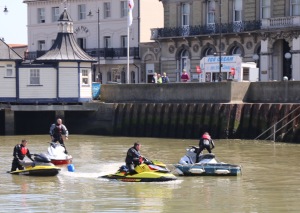 The responsible, considerate person wearing a helmet and the idiot with the fountain of spray from their exhaust, that didn’t seem to notice or care, where their spray or wake went. One thing we have learnt is that this second type of inconsiderate person are always around, unfortunately. They go without causing too much noise or trouble but it is unusual to see the two types of person in one group, in an often criticised form of water sport. Other yachts, and passers by, come and go and we also have the regular
  ferry journeys to Felixstowe and Shotley. It is always interesting to catch up with these people and to understand their stories as well as discuss our hopes and plans. Around about lunchtime on Sunday, Jean has to go home, but we all agree it has been a nice time and a good first meeting with Mariadz. Jean has promised to return and we will take her sailing and also get her behind the wheel.
 decide we will leave early afternoon and sail up the river with the gusty south easterly behind us. However the winds are gusting well over thirty knots and so we decide that we will only have a third of the main and the headsail out, this means a little slower progress but also means that a strong gust will not overpower us. As we enter the River Orwell, we make the turn past Felixstowe towards Levington and the wind is nicely on our beam. Even with little sail, and no engine, we are bounding along at eight knots with just a little help from the river. As we go up river, the wind angle does present some challenges though. One of the things we have been taught, and learnt well, is to rig a gybe protector. This is required if the wind is behind you, because a relatively small shift of the wind can catch the other side of the mainsail, smashing the boom across the boat. This is dangerous for people – do not get your head in the way of a flying boom – and also for the boat, because of the power being thrown around and the potential impact on the rig. So we tie a line from the back of the boom tightly to the forward mid-cleat on that side which is enough to stop the boom crashing across if the wind shifts. Of course coming up a river with hills, trees etc, there are lots of wind channels that can throw the direction of the wind so we always rig this as a precaution. We are having a lovely, and safe, sail up the river, in fact we are working quite hard, as we tack the headsail around from time to time, sometimes goosewinged, with the two sails on opposite sides of the boat, and sometimes sailing with both sails on the same side. Progress, since that first tack with the wind on the beam, is slower and we take a couple of hours to get up the river. Obviously not so slow that another cruising yacht overtakes us….Maria wouldn’t stand for that but still slower than we are accustomed. As we approach the lock there is no let up in the gusts, which means that Mariadz is being pushed away from the pontoon in the lock, but Maria has it all under control.
 our first time through the lock for ages is uneventful, although we are clearly a little rusty and the tying up on the pontoon in the lock isn’t quite as unhurried and calm as usual as we get slightly blown on and Maria has to make a couple of
  adjustments to get us away from the pontoon and then back on it. After a long time in the lock (there is a lot of water to move), we are on our way.
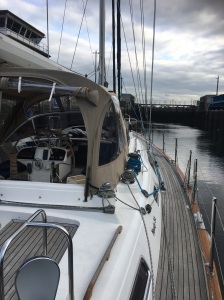 We have had to do this on a “sailing holidays” boat before so we are not worried about it at all, Mariadz will tell us if she isn’t happy with the wind. There is nothing on the river at this time, a couple of hours before sunset, and it is very peaceful.
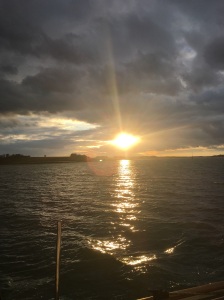 I had spoken to Nick, one of the harbourmasters at Harwich and he said that we can use the ferry berth if the pier is full because we are away early in the morning. We also have to post our overnight fee through his door – you have to love the trust and honesty system on the East coast of the UK. We pass Felixstowe and start heading to Harwich to find the outside of Halfpenny Pier completely empty. Maria approaches into the tide and wind and gently ferry glides Mariadz onto the pier and I tie her off. The wind is actually a fair bit stronger than we expected, blowing around 15-20 knots, so actually it is not as if we really need to tie her off, she is pinned against the pier anyway. Still tied off and with all fenders on the pier side, we are ready to get changed for dinner.
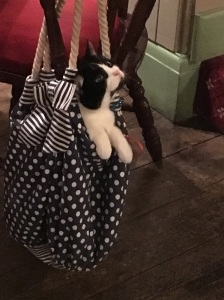 All five of them were staying on a twenty footer which he’d described as his yacht when they met. I don’t think it was quite what she was expecting when she first went aboard but they seemed very happy and we had a lovely chat. The cats may also have got a few treats from the kitchen too 🙂 I’m not sure it is anything we can do with Bonnie and Clyde but the cats were really well behaved, happy and loved. At the end of another gorgeous meal, we returned to the boat and settled down for the night ready for our early start the next day and the trip down to North Kent.
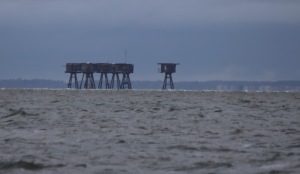
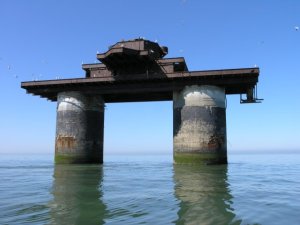 like a bouncer guarding the Thames and is similar to Sealand, the principality in the North Sea that we often end up sailing around if we go across the channel. These were anti-aircraft platforms during the war apparently but look imposing structures on guard permanently and should be painted black for the full doorman effect. Fortunately it looks like our name is on the list so we can keep going. After this you see the Maunsell Navy Forts which look like Martian tripods from War of the Worlds but from our angle it looks like one has been ostracised – not quite sure what it said but it looks very sorry for itself.
  It still takes another hour and a half for us to get into the River Medway and as we enter the river we see several yellow buoys and some masts protruding through the water. This is the SS Montgomery, a munitions ship that sank in 1944 and still has 1,400 tonnes of explosives on board. We’ll tip-toe past that then! We are now looking for the creeks since we have decided to anchor in one of the creeks in the Kent marshes. We go into Stangate Creek so that we can
 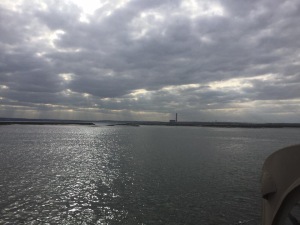 find Sharfleet Creek which gets quite shallow at low water with a six metre tidal range at this time and we are pretty much at high tide so it looks very inviting. We have decided to anchor in one of the “holes” which is charted at 4 metres and so should have something like 8 or 9 metres of water at the time we are there. We’re intending to stay for some time so I deploy our heavy rocna anchor in the middle of the hole with forty metres of chain. The thought was that this would give us four times the maximum depth when the wind was likely to be blowing 15-20 knots. The other side though is that when we are around low tide with four metres of water, there is a lot of chain. This has the effect of making us “wander” around a bit on the anchor, although the anchor isn’t moving.
 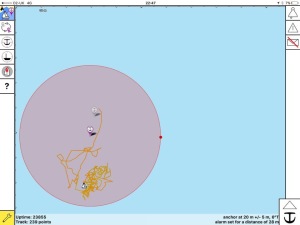 We use an app to help us when anchoring, Anchor on the iPad, which shows you a track of how you are moving around your anchor. It is important to remember to switch the app off before you move off though, or the anchor alarm starts going and you are frantically trying to work out what is going on.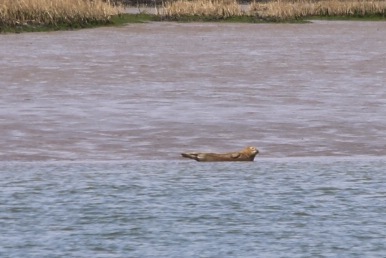
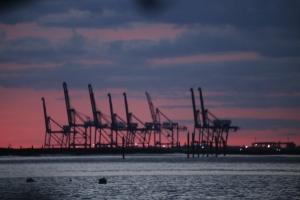 in a really peaceful place but with the wind expected to pick up over the next few days we decide that we will pick up anchor first thing tomorrow and head to Queenborough.
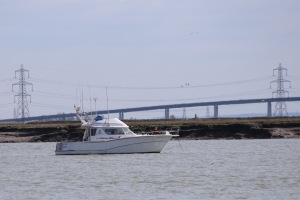 We saw this setup on a Swiss boat in Ramsgate once and decided that this was a good idea for us. It means the whole deploying and retrieving the anchor is extended but we felt the advantages outweighed this disadvantage, although all of this was about to be reviewed. We are at low tide and we know that at places this area is quite shallow at this time. However, we are keen to get away. There is also a North Westerly wind which is quite strong and blowing us towards the shallow centre and southern section. The snubber comes off quite easily and the anchor is on its way up. As the anchor comes up, it comes up to deck height, the wrong way round and so it needs to turn. I lower the anchor again and then allow the twist to free itself. Meanwhile Maria has the boat under power. The anchor turns and comes back up with a quick flick throwing Medway mud all over me and the foredeck. I set about retrieving the anchor float and am getting the ten metres of line in quite well. Unfortunately as Maria is moving forward the float drifts backwards. Maria decides to use the bow thruster for a course correction and despite having nearly all of the line in, the float won’t budge. I call to her to use the bow thruster the other way so that we can free it. She does and the float comes free with some minor damage.
 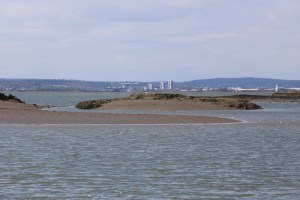 However, the combination of the bow thruster and the wind is moving us to starboard and towards the south of the creek….where the shallows are. Maria calls that we are getting low on depth and we quickly agree to turn hard to port, that was when we lost all motion and now we are stuck. I am quickly back in the cockpit and we discuss our options. This is potentially serious despite that we are five minutes prior to low tide (a good decision) and there will be more water lifting us momentarily. At the same time, the wind is blowing us into the shallows so we could just find ourselves being shifted further and further onto the mud as the water rises. Maria is trying to turn hard to port and using the bowthruster while I am starting to contemplate getting the rib deployed and using our anchor to kedge us off. In what seems like an age but was really just a few minutes, Maria starts to get some movement to port and we are unstuck. We now just need to make sure we don’t go slamming into the other bank, but at least that will be easier to get off 🙂 On reflection, we decide that Mariadz didn’t really run aground on the mud but was dredging a channel for smaller yachts!


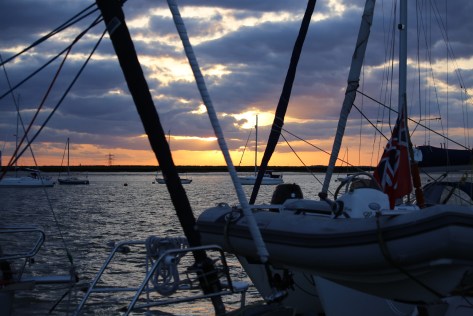 We have explained to Deanne where we are and she gets most of the way before calling in to get the last few details of exactly how to get to us. I describe the pub we went in the other day and explain that if she proceeds along the waterfront there is a car park right in front of the pontoon. After a couple of minutes my directions have apparently put her onto a footpath with bollards at the end! I go to find her…with additional instructions from Maria for some more shopping for the meal – I had forgotten a few things. I arrive at the footpath to find Deanne’s car very close to the road to the car park. Unfortunately, she has to reverse out and go around a park to get access to the road to the car park, sorry!
 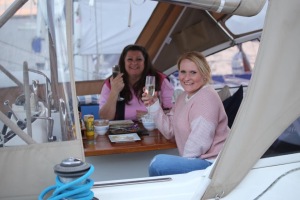 We haven’t seen Deanne for some time and it was nice to catch up and the weather was kind so we spent most of the time in the cockpit area protected from the elements by the cockpit tent. It’s a lovely evening but in common with other times when Maria hasn’t seen a friend for a while, she will not go to bed. As the song has it, “it was only 10, how did it get to 3” and this is my life 🙂 Eventually, the girls stop chatting for long enough to realise it is probably time for bed, especially as Deanne has to collect her daughter early in the morning.
 Deanne surfaces and is over an hour late, oops! Maria cannot lift her head from the pillow. I see Deanne off and settle in the cockpit chilling and catching up. Periodically, I pop down to check on her ladyship, who is clearly broken. She isn’t able to get out of bed until 2pm and then it is tomato juice for quite a while! Maria is a traditional girl though and no Sunday would be complete without a roast dinner and this time it is roast beef. Despite her hangover, Maria excels and dinner is fantastic. We also have a couple of pleasant conversations with some of the locals including being described as “proper sailors” because of the amount of mud on our anchor! That’s one in the eye for those who criticise us for having too big a boat with too many creature comforts.
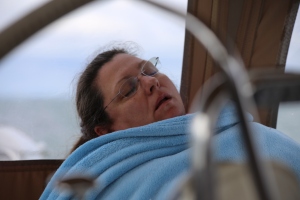 time sleeping while I am on
 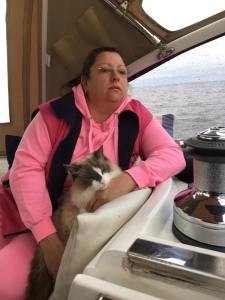 watch. She does allow me to get some rest while she is on watch though. I say she is on watch, I think Clyde probably does as much as she does 🙂 Bonnie doesn’t like to be on the outside and when I lay down to close my eyes for a while she becomes very demanding wanting to be cuddled while I sleep.
 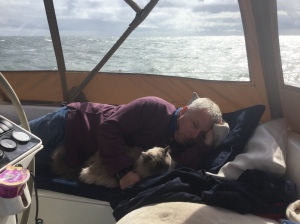 In the end I have to cuddle her, while she headbutts me and I try to rest.
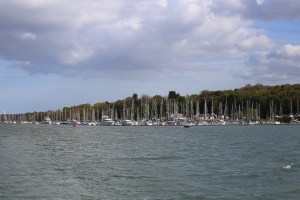 We continue sailing a fair way up the Orwell river before deciding to take the sail in and motor the final leg home. The weather is clearing now and there are some lovely views as you go up the Orwell.
 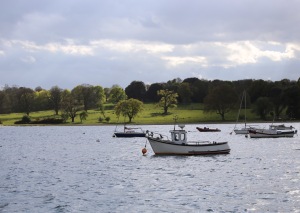 As we proceed up the river we are know that we are now in the last stages before we can tie up.
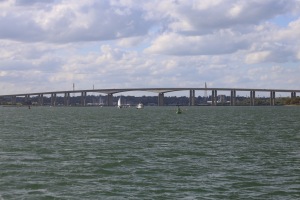 It has felt like a long trip back. As you approach the Orwell Bridge, you need to call up to the lock so that you can get into the locked marina. Maria calls in and we are lucky to be just catching the gates before they are closed. Maria approaches warily because of the quite strong cross wind but handles the boat almost perfectly as this time she did make me jump a few feet rather than the more usual step down to the pontoon.
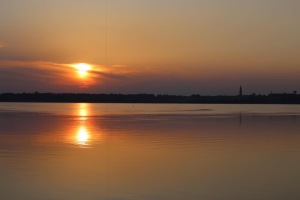 You then get a full day’s sailing on Saturday and probably Sunday before getting back to your home berth. Within 30 minutes of arriving back at your berth the boat is back to being a home, rather than a sailboat, and you settle down for the evening. If you are lucky, Maria has started cooking the roast dinner on the way up the river, and you are ready to eat it by the time you are tied up 🙂 It seems that you get a lot more opportunity to be out there when you live aboard and you are out in the boat for twice as long.
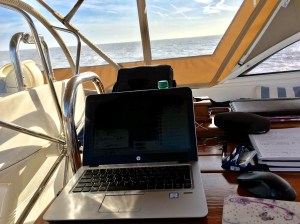 That can get you another night anchored in a quiet spot – with network access obviously! Also working from home in your cockpit in a marina is a pleasure in the spring and summer, even if the reflection of the sun on your laptop screen can be a little tricky.
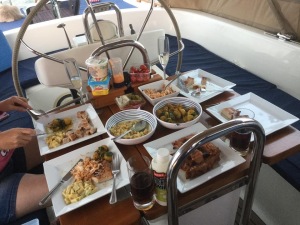 When you live aboard, this seems to happen less (probably a good thing for the liver to be honest). You still see people, have people over for dinner but it doesn’t seem as often when you are only down for the weekends. It probably doesn’t happen much less but because you have more nights on board it doesn’t feel like you are always in company and you get quiet time. The other advantage we have is a pleasant view across the modernised docks which in the summer is fantastic,
 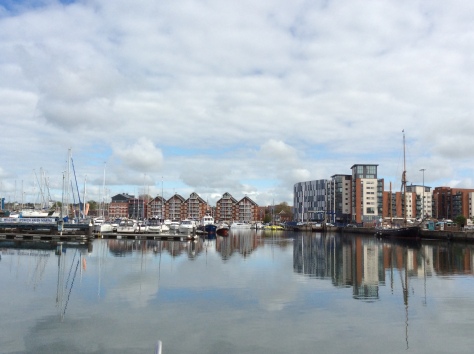 you feel like you could be in the Mediterranean and every weekend feels like a holiday whether you go out or not. I should also mention that we are very lucky with our neighbours, having some really nice people around but then, the other great thing about being a liveaboard….if you don’t like your neighbours move, and keep moving ’til you find some you like or you find somewhere where there aren’t any!
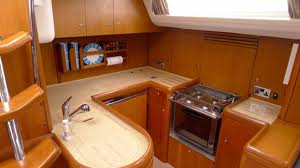 We are having to bite the bullet and come up with a better long term strategy for resolving the issue or we will be haunted with these problems for the rest of our lives. The first step is to perform a pressurisation test to try and see where the leak is located. By excluding parts of the system, such as the compressor, we can ensure that the rest of the pipework for the freezer (and fridge) are working as expected. If this proves that the pipework is in working order then we will change the compressor for a new one with air-cooling then when we come out in the summer for some other work, we can resolve the issues with the water cooling system. Fingers crossed this means that we will have finally solved the refrigeration problem!
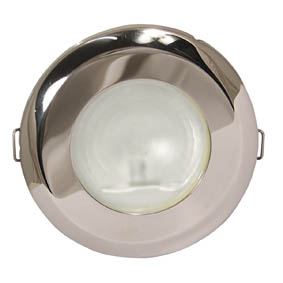 as a halogen replacement from aquafax which I could order through fox’s chandlery in Ipswich. I could then fit my 24V LED replacement bulbs. By replacing all of the lights in our stateroom, I freed up enough spares to replace the faulty lights in other parts of the boat. We now have working lights everywhere which don’t fall out of the headlining and the new ones look pretty good too. Maria seems to like them too….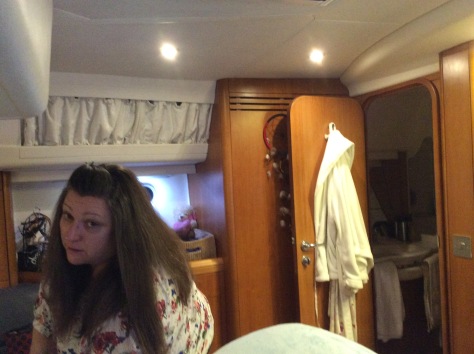
 Mariadz