And so it began. The hunt for a portable ice maker that could make ice quickly and didn’t use much power. Our cruising friends have always said that ice is very unusual on cruising boats and potentially a commodity. I can see the ice maker being on permanently! Very reasonable rates, or you bring the alcohol and we will supply the ice.
When we had the house we had a top loading ice maker that worked a treat but the location we wanted the ice maker was tucked in next to the washing machine in the centre of Mariadz. A top loader would have been awkward so we needed a front loader.
The one we selected was the Hostess Ice Maker which makes ice within fifteen minutes and can produce half a kilo of ice an hour. A little faster than Maria normally uses it for her drinks:)
The best thing is that with the inverter running, it doesn’t use much power at all so perfectly reasonable to run it off batteries, as you would a fridge, and let the solar pump the power back in.
We had a lot of electrical work done a few years ago and as part of this we had some extra 240v sockets added in useful places with usb sockets included. The vast amount of devices that are now chargeable by usb seemed to make this a sensible change.
Unfortunately this year one of the usb units had failed and of course it is the one we use the most. The double socket is a standard model from screwfix but while I wait to source a suitable replacement, it seemed sensible to swap the broken socket for a functional one that we don’t use. This was done on a Sunday and flush with the success of having fixed the windlass remote I switched off the sockets on the board and set about unscrewing the ten screws to swap them over. Half way through this Maria has dished dinner and rather than letting it go cold, I stopped what I was doing. We thought we would watch something on the tv that we had recorded on sky… better switch the sockets on to do that!
No prizes for guessing the idiot next step. Having eaten my gorgeous dinner, I picked up the screwdriver and went to finish the job without remembering to switch off the sockets again. Earth and neutral were fine but as I touched the live there was a loud bang and lots of sparks. Fortunately, the screwdriver was insulated and so I didn’t personally try to conduct the electricity but it was a stupid mistake. Of course all of the trips have gone so I need to reset the power which includes a breaker next to the inverter charger, two shorepower breakers in the lazarette and the shore power itself on the pontoon. It takes some time to remember all the potential breakers that may have gone but eventually the power comes back on. I leave the sockets off so that I can finish the job, hoping that I haven’t damaged anything. After screwing everything together, I can safely switch the sockets back on. I test the two sockets I have swapped and the original faulty one is working but the one I was working on that banged has no power. Maria then notices that another one in the same area is also not working. This is also true for the sockets in the aft cabin but the ones in the galley are working fine. Hmm, that is weird. We seem to have only one 240v circuit so how come half of the sockets no longer work? I spoke to a friend of ours, James on Valentine, who suggested that the short circuit caused by my screwdriver may have caused a problem with one of the sockets and any that are “downstream” of it. Apparently, this is common in older houses where one of the wires downstream effectively acts as a fuse and breaks but how do you find the break? Hopefully it would be into one of the sockets that isn’t working. I decide to start where the problem first occurred, by undoing and reseating the live wire (having switched off the sockets first of course). This had been blackened and I wondered if this was causing a poor connection so I set about cleaning it up and reseating it. By luck rather than good judgement this resolved the problem and all of the sockets were then working. I still have to do the job properly, which will include stripping the wire back a little but that needs to wait for the replacement sockets. Next time, of course, I won’t forget lesson number one: double check that the power is off!
When we bought Mariadz, the anchor windlass had only just been replaced and we laughingly have suggested that this was the only thing that actually worked properly when we got her. So it was with some dismay, that on our first weekend of the 2018 season, we tried to deploy the anchor and got nothing. Fortunately this was immediately traced to the remote as we were able to control the windlass from the now working button on the steering console in the cockpit. However, this would need to be sorted.
Having checked the remote control unit it was clear that one of the pins had broken within the connector, having corroded badly. It wasn’t repairable and actually the buttons on the old controller had started to fail as well as the labelling. Time for a replacement then.
Originally we had a Quick remote control and this seems to have done well so we decided to implement a like for like replacement. The new one has a slightly updated design, and also had the option of a torch, but the rest looked very similar. We decided on the two button control with lamp But as you can see they sent us the six button instead.
I decided I wanted to resolve this issue without the help of my friends, whether fellow boat owners or professionals. At least until I had messed it up, anyway!
The first stage was understanding how the old control unit, itself an eight button, was wired in. Only two buttons worked and on investigation there were three wires required to make this happen. Thankfully, on checking the manual, it appears that the colour of the wires hasn’t changed since this had been fitted so that would make it easier. I decided to do the same, with the slight added complexity of adding in the two extra wires required to support the torch functionality. In retrospect I am thinking that it would be good to connect all of the buttons to the windlass so that if there is a problem within the remote, I have an alternative. I may go back and do that!
The female end of the connector for the remote is mounted on a stainless steel bracket (top right of the picture) and of course the design of this has changed which meant I needed to redrill holes into the plate for the new female connector. The wire then goes around the aft part of the anchor locker to the control box. Having crimped each of the wires and having learnt my lesson from the recent stereo replacement, we were soon ready to go. I am connected up and so go back into the boat to switch on the power. Silence so at least I haven’t done anything stupid! I go to the steering console, let’s make sure that I haven’t broken anything, it works. That’s a good start, at the very least it isn’t worse than when I began. I plug in the remote and go for the buttons. The windlass springs into life and works as expected. I have wired the power for the light to the incoming live but wasn’t sure which negative to use so I test it and that works. I am now feeling very smug as I replace the cover for the box, cable tie the wire for the remote and finally fit the cradle for the remote to the wall of the anchor locker.
One more test…..of course it still works! How many times have you put everything back together after it has been tested and it suddenly stops working. Final test at the steering console and no problems there either. We have a fix.
However, my smugness is short lived after I start the next simple job.
Those that are familiar with our journey will know that music is important to us. One of the first things we did when we got both of our boats was install new stereo systems with Bluetooth, to access music on phones, and a remote control to allow us to control the stereo from anywhere on the boat. Having installed the same head unit, a Sony, on both boats we have been happy with what we have – Music.
So it was disappointing to find that after four years intermittent use, the stereo was resetting itself every five minutes or so.
That has to be sorted. So off to Halfords and look at the stereos…. we’re looking for one with Bluetooth and a remote control, preferably a Sony, a good name and the same as we had. “Nah, none of those sony’s come with a remote control”. Ah, back to the drawing board.
Maria and I go back to the internet, what stereos come with a remote control and the answer is……none of the quality makes but a number of random makes you have never heard of have them. There has to be a reason. And there is. You don’t need a remote anymore because remotes are so last year, this year is the year of the app. Sony, and other manufacturers, do an app that controls the stereo. Now in a car setting that sounds even worse, i can imagine the random passenger in the back that now has complete control of my stereo, including the volume, without my knowledge! Can you imagine the horror of Amanda Jane Furber having access to this technology!!! Dancing Queen from ABBA at top volume, and nothing you can do! 🙂 obviously one thing you can do, “I’m sorry officer, I had to drive off the cliff to stop the music…..thank you for saving me.” And you know, the stereo would have moved on to Waterloo!
Anyway, having established that a remote is no longer required, we return to Halfords to choose a suitable stereo. Stereo selected, a Sony MEX-N6002BD Stereo, we are off home and my job is to fit it.
That is a five minute job…….
Of course the first task is to remove the old stereo which is obviously made very easy by the two metal keys that are apparentlyinserted in either side to pull the old one out. Simple. Remove the plastic surround by pulling hard, with. Little inward pressure and the access slots are revealed. Insert one of the keys and then the other, pull them out together and hey presto.
You have two keys in your hands and a stereo looking at you saying “what?”.
Ok, carefully ease the left key in, hear a click. Same with the right. Ah, now I know what I did wrong. Most importantly pull very gently and together. Easy…. Easy….. you have two keys in your hands and a stereo sit sat in place looking at you saying “what?”. Repeat for at least twenty minutes.
My new stereo is not even out of the box yet, I’m not having that! In these situations the internet is your friend. So let’s spend half an hour watching random videos of Eastern Europeans with broken English, explaining how you can also do this using two large chopping knives before you lose patience.
The problem is that the chassis that holds the stereo, has some side panels that spring in and hold the stereo in place by catching it. This stops it coming out in normal use. So let’s get in there with a flat had screwdriver and lever the smug {expletive deleted} out! That works perfectly 🙂 time for a victory dance!
Then we can pull out the aerial plug and the plug for the power and speakers so we can get the old one out. Get the new one, plug in and job’s a goodun! The aerial connection is fine but even though the functions of power and speakers are exactly the same from the same manufacturer, it’s a different plug! Thank you, sony.
Now the plug has two sets of cables with big black plugs on the end, one for the power and one for the speaker system. I imagine, in a car, these plug into the stereo harness – if you are lucky. On a boat, no chance. However, the advantage of buying the same manufacturer is surely they haven’t changed the colours of the speaker cables over time……. Writing this has made me realise that I haven’t checked that the speakers are connected to the right cables, but surely not..please….. that may be a later blog!
I recall that when we fitted this stereo, we had the same problem and removed the blocks and replaced them with spade connectors for each wire ensuring that there was a good connection with each cable. So I need to do the same for the new setup. Cue 24 hour delay as I go to my toolbox and find all I appear to have left are the female end of these connectors!
The next day, I have acquired more than enough spade connectors, I have been here before. I have my useless crimping tool from the toolbox and I get to work. Firstly, the wire stripper on my tool doesn’t work so I will be doing this the old fashioned away. Fourteen wires later, I have a harness with spade connectors and I’m ready to go.
I decide to swap the harnesses one wire at a time by disconnecting one wire from the old and plugging the same colour in from the new. This looks like spaghetti junction in no time and I am sure I inadvertently do it the wrong way round a couple of times as I get confused. But it is all done soon enough and the old harness drops to the chart table as I disconnect the last wire. What could be simpler, plug it all in, leave the stereo half in the hole just in case and off we go! So plug it all in, power on – excellent, tune the radio and I have stations so the aerial is working ok – excellent :). I also have sound, excellent 🙂 🙂 …..from one speaker, not so excellent! 😦 pull everything out and disconnect. One of the speaker wires has come out of its spade connector. Surely that wouldn’t cause such a big problem but repaired I try again – no difference. Take another look, push in the spade connectors a bit more, put it together again and……nothing at all. Not even power. The power lead has come out of the connector but pushing it back in solves that problem, but still sound is an issue.
At this stage, your mind plays tricks on you. Clearly there could be nothing wrong with my work so maybe as I have pulled the wires to connect them, I have pulled something out further behind the stereo. Better check the old one stick works. Go through the one wire at a time swap to the old harness and plug in the old stereo. Of course the sound is crystal clear on all speakers! Guilty as charged 😦 So let’s take a look at my harness. I decide that I haven’t stripped back the wires enough and so redo them all with new spade connectors. I am particularly careful to make sure that none of these puppies are getting disconnected! The painstaking swap of the harnesses is working fine and we have a successful retest 🙂
Now we all know what happens next. You put the stereo back in the hole properly, fit the fascia surround, switch on the stereo and nothing!
But not today.
This stereo has dual Bluetooth connections which allows you to have one as a source for music and another as a remote control using the songpal, or Sony music centre, app. Installing this and you have full control of the stereo from anywhere on the boat, and off it. Absolutely perfect for a marine setting. Now to get somewhere where we can play our music loud!
A final thought, there are people out there who wonder why I don’t do everything myself! When something this simple takes this long, maybe there is justification…. nah, I enjoyed it and every day is a school day, I have learned some useful things through the experience.
So on the back of our first weekend, the weather held on and we decided that another jaunt down river would be the perfect way to recover from a hard week of work. Maria was working from home on the Friday and was able to get the boat prepped and I finished early so that I could get home and we could get on our way in time to spend a couple of nights on anchor before returning in perfect wind conditions early on Sunday. In fact for mos of the weekend, the wind is blowing up to 20knots from the South. Not a concern for us at anchor or when we are sailing, we have done both in much worse than that.
The anchoring would require the hand signal approach we had developed previously since, although I had acquired the replacement remote for the windlass, I would not risk fitting it while the anchor was down in case I did something to stop the other control or windlass from working. That would be bad so I will fit it when we have a little time in harbour. That way if I mess it up, I can get it sorted without having to come up with a way of raising the anchor by hand (or winch)
Our plan worked well to start off. Maria had done well to get the boat ready, got bait from the fishing tackle shop and collected me from the station to save us another ten minutes. Engine started and Maria is calling into the lock to request a lock out. We’re in luck, we are catching the end of freeflow which means the water is at the same level as the river and we can go straight through the lock, as long as the light is green.
Heading down river is fine although we are taking it in turns to do some work, whether taking calls, processing emails or working on our laptops. It’s very quiet down the river as everyone else is starting to eat out of work. The wind is a little close on the nose so we decide to motor down so that we can be sure to arrive at our chosen anchoring spot in good time. This will give us the opportunity to relax and enjoy the last of the evening before the sun goes down.
As we approach Felixstowe, the wind blows up a little more and is a bit more than forecast. We discuss our plans and consider an alternative of spending the night on halfpenny pier in Harwich. This is well protected from a southerly wind. As we round the corner of Felixstowe we approach the confluence of the Orwell and the Stour. There are only two boats on the outer part of the pier which normally means that there is space. However the motorboat in particular looks something like 60 feet and it is right in the middle of the western half of the pier. We call into the excellent harbourmaster on their mobile phone. It is clear as we get close that even moving the two boats around won’t give a great amount of space for Mariadz who can take up 60 feet herself. The harbourmaster suggests we could raft up to the motorboat but at twenty tonnes we are concerned that it will not be a comfortable night for any of us. Also we imagine that they would get quite upset at someone rafting up. We revert to plan A and head down the river Stour to one of our chosen anchorages. In the Stour we have a few options, we can anchor near the top of the river opposite Harwich Parkeston Quay, we can return to the Holbrook Bay area and anchor where we were the previous weekend or slightly further up where we traditionally anchor near the cardinal buoy. We decide to anchor near where we were last weekend where the water is a little deeper. With our new system and Maria controlling the anchor, we are anchored in no time with anchor float showing where we are, snubbers protecting the windlass from damage and the anchor ball flying.
At the time it is wind against tide and when the wind is in the opposite direction to the flow of the water, the chop is a little worse. We are hardly moving but the water is not smooth. We know we are comfortably anchored for the night and settle down for a healthy dinner of steak and cooked vegetables, and by cooked vegetables I don’t mean potatoes cut into long fingers and deep fried!
In the summer and especially at anchor, we often stay in the cockpit watching the world go by, chatting and listening to music. The cats are settled and like being close as they sleep. We are all really relaxed. With the built in stereo system still temporarily unavailable, see later blog, we are using the amazon echo to play the music. This has the added advantage of being voice controlled :). It’s a lovely evening and we may have enjoyed a couple of drinks and maybe even a little dance after it got dark but thankfully it is not too late a night since we are both shattered from the working week. Just before dark, one of the scout training yachts decides to anchor near to us, actually in our traditional spot near to the cardinal buoy. They have a reputation of bouncing off people but we haven’t personally experienced it and the skippers seem very nice when you meet them. Apparently, on this occasion they were concerned that they may have disturbed our tranquility in the evening. They clearly don’t know Mariadz at all 🙂
The next morning there is some trepidation as we approach the scales but we decide to weigh in and survey the damage since we are both meant to be dieting! We are both pleasantly surprised to see our weight has gone down a lot over the last few days. At least now we know what we need to do…. 🙂
It is not too late when’s we get up, and it is a beautiful day with quite a bit of wind. In short perfect sailing conditions. So Mariadz in the spirit of rebellion settles down for a chill day. Maria decides that today is the day she is going to catch our dinner. Now I don’t think this sounds too difficult, surely you go to the freezer, pick out the packet, put it on the side – dinner caught! But apparently, Maria has different ideas. She has gone to the freezer as I thought but she gets out the squid and puts it next to the worms, she is fishing for supper! Now with our standard amount of success in this area, it is certain that we are going to starve but it is ok since we have food available on the “off chance” Maria is unsuccessful.
It takes Maria some time to set up the two rods but she is pottering around having a great time and looking relaxed without a care in the world so I am not going to complain. It’s not as if she’s going to catch anything so it will be a nice relaxing day!
As the afternoon progresses, Maria has lost some bait so something is going on under the surface of the water. And then suddenly, the rod moves, and Maria gets excited…. she heads over to the port side rod and wow, she has only gone and caught something. It is time for Maria’s caught a fish song! Now the interesting thing about Maria’s “I caught a fish” song is that apart from the “I have caught a fish” chorus, every other lyric in the song starts with the letter “f” and is a word normally deleted in polite company. Unfortunately I don’t have video evidence, not that I could show until after the watershed! But it’s ok, because she follows up this crowd favourite with a haunting second song, now this one I do have on video!
She’s caught a whiting and is a very happy and proud girl. The rod is ready to go again and she is on a roll. Maria catches a couple more smaller fish but decides to put these back. Now normally when they are a little smaller, Maria struggles to remove the hook and fatally damages the fish. Sometimes it is still moving and she hopefully returns it to the water where it lays on the surface until some passing seagull puts it out of its misery. More recently I have been asked to despatch them. She is on a roll though and really enjoying herself, work is something that effects other people. That’s how a weekend should be. Then late on, Maria has more luck! This time it’s a larger sea bass, and we have video evidence…..
Clearly I was very confident about Maria’s prowess with a fishing rod and not at all surprised so we had the meat for a BBQ already out on the side, so no fish supper tonight! Another relaxed evening chatting and, it has to be said, that since Maria’s weight loss, dancing has featured a lot again. She’s happy 🙂
The next morning we are to return to Ipswich and it is a glorious day: bright sunshine, and a southerly wind of about 20 knots. Perfect wind to get Mariadz going and we can have a nice relaxed sail home. The boat is ready to go and we get the anchor up in the now familiar way with Maria controlling the windlass from my instructions. To my knowledge this is the only time Maria has ever obeyed my instructions 🙂
We have decided that we will sail and drift all the way home today, there is no rush and although we have a few chores we want to get done, as long as we are back before 3pm all is fine. It’s a day for all three sails as the reasonably steady wind comes across our decks from the starboard side. The staysail is deployed first and comes out easily, the lubrication the other week has done a great job. Next for the main. This is normally a one person job, keeping an eye on the sail as the winch pulls it out. The sound of the winch is always a good tell-tale for how it is coming out, as the winch starts to struggle you normally pull on the outhaul to ease it. We have done this consistently for four years while we have owned the boat. That said, when we first got her we had a couple of mild sail jams as the main was furled into the mast. However, we soon found a technique for avoiding these by keeping the tension on the main as it furled. This and the boom being horizontal stopped any creases in the sail which could then cause a jam. As I say we have had four years of jam-free sailing so the technique seems to work. Until today! The sail is a third out when it folds against itself and jams solid! I notice that we have a crease and the sail has stopped coming out from the mast. Not good. The sail will not come out and will not go back in again. The problem area is too high to reach so I will have to use a combination of pull from the outhaul, jiggling from the furling mechanism and leverage from pulling down on the sail occasionally to see if I can shift the fold that is jamming the mechanism. Initial results are not good but I persevere with the sail under tension, trying to adjust the angle of attack on the crease. There is movement but there is still a crease at the top of the sail. The problem area is moving up the mast so I decide that with the wind veering slightly behind a slight change of course will allow me to safely deploy the whole sail and remove the crease once and for all. It is slowly coming out just using sail tension and the furler now and Maria is keeping a watchful eye as well as keeping an eye on our course and other water users.
We’re clear and I even bring in a little of the main just to check that the fold doesn’t reappear. It’s all good. So we then turn our attention to the head sail and with roughly half of these flying we are sailing comfortably.
But the episode of the sail jam makes you think, what would we have done if we hadn’t been able to clear the jam. The answer lies in my trusty red rope with a loop in one end. This rope is the equivalent of James Milner, or Fabian Delph, for those who like their football. It’s a do anything, equally well, rope. It has acted as a harness for an outboard, a replacement main sheet holding the boom in place, a dog lead as well as any number of uses where a short strong line was necessary. Today, as it has previously, it would have been a sail tie. We would have loosened off the outhaul, trusty red line would then have pulled all of the offending sail into the mast and with a couple of wraps would have held the sail in place with little showing. But all of that isn’t necessary today and we can enjoy our sail up the Stour. As we get up towards Harwich the wind gets a little stronger and to be fair at this stage we would normally have reefed all of the sails to reduce the power from the wind driving Mariadz. We generally reef the sails a lot and early, Mariadz is more than capable of handling that much power, although she sails more comfortably and faster when nice and steady rather than heavily heeled.
We make the turn at Felixstowe towards Ipswich with the wind directly behind us. This disappoints Clyde who was really enjoying the sea air.
There are quite a few larger yachts behind us in the forty something range. Now we are very clearly cruising sailors, we have never raced a yacht or any sailing vessel competitively and to be fair I don’t think we have anything like the sailing skills to do this well. However that does mean that Maria is not competitive, and maybe me too! Although we are not racing, whenever there are two boats sailing Ona river that are reasonably well matched a race shall ensue. Maria’s view is very similar to Gandalf in Lord of the Rings, when faced with an army of Orcs – “you shall not pass!”. This is normally accompanied by a soundtrack of “Ad, Ad…” any time someone gains on us. Mariadz is not the fastest boat but of course being a little longer than a number of other boats helps to keep her ahead. Of course, if the worst comes to the worst, we can always switch on the iron sail, with its water free exhaust, meaning no-one would know…. not that we would ever do that!
The trip up river is relaxing but the wind has veered a little to the West which means it is slightly in our faces as we get to the top of the river. It is also intermittent which is caused by the the hills and trees on the banks which funnel the wind, giving changes of wind direction, spots where it is very blowy and other spots where it seems still. This presents some challenges for us trying to keep on course up the winding river when we are tight to the wind. As we go past Wolverstone, conditions and our angle to the wind improve and we are clear now until the Orwell bridge where we must call into the lock, take the sails down and prepare for mooring.
We haven’t seen many other yachts for a while, obviously laying in a trail of dust behind us! But up ahead, we have Lister Light again, that’s two weekends on the trot. They are drifting nicely down river having a leisurely sail with Sally at the helm. To be fair I really wanted to pass them on the “wrong” side so we could get a better lit picture but at least the got a good one of us just before we took the sails down.
Now clearly , we are very careful putting the mainsail away and are even more vigilant in checking for folds as the sail goes away. It seems to curl away fine and so we breath a sigh of relief although the true test will be when we next take the sail out! The lock is easy and soon we are in our berth, tied up nicely (that’s Mariadz is tied up rather than Maria, by the way) and thinking about dinner. Hang on, don’t we have two gorgeous fish we can eat….straight on the BBQ in foil with our own Italian olive oil, lemon and vegetables.
Accompanied with fish skewers and a salad it is very healthy and more than we can eat. Please ignore the optical illusion of a cheeky glass of white!
so the end of a cracking, relaxing weekend. The best part of it? The fact that nothing new had broken…but I still haven’t fixed all the breakages from the last weekend away so it’s a small mercy.
It is unbelievable that we are already in the middle of April and there hasn’t been a single good day for sailing! Normally we would have had a few, potentially chilly, eeekends by now. I remember from when I played a lot of cricket you would always get some unseasonal warm days early in the season, normally just before a May was rained off completely though.
In previous years we have gone a reasonable distance too especially at Easter, maybe to Ramsgate or across the channel. Going to France is more tricky now because then the cats couldn’t come.
So, at last, our sailing season has started even though it is really late this year. The weather for this weekend was meant to be cool with a very light Southerly wind so not much to get excited about sailing-wise but a great opportunity to get out, check the boat is working well and have some chill time. So we decided to head down river and anchor in the River Stour that is the border between Essex and Suffolk,
We were hoping to get away early on a Friday but unfortunately I arrived back too late from work so we couldn’t sail down to Harwich to see off our friends Lars and Laura on Sweet Dream, a beautiful Island Packet, as they set off to Norway before starting a trip round the world in January 2019. However, there is more than one way to skin a cat………, sorry Clyde! Since we hadn’t had the opportunity to properly say farewell, we decided to drive to Harwich and meet them for their last supper before they left at the Alma. The Alma is a lovely pub that sells very fresh lobster and beautiful cuts of beef, all listed on a blackboard, when it’s gone, it’s gone! The food as always was really nice. We had a cracking evening chatting which was capped off beautifully with a quick dance to a live band – Lars and Laura know how to make an exit. The obligatory exchange of a few presents including our crew t-shirts for our friends. In the picture is their very own “Anne Plummer”, she’s a very popular artist, don’t you know!
After a good nights rest, we decide to be up early to get our chores done prior to going out on the boat. We have refilled with water and fuel as well as running all of our pre-trip checks. One of the jobs since it was our first trip of the year was to go around all of the blocks lubricating them. Last year we noticed that there was a lot of power required to bring in the head and staysail. This year I have lubricated everything I can reach including all of the guides for the furling line that runs it from the bow to the stern. Let’s see if that helps. So Mariadz is well lubricated, no change there, and we are ready to go. We have timed going through the lock just before high tide which means that we can go through the lock without stopping, with permission of course and only on the green light.
The engine hasn’t had a proper run for six months or so and is slightly smokey, we will need to keep an eye on it but I suspect that this just needs a good run.
At last, after six months of confinement to Ipswich, we are out and heading down the river and it is a pleasant daynot much wind but nice to be out. The trip down the Orwell is uneventful and we make the turn into the Stour. Now what little wind we have is right on the beam and so we decide to get all of the sails out to check that they are ok. Everything comes out fine but we are against the tide with little wind and so keep the engine running to ensure we can make a sensible pace. Of course the key will be how they go away and whether I need to use all my strength!
The cats are incredibly comfortable and also grateful that we have got them such comfortable new seating in the cockpit. This of course means that the two seating areas that we had set up seem to be feline spots. It does amaze us though how comfortable the cats are on the boat. No matter what the conditions, they seem happy and relaxed. When it is bad they stay quite close to us for reassurance but when it is a nice day like today they stretch lazily and chill. We have a number of friends who have commented that they don’t necessarily believe in reincarnation but if they did, and could choose, they would like to return as Maria’s cat – spoilt isn’t the word!
After an hour of motor sailing, we are approaching our anchorage at Holbrook on the North side of the river under the watchful eye of the magnificent Royal Hospital School. It is time to get the sails away so fingers crossed. The smaller staysail flies back in with relatively little effort but the real test will be the much larger headsail. The difference lubrication makes is amazing, the sails go back quite easily.
So the sails are away and we can now think about anchoring. Maria selects the spot as I am forward preparing the anchor, anchor float, snubber line and the anchor ball. The anchor float that tells us where the anchor is located is fixed with its ten metre line to the anchor itself. This has the added advantage of acting as a trip line if the anchor gets fouled. Maria is pretty much ready so I decide to ease the anchor off it’s stowage using the wired remote. Nothing, not even a click of a solenoid. Hmmm. I know I have flicked the switch on for the windlass down on the electricity panel -that is normally what I have done wrong when something doesn’t work! I immediately go back to Maria and explain the situation and also to check the anchor controls at the steering position – let’s at least try and isolate the problem. The issue I have here is that when we got the boat, as mentioned previously, pretty much everything needed fixing….. except the windlass that brings the anchor chain in. That had been replaced at great expense just before we got her! So with some trepidation I press the button on the steering column and the windlass springs to life and the anchor starts to deploy. Huge sigh of relief, it’s “only” a remote that I need to replace! However, we like to deploy the anchor in stages so I need to be back on the bow while we do this. We quickly agree some obvious hand signals for up, down and stop. I think Maria has some hand signals of her own planned too!
It is quite high tide and we are in a nice spot with about seven metres of water so we will be perfectly safe even when the tide is out. We start deploying the heavy rocna anchor and our the chain in ten metre increments letting the boat settle after each one. This helps with getting the anchor set and also stops piling a lot of chain on top of itself is a cone or on top of the anchor. Despite it not expecting to be windy, we deploy thirty metres of chain so we can be confident that Mariadz is going nowhere. As we get to thirty metres I put a hook attached to the middle of our snubber line through a link of the chain and tie it off on both bow cleats. This takes any pressure off the windlass hopefully meaning we won’t have to replace it in the future! It also balances the load across both bow cleats and means that the anchor chain doesn’t rub against the hull as we get pulled around the anchor. Lots of great reasons to do that then. Letting a little more chain takes the tension off the windlass. I can then tie, three further snubbers onto the chain which can take the pressure even if the hook falls off the chain. Probably a little too much redundancy but you just get into the habit. The final job is to raise the anchor ball that tells everyone during the day that we are anchored. This is attached half way up a spinnaker line run down to the deck, we hoist it about ten feet up so that it is easily seen. Obviously at night the anchor light at the top of the mast is illuminated so that people know where we are. These signs usually work very well and people know where you are and keep clear. Unless of course they are a blue hulled scouts boat, in which case you need to switch on the spreader spotlights and everything else you have got before they hit you!
Mariadz is settled nicely, there is a very light breeze and a gentle soothing movement of the boat, it’s mid afternoon. We decide to stay up in the cockpit as Maria prepares the feast of fish which is our lunch and dinner, or so we thought. As you can see from the picture, Maria has a little furry friend. Now Clyde is rather partial to prawns and demands them as an almost daily treat. When Maria brought the platter up, Clyde stirred. Ah, treat time and wow what a great selection. What shall I have first mummy? Maria of course obliges and starts feeding him lobster. LOBSTER! Is there another word that is more than spoilt… hmm a very lucky cat.
Anyway, let’s just talk about the weather…..when the weather is good on a yacht, there is no better place. In the winter we are cooped up down below catching up on films and box sets. In the summer, the TV is rarely on and we sit up in the cockpit listening to music. This is the first time that we have had the opportunity to use the cockpit properly with the cushions that James has made us, one word – excellent.
So the music is playing as we chat.
Today is the day of the grand national though and the one day a year when Maria likes to gamble – except for the lottery and the annual trip to the casino. We choose roughly nautical and lifestyle names for the horses and we have our four. Last year Maria won so she is relaxed and confident. Obviously our interest in the race is over by the first circuit and as the winner wins by a small margin, Maria announces that she was going to choose that one….that’ll be my fault then!
It’s getting to the end of the day and we have been anchored for over six hours, usually at this stage the electrics, such as the fridge and freezer, have started to take a toll on the batteries but not tonight. With our new solar power set up our batteries are at 100% as the sun goes down – we like that!
The sun is going down and as we look down the river we see lister Light with the young Thompson family on board. yeah that ones for you Sally 🙂 you owe us. So our neighbours who are 250 metres away from us in Ipswich are the same distance from us in the stour. But wow doesn’t their boat look great in that light.
While the Thompson’s have their own great evening, we are settled down listening to music. It’s a lovely evening with a variety of music and we go to bed at a reasonable time. Of course with Maria that is any time before 4am – but it was early even by these standards!
It’s not an early start, which gives an idea of how late the previous night was, but as we get up we find that there is a thick fog with 50-100 metres visibility. So we will need to put the fog lights on and continue to drive at 70+ miles an hour! Not quite.
A very thick fog means it is a day for AIS and radar. AIS is great, it tells you the course and speed of larger ships, whilst also telling you how close how close they will get to you. We have an AIS transponder so we are sharing the same information with everyone else, if they are looking out for it, going through a major port it does gives some reassurance that we are suddenlyWe leave it till noon to go so that there is a chance to burn off and it does seem to clear.
Until we get to Felixstowe. Pea souper. Fifty metres visibility with no idea what big ships are moving. Radar is helping and ais is also sounding but the hardest is finding the buoys so that we know where we are – thankfully we know this area quite well.
But of course this could be about to to get much worse in the Orwell where the vessels aren’t very big with no AIS transponder or a big radar shadow. This is going to be very stressful. But as we move away the fog lifts and we now have a few hundred metres of visibility before it lifts again and we can see up to a mile. Stress over.
The return journey is all under power and the engine is a lot happier now, not much smoke for a start. Mariadz has a split exhaust which means we still get people frantically trying to stop us at the dock because of the lack of water coming out of the exhaust. It does help when we motorsail too when people are amazed at how fast a larger yacht can go with so little wind. 🙂
We come up the river and arrive at the lock gates. While we wait for the water levels to equalise, we meet a couple with a new to them boat who will be staying at Ipswich. We recommend b pontoon – best, beautiful and boozy! All the “B”s.
Coming in and Maria has everything under control. I have set up dual lines on the bow prior to entering the lock so I have swapped over the mid line, the first line we generally get ashore. Linda our very helpful neighbour comes over to give us a hand and takes the mid line for me and I glance aft to notice that the stern cleat is bare, I haven’t moved that line. What a wally! I’m sure there would have been panic in our first few years of sailing but I tell Maria the situation, not that she can do anything about it and quickly swap the line over. Lasso the cleat from th deck of Mariadz and we are back where we should have been.
We get into our routine of adjusting lines and getting the power on and we are all tied up adjacent to our steps. The other boat we have just seen has been put on b pontoon and so we give them a hand before settling down for food.
The weather has brightened up noticeably and so it must be bbq time. Obviously that changes the weather and of course it starts to rain but not before I get the rail mount fitted and the bbq fitted. Really convenient, now if only the food would cook quicker!
So a weekend away and as is common on a boat, a list of maintenance jobs: stereo needs replacing, the usb charger in saloon has stopped working and the remote for windlass. Ah sailing life, going to beautiful places to fix your boat!
Mariadz had the same cockpit cushions for seventeen years and if we are honest they were a little “tired” and not as comfortable as they could be. We knew before we left on our big trip we would need to sort these out and Maria has also been keen to remove any semblance of the old, dated dark blue from the boat so she would be changing the colour at the same time.
Having reviewed a number of other people’s designs and after four years of our own use, we had a fair idea of what we wanted. A friend, James, has been doing canvas and cushion work around Ipswich and offered to help us. It was never going to be a simple job! Hopefully he doesn’t have too many regrets.
Looking at other centre cockpits, a number of people have seat cushions with a back that goes around the combing of the cockpit. This does look good but we felt although great as a seating area, it restricted us when using the cockpit as an entrance. It would be difficult to lift out the seat if it was covered by a back. This would mean that the cushions get stood on by outside dirty shoes. So we decided to mix it up.
The design exercise was quite complex since we knew how the area was likely to be used. Just looking at the access areas for the cockpit made that clear. We have two side entrances and also access at the aft end of the cockpit. During the winter, most people come in via the aft entrance. We were keen to make sure that people didn’t stand on the seating, irrespective of the entrance and so a number of folding sections were incorporated so that these could be lifted to provide a step and to stop the cushions being spoilt. These folds were two at the aft area of the cockpit and one on each side. James incorporated a nice way of fixing these with Velcro underneath the seat and a flap which meant that the join was very strong and invisible when the seat was setup – much better than two cushions butted up to each other with Velcro on the edges. This works for all four entrances into the cockpit.
When we are sailing, our normal position is under the spray hood. When I say “our”, I do mean Maria, Bonnie, Clyde and myself, since the cats like to be on deck when we sail. This area has full backs to make it comfortable but these were a real headache to get right with the curve of the cockpit and the shape of the back that cushions need to rest against. All other areas have a selection of loose cushions, in a couple of contrasting colours, that can be used for the backs. This gives flexibility and also means that when Maria sits behind the wheel steering with her feet, she is surrounded by comfy cushions.
So the design is finalised but colour is also important with cushions since a dark colour absorbs too much heat meaning you can’t sit on them comfortably and too light a colour attracts a lot of dirt and always looks mucky. Hopefully we have struck a nice balance with a shade of tan that matches the colour themes on the boat but hopefully won’t be too hot. If we ever get some decent weather in the UK, we will know for sure. Our final aesthetic feature was to have all of the cushions piped in a different colour to provide detailing and a contrast. This worked really well. These two colours reversed gave us our contrast cushions.
Maria likes a good sing song and will often be heard belting out Whitney as well as forcing me to sing to Islands in the Stream with my own “Dolly”. Sometimes she is brilliant and other times not quite at the top of her game. In the early days of our relationship, I probably didn’t go into this wholehearted. There was some recognition that I wasn’t the best singer! But now I give it my best shot, and I apologise for any bleeding ears brought on by my enthusiasm.
A little while ago, Maria requested a karaoke set up so that she could enjoy herself anywhere – I will make no judgements on whether anyone else would be enjoying themselves! This allows us to set up on beaches, in fields, wherever….as long as we aren’t disturbing anyone. This has proved really useful since it allows us to subject our friends to our singing even if there is no 240V power!
On a couple of occasions, I have beeen asked what to get so below is the definitive list of karaoke gear for the true Mariadz experience.
StreetCube – good speaker beloved by buskers the world over with three inputs and able to run off batteries or mains power
Wireless Microphone – one of the few that I could find that had a wireless microphone and a wireless base station. You need this if the diva is going to be able to do her dance moves although she would probably prefer the whole Madonna headset!
ipad – other devices are available…. basically something to play the music with a phono output that can plug into the cube
Wired 3.5mm long connector or Bluetooth Receiver which the iPad can link to and remove a trip hazard
a selection of music on the iPad which can be standard karaoke or original songs with lyrics, we find the original songs work better for getting people who are not karaoke pros to get up
a good bag, we use a dolphin sails bag made from old sails. Strong and water repellent
finally a lot of batteries!
This is allows you to run the full karaoke setup. And don’t forget the camera! One final word of warning though, don’t video yourselves doing Islands in the Stream and put it on YouTube- warner music will claim copyright infringement even when it is clearly your imperfect voices on the soundtrack!
We’re in the middle of the hardest winter since we moved onto the boat and now we have been hit by the Beast from the East. Now I have to say that my first thought on this was that it was a woman that we met in a Colchester night club, that I needed Maria to protect me from! But no, apparently, it is from Siberia, freezing cold and dumps a load of rubbish on you. So completely different then!
We often get asked how we survive winters on the boat, surely we get cold! The answer has always been that we have heating, however, this winter is sorely testing our heating setup.
On Mariadz, we have three reverse cycle air conditioning units that pump out heat backed up by a cheap and cheerful 2kW heater in the bedroom and a posh Dyson heater in the saloon. From a heat generation perspective, that is a lot, but it also requires a lot of power to run them all. Each of the aircon units takes 4-5A on average and the two heaters need 8A although one can be set to half that. So if we wanted everything on, we would be using 31A which is nothing in a domestic setup but a lot for a marina where our current is limited to 16A. If you go over the 16A shore power limit, a trip goes on the pontoon, which will result in a lovely stroll in sub zero temperatures through the snow. Definitely not something to do if you were in the shower when it tripped! Of course there are other loads too which further reduce the availability for heating, such as the hot water and lighting, so it is a balancing act with the power. We are in a slightly better situation with our large domestic battery bank and inverter setup which can top up the shorepower but this drains the batteries which then need recharging requiring available power. So the batteries will loan you power but you have to pay it back. However, the inverter does stop the tripping on the pontoon so no cold walks!
Reverse cycle air conditioning isn’t the most efficient system either and I suspect the fact that the water in the marina is frozen in places is not helping. So we use a combination of a couple of air con units boosted from time to time by the Dyson heater. The other useful item for our comfort is the heated blanket on our bed which has individual controls for each side. This goes on early evening, makes the bed warm for bedtime and keeps it lovely and warm all night.
With the battery monitoring we have onboard we are able to play the balancing game quite well but you wouldn’t describe the boat as tropical! So we are not quite as toasty as we have been in the past, when it hasn’t been quite so Siberian outside. One thing that surprisingly seems to make a difference is closing the curtains in the saloon and bedroom, the temperature is noticeably higher.
A recent acquisition which is helping us has been a small supply of smart switches. These work really well and allow some items to be controlled by timer or an app on the phone. It’s really nice to put the heater on in our bedroom half an hour before I get up. It can also be voice controlled by Maria’s Amazon Echo – don’t ask – she had to have it and loves it. It will be interesting to see how the home technology can be deployed on a boat in the future.
Having recently returned from skiing, we’re accustomed to a bit of snow and the few inches we got in the first few days was less than the light snow we had just before leaving Austria. In Austria, that didn’t take much effort to clear but in the UK the story is very different. Fortunately we have the land cruiser to drive around but the roads are terrible around the marina and in Ipswich itself. The pontoons will of course get more treacherous as the snow melts and refreezes overnight. Our snow boots will be tested then.
All of this reinforces Maria’s commitment to only be in warm places, if the butter is starting to solidify then we are obviously too far away from the equator. Maria is definitely counting down the winters before she can go!
So it’s the beginning of March, officially the start of spring, as I recall. Spring is meant to be nice and warm, it is when you start to think about going out in the boat again and going sailing, hmm maybe a few weeks yet!
As always with a boat, there were a few niggly things that we need to get done before the start of the season. The first of these is the throttle on Mariadz. This is located on the steering binnacle next to the forward facing radar control but Maria has always struggled when the engine is in gear. Out of gear, the throttle is smooth and works a treat, having changed the throttle cable some years ago, but in gear it is incredibly stiff and you find yourself using excessive force, going too high on the revs and then having to pull back to where you wanted to be. This is something we wanted to have fixed before starting a new season.
We had spoken to Lindsay at Seapower about this some time ago and there was concern that we may need to replace the entire throttle control with a completely new and very different unit. The first job though was to check that we didn’t have issues with the throttle cable and particularly the gear cable that allows you to select between forward, neutral and astern. This was one of the jobs arranged for while we were away skiing in Austria. On our return from holiday, Maria was planning to turn the boat around so she was bows-to the pontoon. This is our preferred wat round and gives her a nice view over the stern to Ipswich Centre. It provided us an opportunity to test the new setup. After the work was done, there was a complete lack of swearing when Maria was turning the boat around so I think we have a result!
The second job that had been outstanding for a while were the calorifier pipes for the generator. These move the heat from the generator cooling system into the hot water tank, thereby heating up the hot water and also cooling the engine coolant. We have this setup from the main engine but there were a couple of reasons for getting the more complex setup that supported twin coolant inputs to the hot water tank. Firstly, we have a source of heat in the generator coolant which we would be wasting, I don’t like that. Secondly, we like to have redundancy in our systems so there is no single point of failure. We can now heat water electrically on the shorepower (or generator), electrically using the inverter charger and the batteries (very sparingly), from the engine coolant and now from the generator coolant. Surely one of those must work at any given point in time? If not I have a solar bag, that heats water from the sun, on deck!
There was one consideration regarding this which related to the use of the generator. It is important to work the generator when it is turned on. The last generator was 11.5kW and had been continually used at very low loads which killed it. It was scrap after 700 hours. Although in retrospect we could have rebuilt it, the advice at the time was not to and hopefully we will have none of the issues that the last owners had with a flaky generator. To avoid this problem, we took the decision to buy a generator with a lower power output (7kW) so that we were always using a high proportion of its capacity. In the few instances where we need more than this for a very short period, the inverter charger could pull from the batteries but this was likely to be for seconds and so wouldn’t impact the batteries too much.
The electrical part of the hot water system requires 1kW which is a good start load for the generator, especially when you add battery chargers and aircon units. So by using the pipes and removing that element of the load, I may make my job of loading the generator harder. I guess I can always switch off the heated water element if I want!
Lindsay had to do some design work with the Onan generator to get this setup to work well but it is now a very neat installation. Unfortunately as part of the testing of the new setup, Lindsay discovered that five vanes from the impeller, that drives the cold water around the engine, had broken. This has been in place exactly two years and had around 70 hours of use so a little worrying. Of course a broken impeller is not good news and we are grateful that the generator hadn’t overheated because of the lack of water flowing through the system. We are now investigating what has happened but I understand that we may need to be more careful at checking the generator when it hasn’t been used for a little while. I suspect more frequent changes of impeller will be required too.
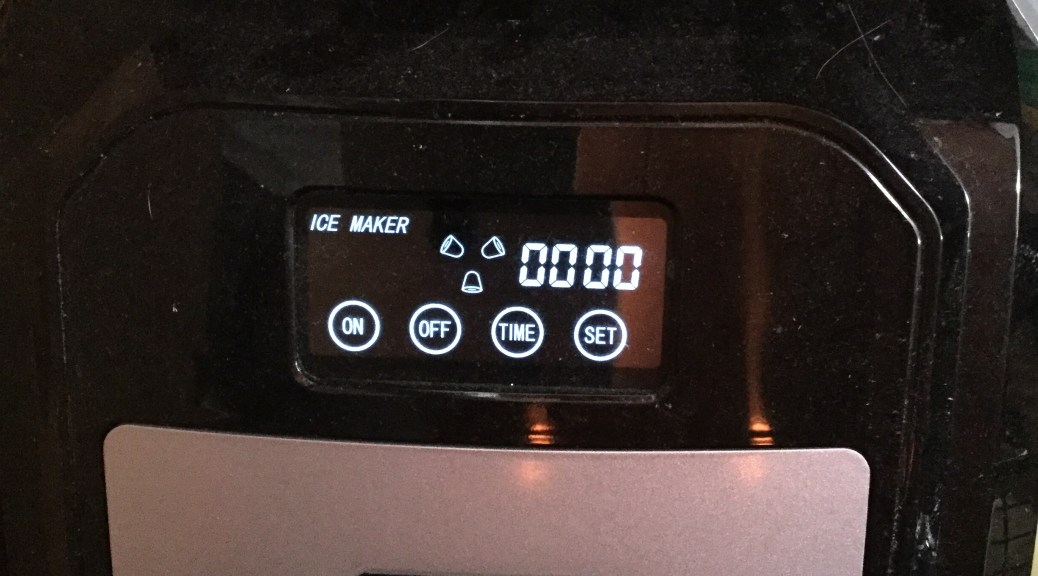
 The one we selected was the Hostess Ice Maker
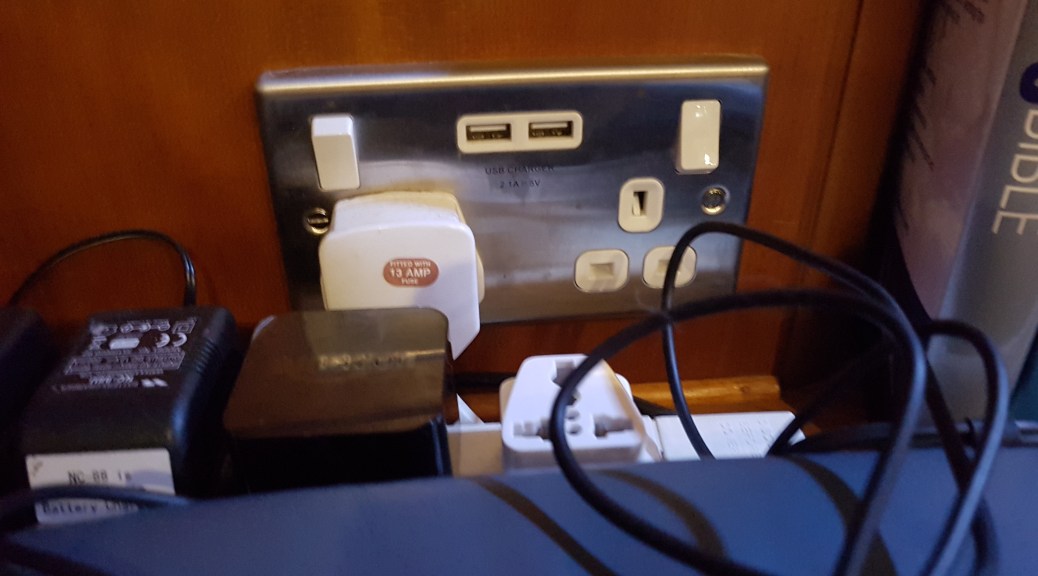
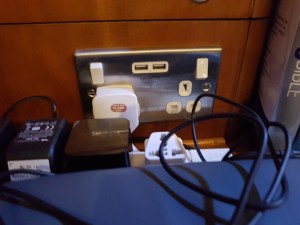 The double socket is a standard model from screwfix but while I wait to source a suitable replacement, it seemed sensible to swap the broken socket for a functional one that we don’t use. This was done on a Sunday and flush with the success of having fixed the windlass remote I switched off the sockets on the board and set about unscrewing the ten screws to swap them over. Half way through this Maria has dished dinner and rather than letting it go cold, I stopped what I was doing. We thought we would watch something on the tv that we had recorded on sky… better switch the sockets on to do that!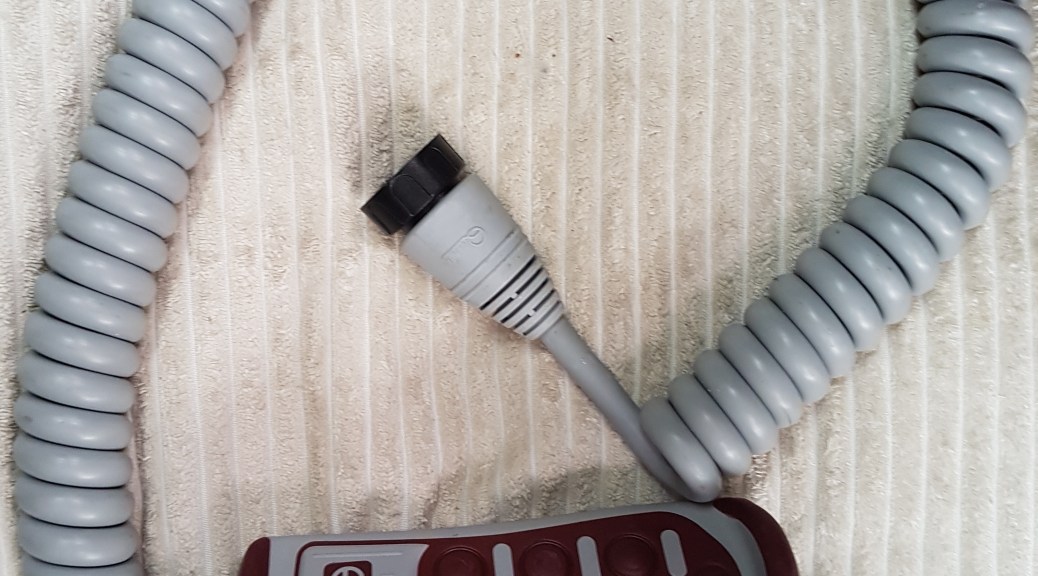
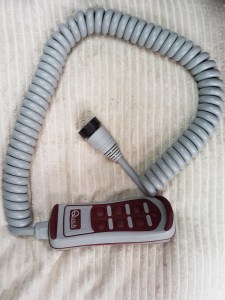 We decided on the
 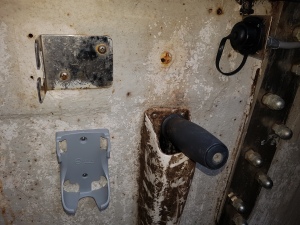 the remote is mounted on a stainless steel bracket (top right of the picture) and of course the design of this has changed which meant I needed to redrill holes into the plate for the new female connector. The wire then goes around the aft part of the anchor locker to the control box. Having crimped each of the wires and having learnt my lesson from the recent stereo replacement, we were soon ready to go.
 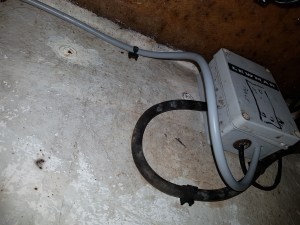 I am connected up and so go back into the boat to switch on the power. Silence so at least I haven’t done anything stupid! I go to the steering console, let’s make sure that I haven’t broken anything, it works. That’s a good start, at the very least it isn’t worse than when I began. I plug in the remote and go for the buttons. The windlass springs into life and works as expected. I have wired the power for the light to the incoming live but wasn’t sure which negative to use so I test it and that works. I am now feeling very smug as I replace the cover for the box, cable tie the wire for the remote and finally fit the cradle for the remote to the wall of the anchor locker.
 , we are off home and my job is to fit it.
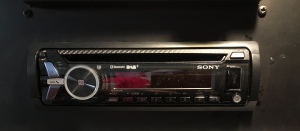 This stereo has dual Bluetooth connections which allows you to have one as a source for music and another as a remote control using the songpal, or Sony music centre, app. Installing this and you have full control of the stereo from anywhere on the boat, and off it. Absolutely perfect for a marine setting. Now to get somewhere where we can play our music loud!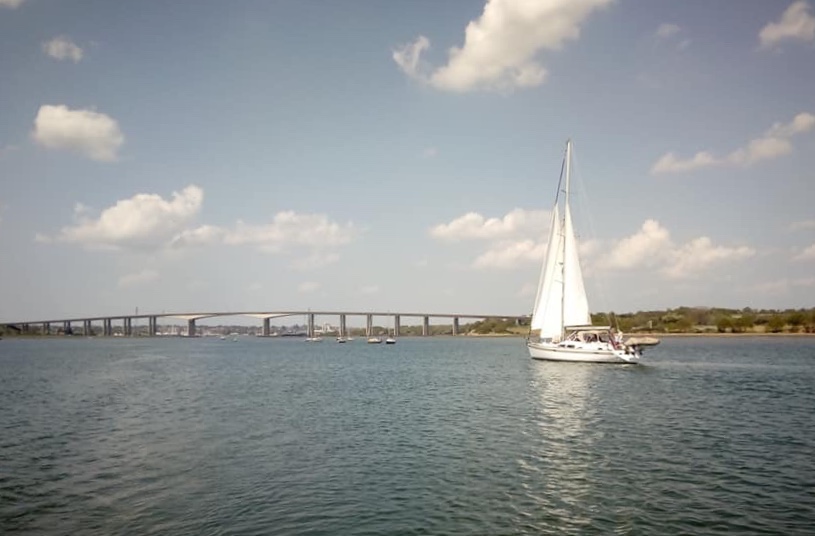
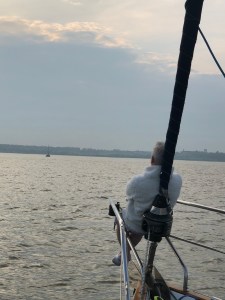 In the summer and especially at anchor, we often stay in the cockpit watching the world go by, chatting and listening to music.
 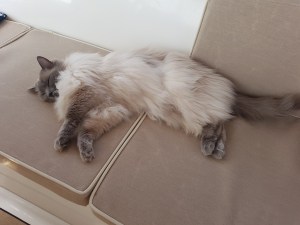 The cats are settled and like being close as they sleep. We are all really relaxed. With the built in stereo system still temporarily unavailable, see later blog, we are using the amazon echo to play the music. This has the added advantage of being voice controlled :). It’s a lovely evening and we may have enjoyed a couple of drinks and maybe even a little dance after it got dark but thankfully it is not too late a night since we are both shattered from the working week. Just before dark, one of the scout training yachts decides to anchor near to us, actually in our traditional spot near to the cardinal buoy.
 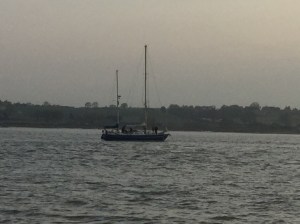 They have a reputation of bouncing off people but we haven’t personally experienced it and the skippers seem very nice when you meet them. Apparently, on this occasion they were concerned that they may have disturbed our tranquility in the evening. They clearly don’t know Mariadz at all 🙂
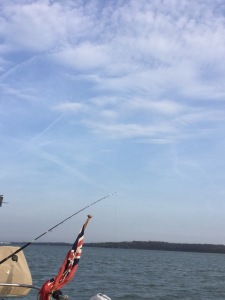 Now I don’t think this sounds too difficult, surely you go to the freezer, pick out the packet, put it on the side – dinner caught! But apparently, Maria has different ideas. She has gone to the freezer as I thought but she gets out the squid and puts it next to the worms, she is fishing for supper! Now with our standard amount of success in this area, it is certain that we are going to starve but it is ok since we have food available on the “off chance” Maria is unsuccessful.
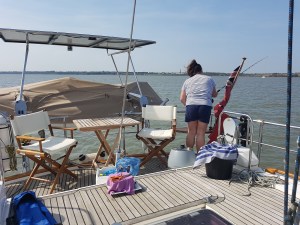 It takes Maria some time to set up the two rods but she is pottering around having a great time and looking relaxed without a care in the world so I am not going to complain. It’s not as if she’s going to catch anything so it will be a nice relaxing day!
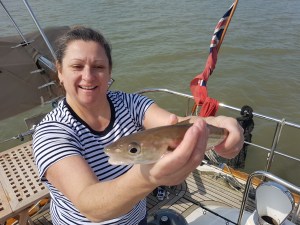 And then suddenly, the rod moves, and Maria gets excited…. she heads over to the port side rod and wow, she has only gone and caught something. It is time for Maria’s caught a fish song! Now the interesting thing about Maria’s “I caught a fish” song is that apart from the “I have caught a fish” chorus, every other lyric in the song starts with the letter “f” and is a word normally deleted in polite company. Unfortunately I don’t have video evidence, not that I could show until after the watershed! But it’s ok, because she follows up this crowd favourite with a haunting second song, now this one I do have on video!
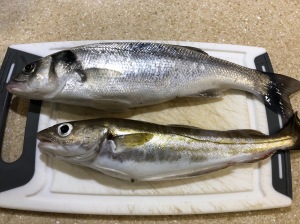 Another relaxed evening chatting and, it has to be said, that since Maria’s weight loss, dancing has featured a lot again. She’s happy 🙂
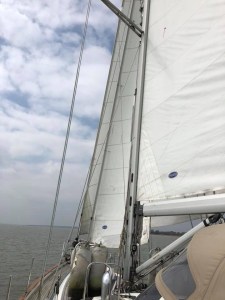 It is slowly coming out just using sail tension and the furler now and Maria is keeping a watchful eye as well as keeping an eye on our course and other water users.
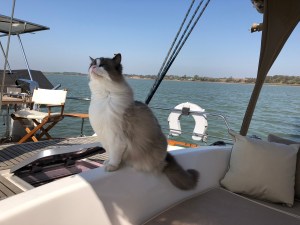 We make the turn at Felixstowe towards Ipswich with the wind directly behind us. This disappoints Clyde who was really enjoying the sea air.
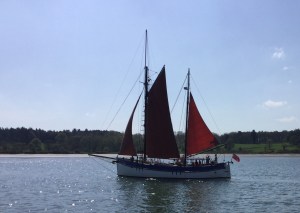 We haven’t seen many other yachts for a while, obviously laying in a trail of dust behind us! But up ahead, we have Lister Light again, that’s two weekends on the trot. They are drifting nicely down river having a leisurely sail with Sally at the helm. To be fair I really wanted to pass them on the “wrong” side so we could get a better lit picture but at least the got a good one of us just before we took the sails down.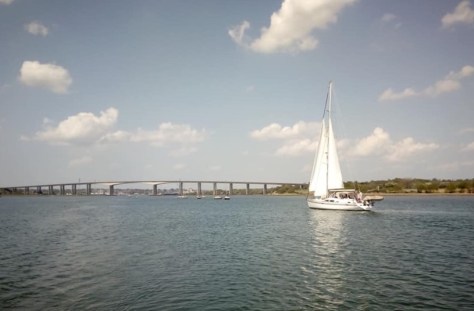
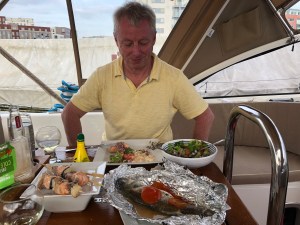 Hang on, don’t we have two gorgeous fish we can eat….straight on the BBQ in foil with our own Italian olive oil, lemon and vegetables.
 The Alma is a lovely pub that sells very fresh lobster and beautiful cuts of beef, all listed on a blackboard, when it’s gone, it’s gone! The food as always was really nice. We had a cracking evening chatting which was capped off beautifully with a quick dance to a live band – Lars and Laura know how to make an exit. The obligatory exchange of a few presents including our crew t-shirts for our friends. In the picture is their very own “Anne Plummer”, she’s a very popular artist, don’t you know!
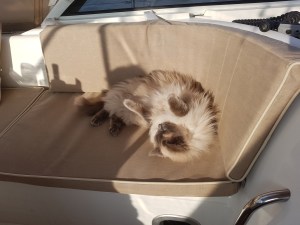 It does amaze us though how comfortable the cats are on the boat. No matter what the conditions, they seem happy and relaxed. When it is bad they stay quite close to us for reassurance but when it is a nice day like today they stretch lazily and chill. We have a number of friends who have commented that they don’t necessarily believe in reincarnation but if they did,
  and could choose, they would like to return as Maria’s cat – spoilt isn’t the word!
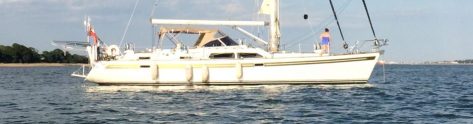 The final job is to raise the anchor ball that tells everyone during the day that we are anchored. This is attached half way up a spinnaker line run down to the deck, we hoist it about ten feet up so that it is easily seen. Obviously at night the anchor light at the top of the mast is illuminated so that people know where we are. These signs usually work very well and people know where you are and keep clear. Unless of course they are a blue hulled scouts boat, in which case you need to switch on the spreader spotlights and everything else you have got before they hit you!
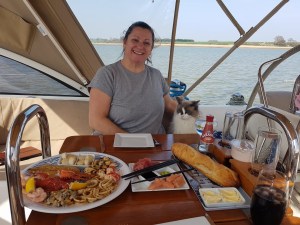 We decide to stay up in the cockpit as Maria prepares the feast of fish which is our lunch and dinner, or so we thought. As you can see from the picture, Maria has a little furry friend. Now Clyde is rather partial to prawns and demands them as an almost daily treat. When Maria brought the platter up, Clyde stirred. Ah, treat time and wow what a great selection. What shall I have first mummy? Maria of course obliges and starts feeding him lobster. LOBSTER! Is there another word that is more than spoilt… hmm a very lucky cat.
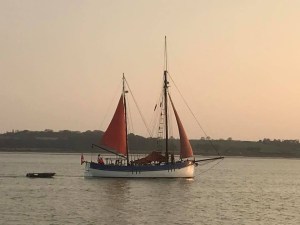 The sun is going down and as we look down the river we see lister Light with the young Thompson family on board. yeah that ones for you Sally 🙂 you owe us.
  So our neighbours who are 250 metres away from us in Ipswich are the same distance from us in the stour. But wow doesn’t their boat look great in that light.
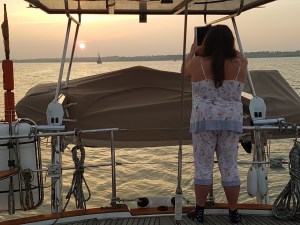 While the Thompson’s have their own great evening, we are settled down listening to music. It’s a lovely evening with a variety of music and we go to bed at a reasonable time. Of course with Maria that is any time before 4am – but it was early even by these standards!
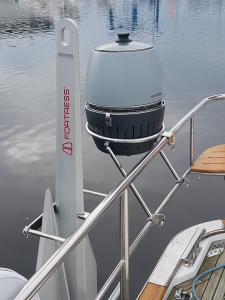 Obviously that changes the weather and of course it starts to rain but not before I get the rail mount fitted and the bbq fitted. Really convenient, now if only the food would cook quicker!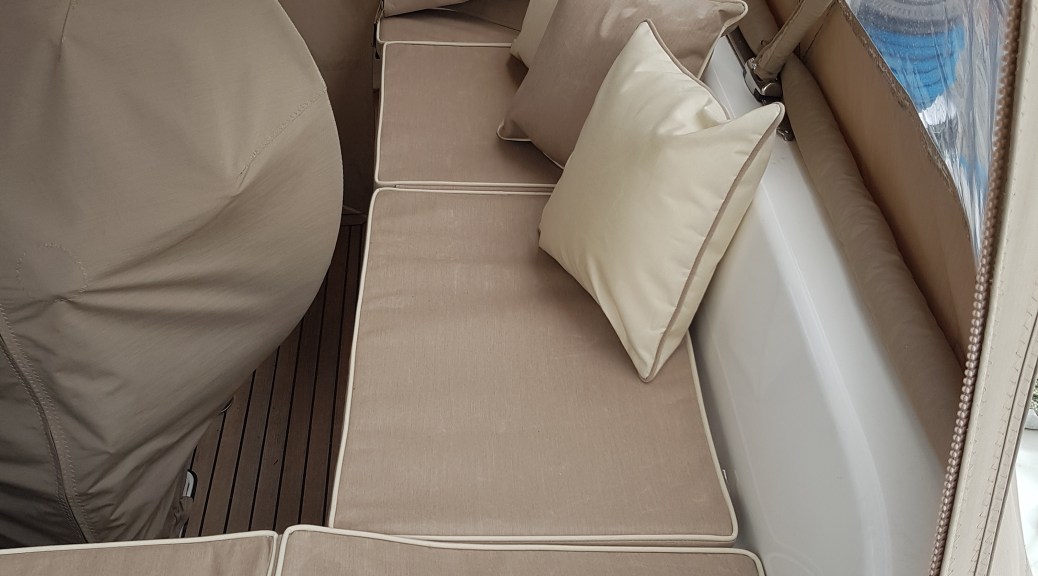
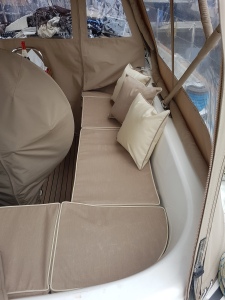 The design exercise was quite complex since we knew how the area was likely to be used. Just looking at the access areas for the cockpit made that clear. We have two side entrances and also access at the aft end of the cockpit. During the winter, most people come in via the aft entrance. We were keen to make sure that people didn’t stand on the seating, irrespective of the entrance and so a number of folding sections were incorporated so that these could be lifted to provide a step and to stop the cushions being spoilt. These folds were two at the aft area of the cockpit and one on each side. James incorporated a nice way of fixing these with Velcro underneath the seat and a flap which meant that the join was very strong and invisible when the seat was setup – much better than two cushions butted up to each other with Velcro on the edges. This works for all four entrances into the cockpit.
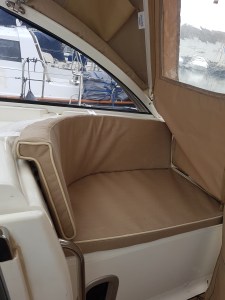 When I say “our”, I do mean Maria, Bonnie, Clyde and myself, since the cats like to be on deck when we sail. This area has full backs to make it comfortable but these were a real headache to get right with the curve of the cockpit and the shape of the back that cushions need to rest against. All other areas have a selection of loose cushions, in a couple of contrasting colours, that can be used for the backs. This gives flexibility and also means that when Maria sits behind the wheel steering with her feet, she is surrounded by comfy cushions.
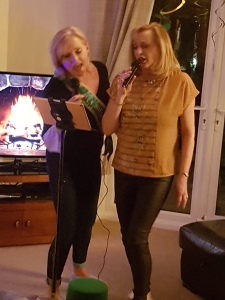 Sometimes she is brilliant and other times not quite at the top of her game. In the early days of our relationship, I probably didn’t go into this wholehearted. There was some recognition that I wasn’t the best singer! But now I give it my best shot, and I apologise for any bleeding ears brought on by my enthusiasm.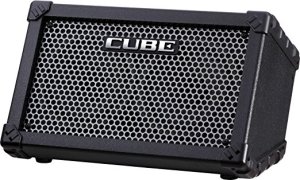

 – one of the few that I could find that had a wireless microphone and a wireless base station. You need this if the diva is going to be able to do her dance moves although she would probably prefer the whole Madonna headset!
 – something to hold the iPad with the lyrics on
 which the iPad can link to and remove a trip hazard
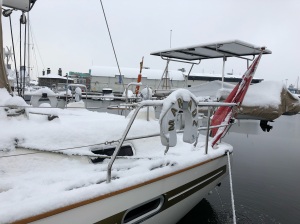 Now I have to say that my first thought on this was that it was a woman that we met in a Colchester night club, that I needed Maria to protect me from! But no, apparently, it is from Siberia, freezing cold and dumps a load of rubbish on you. So completely different then!
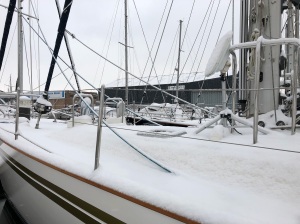 We often get asked how we survive winters on the boat, surely we get cold! The answer has always been that we have heating, however, this winter is sorely testing our heating setup.
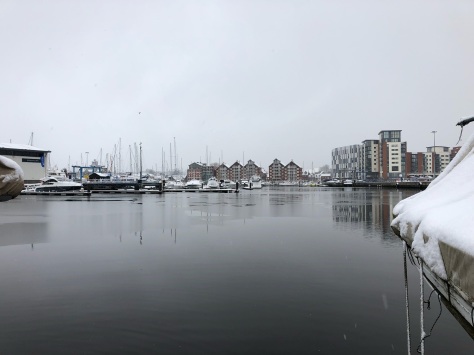 Reverse cycle air conditioning isn’t the most efficient system either and I suspect the fact that the water in the marina is frozen in places is not helping. So we use a combination of a couple of air con units boosted from time to time by the Dyson heater. The other useful item for our comfort is the heated blanket on our bed which has individual controls for each side. This goes on early evening, makes the bed warm for bedtime and keeps it lovely and warm all night.
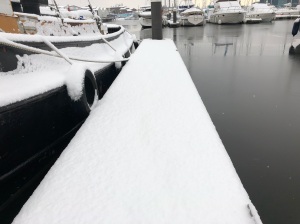 we’re accustomed to a bit of snow and the few inches we got in the first few days was less than the light snow we had just before leaving Austria. In Austria, that didn’t take much effort to clear but in the UK the story is very different. Fortunately we have the land cruiser to drive around but the roads are terrible around the marina and in Ipswich itself. The pontoons will of course get more treacherous as the snow melts and refreezes overnight. Our snow boots will be tested then.
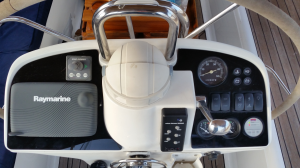 We had spoken to Lindsay at Seapower about this some time ago and there was concern that we may need to replace the entire throttle control with a completely new and very different unit. The first job though was to check that we didn’t have issues with the throttle cable and particularly the gear cable that allows you to select between forward, neutral and astern. This was one of the jobs arranged for while we were away skiing in Austria. On our return from holiday, Maria was planning to turn the boat around so she was bows-to the pontoon. This is our preferred wat round and gives her a nice view over the stern to Ipswich Centre. It provided us an opportunity to test the new setup. After the work was done, there was a complete lack of swearing when Maria was turning the boat around so I think we have a result!
 To avoid this problem, we took the decision to buy a generator with a lower power output (7kW) so that we were always using a high proportion of its capacity. In the few instances where we need more than this for a very short period, the inverter charger could pull from the batteries but this was likely to be for seconds and so wouldn’t impact the batteries too much.
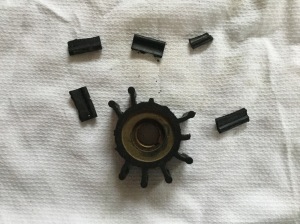 This has been in place exactly two years and had around 70 hours of use so a little worrying. Of course a broken impeller is not good news and we are grateful that the generator hadn’t overheated because of the lack of water flowing through the system. We are now investigating what has happened but I understand that we may need to be more careful at checking the generator when it hasn’t been used for a little while. I suspect more frequent changes of impeller will be required too.
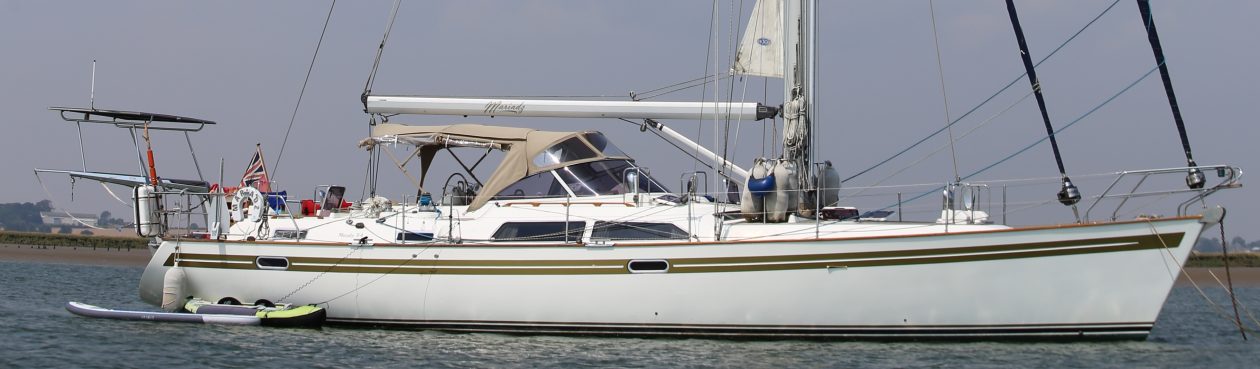
 Mariadz