All posts by mariadz2010

The journey south begins in earnest

It has been two weeks at Burnham-on-Crouch rather than the four we had planned originally but it is time to depart and to start to head South so that we can be ready for Biscay in a month’s time. One month, wow, it is getting real now.

Maria has been hard at work on crew seekers and has found two people who can accompany us on the Biscay run and we agree that they should meet us beforehand so that we can be sure we won’t all want to throttle each other in the middle of the Atlantic, well the eastern part of the Atlantic.

First up is Richard, who has lots of sailing experience and is studying for his yachtmaster, for which our trip can act as his qualifying sail. His acclimatisation trip will be burnham to Southampton via Eastbourne over a few days.

Richard is due to arrive on Friday and I am frantically going through the last of the items on the list that we need cleared before we go. It is all looking good and by 4pm on the Friday, with Richard due at 7pm, I only have to lift the rib onto the davits. What could be simpler?

I get a chance to do this in a spare half hour in my busy work schedule, when I should be having lunch. I get the rib over to our new davit wires, as fitted by myself and Richard from evolution rigging amidst much swearing and grazed knuckles a few week’s previously.

I fit the davit wires to the new rib lifting points, which are directly in line with the davits to avoid chaff. I start to lift when the 4mm wire connected to the bow gives way and drops the bow into the water. My disappointment is compounded by the certain knowledge of how difficult it is to replace the wire. This also seems ridiculous since the breaking strain of that wire is over 900kg and the whole rib is 150kg with the bow the lightest bit! Clearly there is another problem and we will need to understand what caused the breakage before fitting another wire and finding that breaks in a short period.

A frantic call to Richard at evolution rigging and we have two new wires being produced … in Ipswich…. over an hour away…. on the day before a bank holiday weekend…. with no car….

An old school friend of Maria’s (no she isn’t old, they have known each other a while!) is visiting and wonderfully offers me the use of her car so that I can collect the wires and have them ready. This is especially helpful since we are leaving at 5am the next morning and it would be even trickier to get these from Eastbourne or Southampton without a car. I hope in the car and three hours later I have driven to Richard, collected the wires and got back to the boat, just to late to be there to greet Richard. It is also a baptism of fire for Richard since we still need to get the rib up and there is no way we can replace the wire quickly. Fortunately, as part of our pasarelle setup we have a 6:1 pulley system which will fit to the davits and allows us to lift the bow while the stern is lifted using the davit motor.

The rib is now stowed and we are ready to go first thing in the morning but it is late and we haven’t eaten yet. Maria has knocked up one of her original curries with a chicken balti, gorgeous mushroom and courgettes, rice and breads so Richard has his first taste of Mariadz cooking which seems to go down well, certainly by the number of times he returned for more – a very polite person!

The next morning and the weather forecast that we had checked proves to be absolutely right with little or no usable wind for our journey. In common with everyone who sleeps in the forepeak, Richard has woken refreshed and raring to go. So it is a quick setup of the boat and we are ready to go.

Originally we had talked about stopping at Ramsgate but we have decided to skip that and do the journey in one hit to Eastbourne. We expect this to take about 14 hours since it is in excess of 100NM but we should just about make it in daylight. I have decided l am keen to make sure that Mariadz is ok since this is her first major trip since all of the work has been done. It means I am on watch for the whole trip which in retrospect was probably not the wisest decision with two very skilled sailors with me.

We have caught the tide early and make reasonable progress across the Thames estuary seeing all the familiar sites. These are happy hunting grounds but it does seem strange to know we will never sail here again.

We reach North Foreland as the tide changes which means it gets quite lumpy. It also means that the journey to the far side of Dover will be fighting a strong tide. we have made good time but it is slow going past ramsgate ( see ya for the last time 🙂 ). We go on the inside of the Godwin sands even though the tide is stronger here because the detour to go on the outside adds even more distance and time.
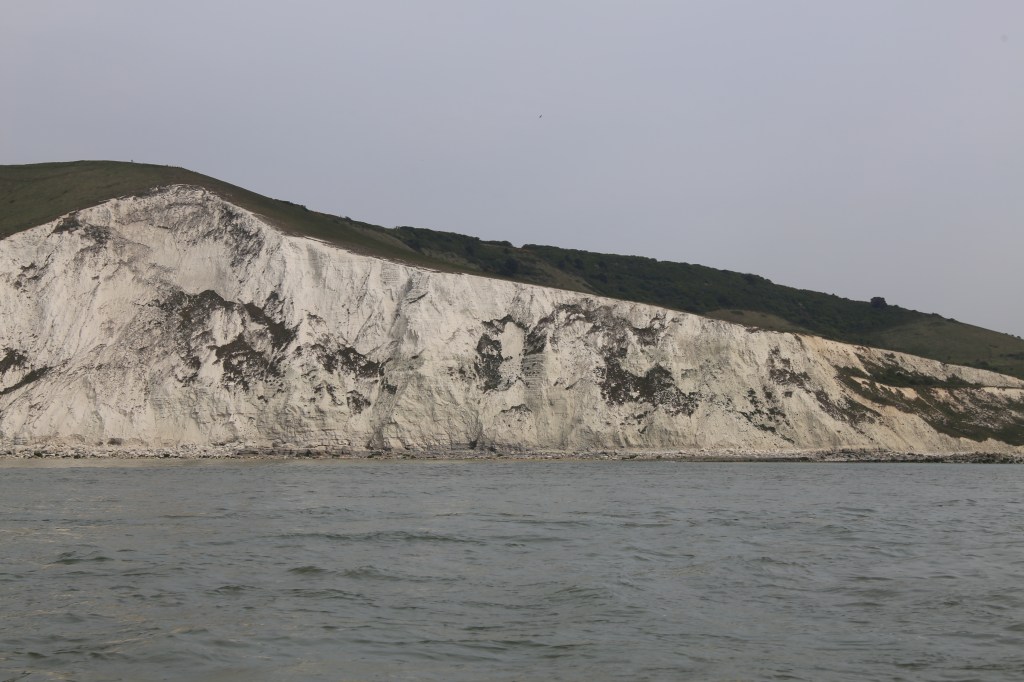
As we approach Dover, I can see a number of vessels crossing our path as the ferries come in and out. I have a good view of them and we are making good speed under power. Unfortunately I have forgotten to check in with Dover Port Control (channel 74) because I will be crossing the entrance within a mile of shore. A schoolboy error and if by mentioning it here I get someone to radio in to make their intentions clear then I will have paid my penance. A very nice lady calls us by name, having seen our AIS track. To be fair, she was very polite considering I have completely ignored the correct protocol but I explain that we are on passage to Eastbourne, make my apologies and we continue on our way.

We are now starting to pick up speed but it is getting later. Our 14 hour estimate is looking hopelessly optimistic as we pass Dungeness and can finally see our destination, even if it is still three and a half hours away.

It is now starting to get dark and in the bay before Eastbourne we start to see a lot of lobster pots. To be fair these are very well marked but it fast becoming the kind of slalom that would be challenging for a skier never mind a 54 ft yacht! After what seems an eternity and with the light disappearing after sunset, we finally arrive at Eastbourne. Richard and I jump up to do fenders and lines, setting up both sides since we are not sure which side we will be on in the lock – we later remember that both sides are setup so you could have gone with either!

Unfortunately, maria has become slightly disoriented by the darkness and misses an unlit green buoy, easily done, which means Mariadz is outside of the channel. Fortunately it is all corrected quickly with no drama and we are able to proceed. It doesn’t do Maria’s nerves any good though especially as we are tired after a long day. However, normal service is resumed as Maria negotiates the lock perfectly. The discussion with the harbour master isn’t great since despite assurances previously we are told we can’t have a hammerhead and have to take an inside berth. That is a trickier manoeuvre especially as we had set up for the hammerhead but we get in after a little bit of fun and games. We are now tied up and can relax for the evening or so we thought.

Since we will be in Eastbourne for less than twelve hours I go to the office and check in. Having paid for the berth and received some excellent advice on when to leave in the morning, especially as it gave us more sleep, I return to Mariadz. On my return, I am told that Clyde has gone for a walk and has left the marina which is about a 150m walk. We are in no mood for this!

The search for Clyde takes a lot longer than you expect and I have been all of the way to the waterfront before eventually finding him aimlessly wandering around a housing estate, clearly lost. When I call him, he hears, turns and comes strolling over to me before doing his usual of walking on the heel most of the way back to the boat. Richard, who has also been on the search with me, is taking no chances, and walks a little behind Clyde in case he changes his mind and runs off again! As we get on board, Maria has cooked us a home made lasagna to a recipe she gleaned from our Italian neighbours. It is lovely, even if she does admit to a mistake when making it!

It’s late and we have another long journey tomorrow so it is time to get to bed. For another good nights sleep before a hopefully easier day and fingers crossed a chance to show Richard how Mariadz sails.
No turning back now.

This year we will delivering Mariadz to southern Italy and the journey has now well and truly started. Having been in Suffolk Yacht Harbour for most of the last eighteen months, the majority of the boat jobs are now done. There are a few things left to do, most notably the toe rail which we had hoped to have redone perfectly before we left but looks like it will need to be started again unfortunately, more of that in another post.

On a boat there is always a long list of jobs to do and as you will find out over the coming weeks as I catch up on blogs, a lot of these have now been done on mariadz. In fact the usually extensive list has very few items on it!

We left Suffolk yacht harbour at Levington mid-April, a little later than we had hoped due to over-running works and headed to Burnham-on-Crouch. This was to be our base for a couple of weeks, while Maria got to spend some quality time with our granddaughter, Isabella. Since this was our last time in these waters we decided to break up the journey and visit a familiar haunt. Hanford water wasn’t possible due to tides and our need to do a long journey so we decided that Osea Island would be our anchorage for the night before moving onto Burnham.

The sail down the wallet to the top of the river black water was uneventful and we were able to get the sails out but had to keep the engine running due to the lack of wind. This wasn’t too bad since we are trying to get through our first 50 hours on the new engine and want to do this before we attempt the “big” crossing later in the year.

All is going swimingly until we decide to take the sails in. Mariadz has in mast furling which a lot of people swear at rather than swearing by. We have always got on with it and in eight years have not had a sail jam. As part of the refit, we had the in-mast furler completely refurbished. During our test sail we had noticed that the looped line for the furler hadn’t been gripping the jaws of the furler well enough so we had that changed for a thicker line that would grip better. We were somewhat dismayed to find that during the unfurling of the sail, this line had jumped off of the furler completely! I believe I may have been responsible for that. The furler has two modes: ratchet and free. Previously, we had always had the furler on ratchet which basically meant that the sail was always controlled by the furler and we could reef the sail or let more out using the furler and under control. After the refurb, the sail will furl in ratchet mode but seems to be locked for bringing the sail out. I realise this only after the line is under some tension and hence is quite a bit thinner than usual. I suspect this helped to throw the line off the furler. I am able to store the sail by going to the mast with a winch handle and doing it manually, tiring but successful. However, I can’t do that every time! I call Richard at Evolution Rigging and we are both at a loss. Clearly it needs to back but it is a small aperture and I have no idea how I will get the thick line in there – I really hope I don’t need to cut the line at the join of the loop and redo it. The internet is your friend in these situations and I discover that the furler is working exactly as designed, even if that isn’t as good a design as our previously faulty set up allowed. So I know what I have done wrong but not how to fix it, yet.

Osea island is quiet, as you would probably expect for April but it is nice to say goodbye, even if we refrained from singing Rehab from the bow this time.

The next morning, and the pull of Isabella is too much for Maria to resist. We are up and away early and back past Radio Caroline, heading to burnham. I am not letting the furler problem stop us using our new sails so we are flying along to burnham and arrive nice and early.

Prior to arrival, we have been told that we will be on the hammerhead at the entrance – “your usual table, sir?”. That would be lovely, and as we enter the marina, there are even some people there waiting. How kind, they are here to take our lines….. nope, the boat in front of us starts to turn back into us to go onto the hammerhead! I swiftly call out that the harbourmaster has told us to berth there, to be told they are just picking up their friends! Errrr, do you want us to wait here while you do that? Or maybe find somewhere empty to pick them up. The decision is made to take the berth and let the other boat pick them up elsewhere, something they handle very well so clearly know how to handle their boat. Maria demonstrates that she can handle Mariadz as well by “Captain Ron”- ing it. For those who don’t know the film, which is a classic Kurt Russell film, this approach to berthing is basically to aim at the hammerhead at speed and then, at the last minute, throw the wheel over, put her astern and let her drift gently onto the berth. This works well when there is a lot of tide or wind. Maria’s attempt was not far off the film although thankfully her crew knew what she was doing so there was no panic 🙂 well not much…

We are now berthed in Burnham for two weeks before the first of our crew members for Biscay, Richard, comes on board for the start of the trip south to acclimatise himself to the boat and us! Now where’s that list to clear some more items off it!

You have to love a list….

One thing my father and I have in common is making sure there are lists for the things we need to do. It is easy to make the job of managing these lists a full time job but it is also important to make sure you don’t forget those jobs that need to be done.

On a boat these lists can take a life of their own and rapidly increase, some say much faster than the ticking off of items on the list. However, I am like a man possessed with a real deadline to get a load of jobs done and a few days, with Maria staying near our granddaughter. The back of the list is broken and I am finding it difficult to find new tasks to add. Some of these will be future blogs so you have been warned now that you have seen the extent of the list, there are many more items off the bottom of the page….

New sails

Although, in the years of our ownership, Mariadz is reasonably well travelled and often used, we have not been excessive (ab)users of the sails even if they are used whenever possible.  A number of people had told us that the sails had life in them yet but we had decided that before we go we wanted to be ready for the next ten years and that meant new sails.

We had already spoken to Dolphin Sails about new sails for number of years and originally we were quite happy with their quote until we asked them to refresh it and were told that there was a 10% uplift due to currency fluctuations (in an environment where the Pound had crashed against other currencies!).  We didn’t go back to them after that. We were also interested in combining this work with the rig work being done to make sure that these were perfectly in tune.  That led us to one sails who work closely with evolution rigging and we spent some time speaking to John Parker about our needs.

In due course, the quote came in which included three new sails and storm sails. We agreed that the existing twin headsail had hardly been used and should be fine for use, although we did identify a problem with it which needed to be addressed.

John came back with a quote which included five different options in sail cloth and cut. Maria and I pondered this for a while and eventually decided that we didn’t want the cheapest but weren’t sure we could afford the Dyneema Tri-radial sails which we assumed were more targeted at heavy users and racers. We returned to speak to John about our choices and to place an order. John is incredibly experienced and we have a rule that we always take advice from people who know what they are talking about. John is also a good salesman and convinced us that far from being race sails, the dyneema were the hardest wearing and for the length of trip we had in mind were perfect since they would retain their shape for the entire journey and wouldn’t need replacing – nice upsell! 🙂

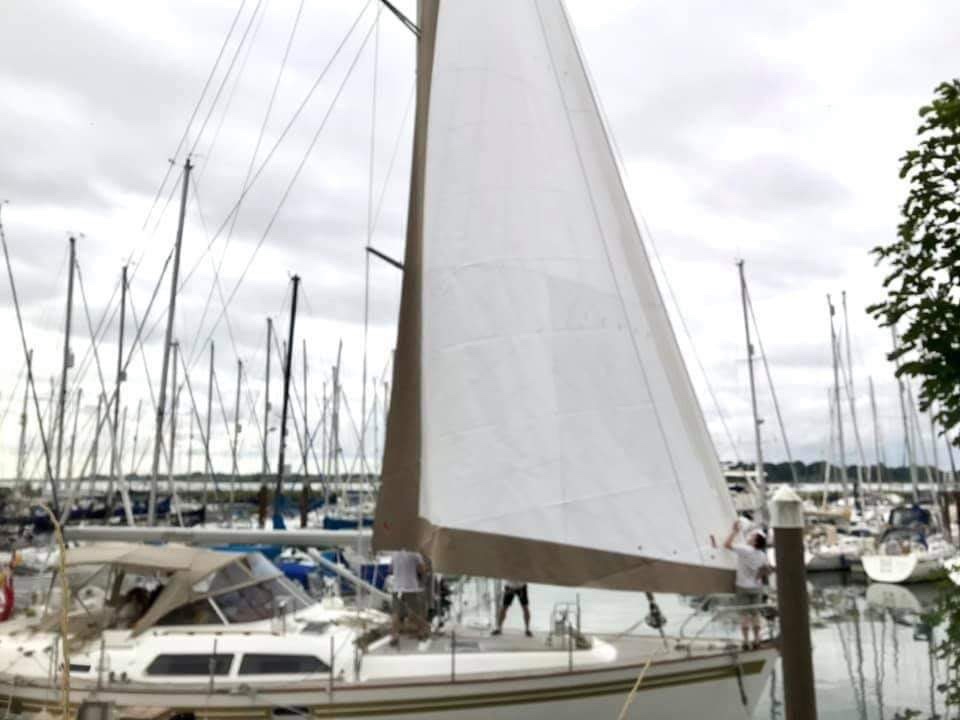
Maria also wanted to change the UV strip as she continued her personal crusade to remove the colour dark blue from Mariadz! The new uv strips matched with the hull stripe and cockpit tent.

We decided to get these done and then to put the old sails back up for the last year in the UK.  Shortly before departure we would replace our old sails, retune the rig if required and check the sails so that we were ready to go.  For that last year, the sailmakers had offered to store our new sails.

Our flexibility meant that John was able to help us with the price and paying for them.

For our standard sails, we agreed to have a new main, staysail and headsail. The existing extra headsail, for our standard twin headsail setup, has barely been used and so we decided to keep that. The headsail was the same Yankee cut that we had originally, we had explored making this larger but in the end we agreed to stay as we were. As for the main, we did not have vertical batons in our furling main. We have seen these on other M54 but at least one had significant issues with furling the main and we were happier not adding to the risk of a sail jam potentially at the risk of a little performance. Finally, we agreed that we wanted storm sails for heavy weather, although our staysail is about the same size as the largest storm sail. It helped us define a smaller storm sail which should mean we have sails for all conditions, although we don’t expect to be out there in bad weather by choice!

The sails were ready when Mariadz was put back in the water in August 2021 and once the rig had been refreshed, more on that in another blog. We were then in a position to have a test sail. This didn’t need to be too long, just up and down the river, checking the different points of sail. John was able to confirm that the sails were performing as expected and we were looking forward to seeing what Mariadz would do now on longer journeys. Maria is famous for not being a racer but being like Gandalf in Lord of Rings, standing there saying, “You shall not pass!”, the new sails should help ensure that remains the case.

The sails came off after the test sails and were stored for the winter before being put back on for our departure from Levington. We have since had the opportunity to test the sails in normal conditions and couldn’t be happier. Mariadz is flying through the water and feels a lot quicker. The sails are a lot better and it has really demonstrated how baggy our old main in particular had become. We couldn’t be happier and they look gorgeous too!

Fixing the engine – the nuclear option

Regular readers will have known that we have had a number of attempts at fixing our 3,000 hour yanmar including a new heat exchanger, all new cooling pipes, etc etc.

We were still unhappy with it and had disconnected the heavy duty domestic alternator which may have been part of the problem. Also, with our change to lithium batteries, we needed an alternator that the hungry lithium wouldn’t destroy or worse still cause to burst into flames.

The nuclear option is not stealing an engine from a nuclear submarine but actually was biting the bullet, admitting that we would never be 100% happy with the old engine and deciding to replace it for a new engine! Eye wateringly expensive but the equivalent of taking off and nuking them from space as they said in Aliens. As they said it was the only way to be sure!

Once you have chosen this path, there are a number of factors to consider. The easy part is the engine choice: the modern equivalent of our old engine is the 4JH110 which is a 110hp, turbo, common rail engine which is smaller than our old engine, a little more powerful (10%) and being brand new likely to have all of those ponies whereas our old engine was probably working at a lot less than the labelled 100 hp. Of course, a more powerful engine can cause more problems since you need to exercise a marine engine to avoid maintenance problems later which was also why we didn’t go any more powerful than the 110. We have seen a lot of people upgrade their engines and then struggle to get the benefit especially as the hull speed of the yacht is quite a limiting factor.

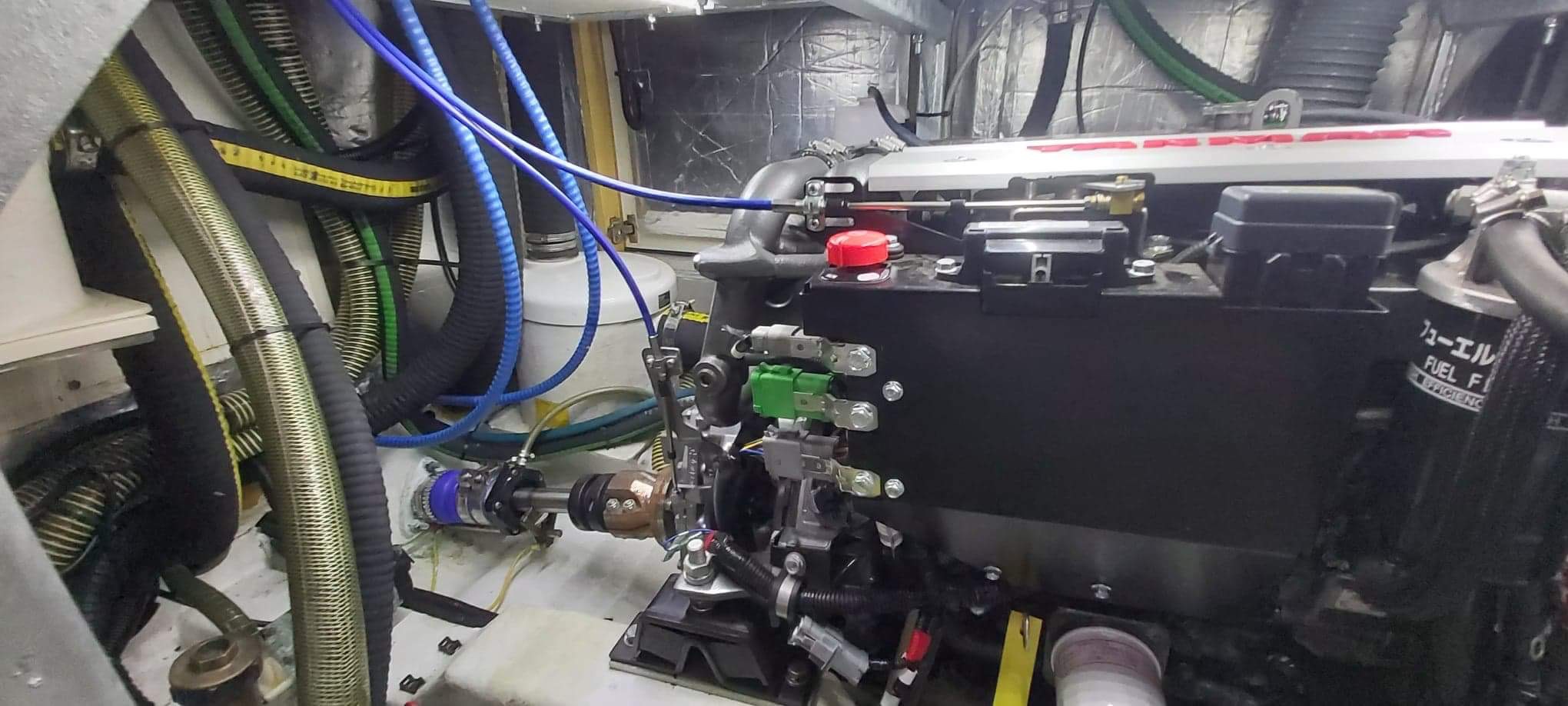
Unfortunately with the larger Moody yachts, the access to the engine is through the cockpit floor which means the removal of the cockpit table, the steering binnacle and then the floor. With the setup on Mariadz, you then needed to remove the Onan generator and the table it sits on before you could access the engine. Suffolk Yacht Harbour (SYH) were engaged to do the work to remove everything to get at the engine. initially, the cockpit floor has to have its outer seal removed and then the screws holding it in place need to be removed, the photo shows where these are but once removed the floor comes out quite easily.

The East coast dealer for Yanmar is French Marine and we engaged with them to understand the costs and what needed to be done. with our recent change to lithium we decided to supply our own lithium-friendly alternator and went with the Balmar 60-series 24V70A alternator with MC624 regulator and temperature sensors. This alternator recognises when the lithium is being too demanding and shuts itself down for a while to recover. It is also able to put a lot of power into the batteries quickly, an advantage when you are hoping not too run the engine for too long.

The work started, after some delays, and everything was going swimmingly. The old engine was ready to come out and would be available to sell, something that French Marine offered to help us with.

When discussing the work, one of the drivers was to have a quieter experience within mariadz when under power. To that end, we agreed to have all of the insulation for the engine room replaced. That would improve the soundproofing and hopefully make the engine even quieter.

While the engine was out, it was also a perfect opportunity to paint the engine room bilge. Once the table for the gennie was removed, we found some corrosion so we took advantage of it being out to have it regalvanised. You start to see how one job can lead to another… all of them seem quite reasonable in isolation but soon add up when done together. The new engine was in quite quickly but as part of the fitting of the shaft a problem was found with excessive wear, not surprising, I guess, after twenty years but a new one had to be sourced and fitted. We then get to the prop which had been out of the water for a while and had apparently seized. Clearly sending that back to the manufacturer is very sensible with everything else being replaced but again not factored into the project originally. It does mean that the entire drive train has been replaced which has to be a good thing.

Unfortunately, while all this work was being done, somebody left the companionway hatch open for an entire weekend of heavy rain. Some of the interior was under an inch of water which damaged the interior wood that we had just had redone in maple. This was very disappointing and caused additional expense especially when no-one admitted liability. Josh at Suffolk yacht harbour agreed to refurbish the companionway steps which had also been damaged by people walking on them with heavy shoes and damaging the edges, not a problem we had experienced before since we are a shoeless boat. This was a kind goodwill gesture but didn’t completely sweeten the taste of having to repair a lot of interior wood in the saloon. We were already having work done in this area so it extended that project and now looks excellent but wasn’t something we were intending to do.

You start to see how these projects add up and blow budgets. that may appear to be a repeat of what I said earlier but it seems so important it was repeating!

As an example, the generator is only a few years old and doesn’t have many hours however, we had a minor interior leak from a corroded part of the generator which needed to be replaced and we decide to have the whole thing properly serviced and checked before being out back into the boat. So now we know everything to do with the generator and engine have been checked, refurbished or replaced as appropriate and we can have confidence in our setup.

Suffolk yacht harbour then started to do the reverse of the start of the project, refitting the table, putting the generator back before replacing the cockpit floor. It is important that the cockpit floor is sealed correctly, since we know of at least one other moody 54 that had a problem here which caused all kinds of problems for the engine room. SYH did a good job of refitting this, resealing and then wet testing to make sure there were no leaks.

We then needed to commission the engine which was much later once a number of other projects had been completed. Initial work on this by French Marine was great and after a weekend of testing we found a slight leak from the shaft housing which was sorted quickly and efficiently. We now have a gorgeous engine room with two fantastic and efficient pieces of kit servicing our needs.

The whole project of the engine swap was a lot of money but the new engine purrs like Clyde eating his treats. We are also impressed by the engine power and have been keen to use the whole rev range as directed by yanmar during that crucial first 50 hours of use. But what of our old engine, I hear you say. 3000 hours is nothing for a good Diesel engine and there would be others who could use it. French Marine were as good their word and introduced us to someone who needed an engine. We agreed a fair price and I was able to offset some of the cost 🙂

Unfortunately the various delays on all parts of the project meant that we were unable to use the boat as much as we expected and eventually we had to leave SYH prior to finishing the first 50 hours. This meant that we would have to get the engine serviced on our route south to Plymouth.

We hit the 50 hours as we approached Southampton since there had been little usable wind and we had a weekend to make that trip. While in Southampton we were lucky to catch up with our good friends Christian and Jennifer which was great but also got us a couple of recommendations for someone who could service our engine. The second of these was Martin Smith who was friendly on the phone and able to fit us in to a busy schedule. He came on board at the time he said, which isn’t necessarily something we are used to, and did a thorough first service for us. We were really pleased with his work, approach and the result. The bill was also refreshingly reasonable too especially when the job had been quite short notice. An unequivocable recommendation from team Mariadz for Martin’s work.

So we now have a spotless engine room with mechanical parts in perfect working order and it is quiet when running, well as quiet as any boat can reasonably be!

Electrical work

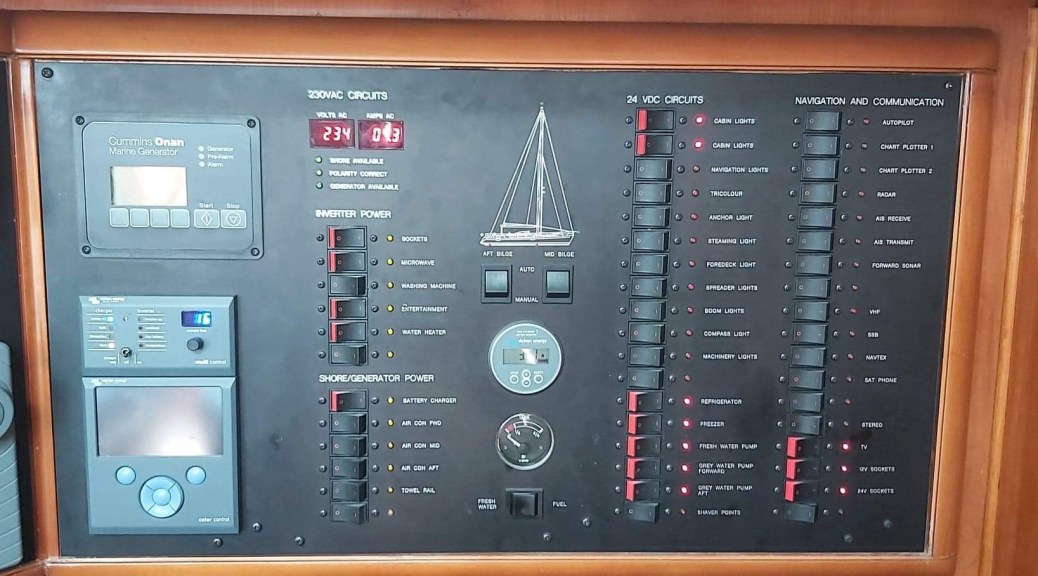
Mariadz was built in 2001, and this was when her electrical system was last overhauled. In the interim, a number of items had been added or removed from the electrical mix and this meant that the switch for a particular piece of equipment was quite random. Apparently, it is logical to switch on the navigation for the 12V charger to be live to charge your phone!  Clearly, there was a lot of duplication in the items on each switch which resulted in more power being used than was required, this would cause us problems on our blue water cruising. And we thought it looked dated! So we spoke to Ollie at Seapower in Levington and started talking about how to redesign the electrical panel.There we’re some features of the old panel we liked such as the outline of the Moody with indicators for the lights being on. However, these no longer worked when we went to LED because of the lower draw of power. A simple change however. This would also provide an opportunity to remove the extra standard horizon chart plotter as part of the navigation overhaul, discussed elsewhere, and also give us room for an SSB.

The new panel has zones to logically group related items together. On the left is power management: the control for the generator, shore power indicators, inverter charger and our victron battery monitoring. Next you have the 240v section which includes areas that can be switched on with the inverter, as well as those that require a power source. We added the water heater into the inverter section, despite its power requirements, so that we could have hot water if the solar was working amazingly. However, a good way to use a lot of power is to leave this on for any time, the bitter voice of experience there! In the middle of the panel is the outline of the moody with h light indicators, bilge pump controls and a single gauge that will show either fuel or water levels. Next up are the 12v/24v circuits including lighting and pumps and then finally the navigation and ancillaries.

Below this panel, there is a smaller panel which houses the vhf radio, navtex and eventually any satellite handheld phone. This also has the main breakers for the domestic, engine, windlass and winches. The return that faces the chart seat has the navigation, SSB and a marinised Sony stereo (our third having gone for standard car stereos previously – buy cheap, buy twice!).

The structure of the panels works well for us and it doesn’t take long to know where to look for something or the standard pattern of lights when on shore power and when sailing. The use of an indicator light and the red border on the switch to show it is on could be overkill but we were happy we would know what was on rather than suffering a power drain because we had accidentally left something on.

All this was done some time ago and the panels were recently remade to cater for the SSB and to remove some redundant kit (an old engine hours dial). So no apologies for bumping up n older blog which has been updated to reflect the current situation.

Batteries and the move to lithium

I had been planning to wait for the price of lithium to come down as these things always do after the first flush of invention. Unfortunately, that doesn’t look likely as the demand for lithium (life-po4) for the motor industry means that availability and prices elsewhere remain high.

However, the technology is definitely the way to go with charge rates high, weight low and usable capacity high too. This is also not the technology that are an explosion or fire risk which seems to be a common concern.

Our hand was forced somewhat since we bought new victron gel batteries in 2019. Being liveaboards with an inverter, we felt fortunate that we didn’t have to constantly go outside to reset a trip if we inadvertently put the kettle on with an electric fire and went over the power limit. The inverter charger would kick in, top up the power required from the batteries and then recharge them when we needed less power. However, there was a price to this convenience. Within fifteen months, our batteries were dead! Firstly we checked that everything was wired correctly and fortunately we have an all victron boat fitted to their standards. We kept investigating and victron agreed to replace our batteries under warranty which was a relief. We all thought we had just been unlucky.

However, nine months later, the same thing happened. We were on passage and a few hours after dark the boat went dark as the batteries died. Fortunately we could run the generator to provide our power requirements. Clearly something must be wrong but we were still at a loss.

Victron again offered to replace our Gel batteries like-for-like but also suggested an alternative. They felt that there must be something going on and that we couldn’t be so unlucky as to have two dud battery sets. They suggested that we upgrade to their lithium batteries which required less capacity to provide more usable power and they felt that we would hopefully not break the lithium! To sweeten the pill, they deducted the cost of the replacement batteries they would have provided and gave us some other incentives in price and some free equipment. It was still an eye watering amount but victron’s charity with replacement batteries wouldn’t last for ever.

However, we still needed to understand what was causing the problem. My current theory is that whenever we used more than the 16 amps coming from the shore power, the inverter pulled from the batteries and then replaced it later, which is effectively a small cycle of the battery. All batteries have a limited number of cycles and every time we used the kettle or marina her hairdryer in the winter it was a cycle, so potentially a number per day. The Gels would have had a few thousand cycles life but these could be being burned up at 10 a day. So in addition to the change of battery type, we also upgraded our shore power cables to provide 32amp power when available to reduce the cycling. That may have worked on its own but traditional mariadz belt and braces we did both!

Unfortunately, moving to lithium isn’t exactly plug and play from lead acid batteries and there are a number of factors to consider. Possibly most importantly is the alternator on the engine. Lithium like to take a charge, all you can give generally. Older technology alternators would just keep trying to give and would burn our very quickly from overheating. The changes we were making were coincide with the change of engine and so I cancelled the standard alternator being supplied and sourced a Balmar alternator with heat sensors from Oliver Ballham at Seapower. This alternator keeps going until it gets too warm and then shuts down. This isn’t too much of a problem for us since we have a lot of solar which can continue to top up the batteries if necessary.

Another area that needs work is the battery monitoring. On our initial test of the lithium we went away for a weekend and by the beginning of the third day had no domestic power at all! That’s just like the old batteries….. what we found were that the configuration variables of our charging systems were not accurate and so they stopped charging the lithium at too low a voltage meaning they weren’t fully charged, but the systems thought they were. We have since adjusted the variables across solar and battery monitoring so hopefully we have these right but there does seem to be an element of tuning. It was disconcerting though since the intelligent lithium batteries have clever electronics, and Bluetooth built in, which means that as soon as they get to a low state, they completely switch off. When this happened we went to our trusty generator which also didn’t start, a battery isolator switch that we never switch off had been flicked over. Still our engine started as always and put enough charge in for us to get going again. We then located the battery isolator problem and were back in business.

We know the engine alternator and the generator pump a lot of power into the lithium very quickly but we have yet to really see if there is any difference in the so,arc performance. In the UK, on a good summers day we were getting 5kwh, or half our battery capacity, from our 720W of solar. This would very much depend on the batteries though since they stopped pulling in too much power as they got fully charged. This often meant that we would switch on the water heater which uses 30A so that we had hot water and continued to maximise the solar. It will be interesting to see if these figures are different with lithium. Although our consumption will be the same, I am hoping that the batteries will take more charge before saying they are full. I will update this blog as we find out more…

In conclusion, we went from 10kwh of gel battery capacity (8 x 110Ah @ 12v) to a little less lithium (2 x 200Ah @ 24v). However, only about 50% of the gel batteries is usable energy whereas the lithium can be discharged safely to 80% so probably 50% more usable capacity in our new setup. These batteries are also half the size and probably half the weight so a lot easier to find them a home. We have yet to use these in anger on a proper crossing but feel more confident we now have a sustainable solution for ourselves,

Something a bit different

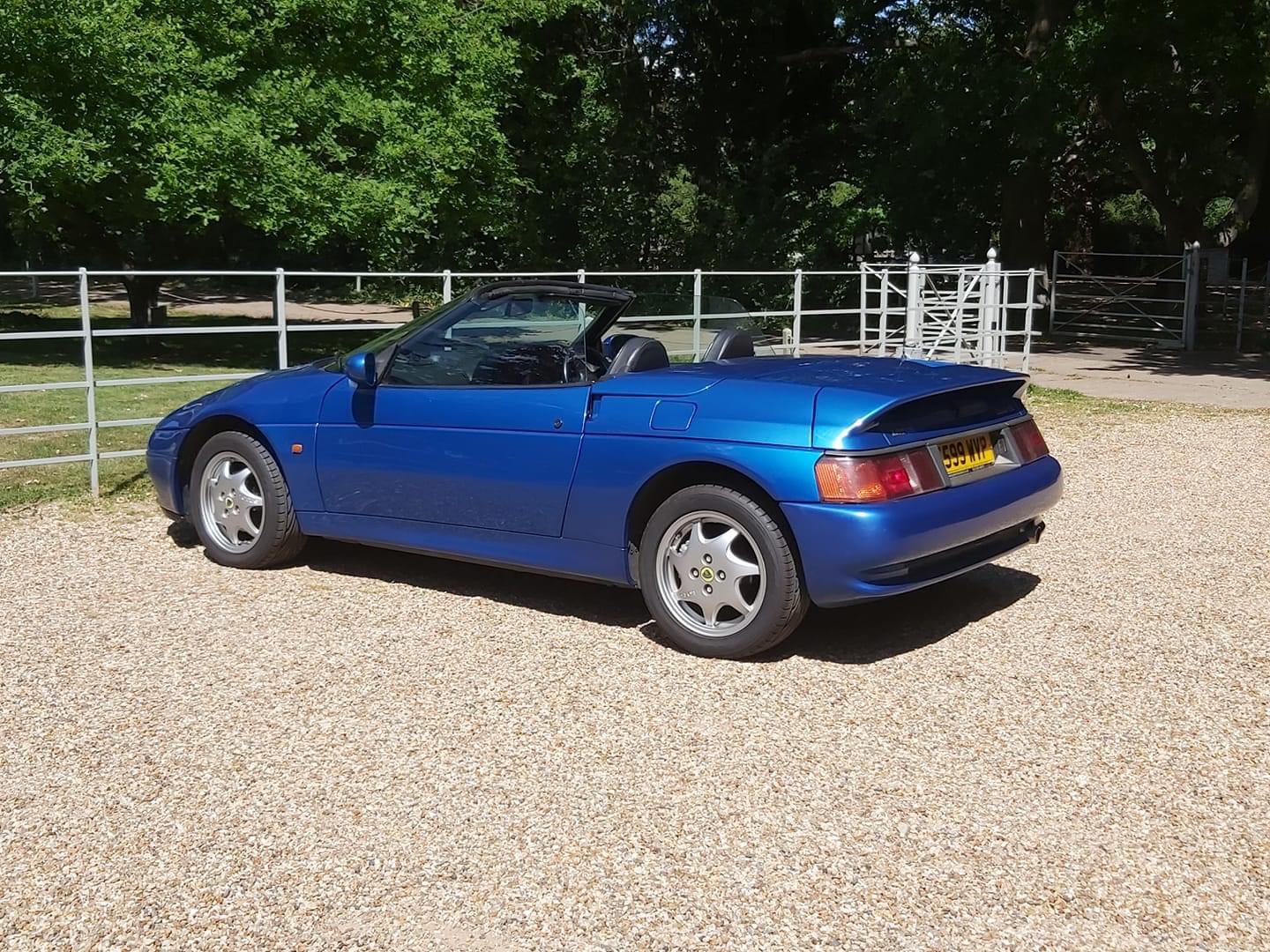
Since the age of 29, I have always had car that was a convertible.  When we bought the Moody I sold my beloved Lotus Elise 111S that I had owned for ten years which contributed to the deposit.  Then when we decided to buy the motorhome, Maria traded in the BMW 650i which was also nearly ten years old.  At that stage, I no longer had a sporty car 😦

One of the advantages of having such a car, and suitable performance car training, is that it is possible to drive them in a spirited fashion if you have had a bad day and feel all of the stresses and strains ease away as you focus on driving the car quickly and safely. Over the last three years, I had missed that.

Maria blames our Matt for what happened next. A bit like Darth Vadar, I realised that Matt’s training was complete when he bought himself a Mazda MX-5 Mk1 with pop-up headlights.  His grandmother would have been proud of him, she liked a pop up headlight! Within a few weeks of him getting his current car, I was reminded of how relaxing and fun having a sports car was.  However, we do have a goal and so wasting a lot of money on such a car was a non-starter. But surely if I could find one that was an investment then I would be fine…..

As a firm lotus fan for years, my eyes naturally fell upon the 1990s Lotus Elan, a car that I dreamed about when I was on my own in my first house as the interest rates rocketed to 16.5% and I couldn’t afford to heat the house.

These are becoming a classic, described as the best front wheel drive car of all time and at the very least holding their value.

I didn’t the search and found one for sale on the cheap side but still with quite low mileage for a nearly thirty year old car of 65k miles. Matt, who is actually younger than the car, and I drove to see it and it was clearly quite unloved. The test drive was interesting since the handling wasn’t right and the engine warning light came on when the turbo kicked in. We negotiated a good deal but there was a list of things that needed sorting.

This list included: two slightly buckled wheels from pot holes, a leaky room needing new seals, fix the sticky waste gate which is a common problem and a pop up headlight that didn’t work properly. All pretty minor stuff that helps get the price down and easily fixed.

The wheels were sorted by Wheelworx in Colchester and Ipswich who did a fine job and the car was driving very nicely. I decided to upgrade the rear brakes to a PNM engineering brake system which was done by hanger111, a great lotus specialist, which also looked the car over for me and confirmed that we had found a good s able to source a replacement seal kit for the roof which I fitted and stopped water pouring in although the lotus is a dry weather car if I’m honest. I was also able to fix the sticky waste gate myself reading articles from the internet for inspiration. A few niceties such as new floor mats and some stainless steel seat protectors to replace the old rusty ones and she looks completely different. I also think that she is worth a lot more now that she is mostly sorted.

Unfortunately, Maria isnt much of a fan since she likes her creature comforts too much but it helps me to unwind so all good 🙂

A weekend of maintenance

We’ve been lucky to get out quite a bit recently but eventually there comes a time when you need to just make sure everything is ok. So no more fun and do some maintenance.

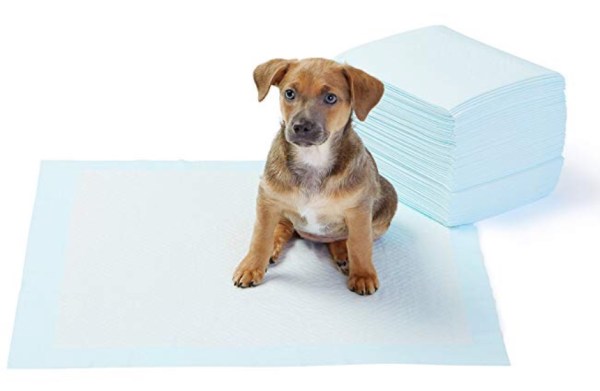
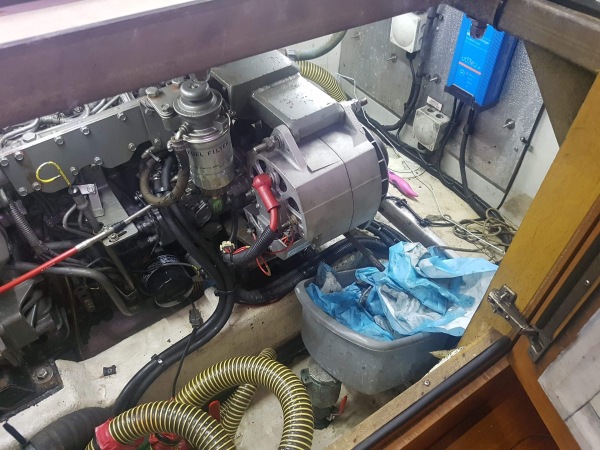
This weekend was our opportunity to do this.  We had noticed a little oil which had mixed with water in the engine room and although there was only a little, we had decided that this needed to be fixed.  Unfortunately, the source of the oil issue wasn’t apparent so step one was going to be cleaning up the engine room so that we could definitively see where the oil was dripping from the engine. DC8E6737-75A6-406A-84EF-F273E3A11A13Maria got some top quality advice on how to do this by cleaning up using Pet Training Pads which soak up the spills really well.  Don’t tell Bonnie and Clyde that they are puppy pads. These allowed me to clean up most of the mess.  That makes it sound easy.  The difficulty is that although Mariadz has some room around the engine, it is not ideal and to dry the floor under the engine, you have to jam yourself between the door and the alternator and try and reach under the front of the engine.  Being a short-arse with short arms and not as thin as a rake doesn’t really help.  It means I am dabbing down the pads using a straightened out hanger but it seems to work.  Having dried out the engine room I then threw some detergent and a little water in to remove any residual grease.  This just feels wrong after you have spent ages drying it out! ED91676B-D694-4F12-BF5A-C8EA3C511034Not least of all because of the alternator shaped imprint on your chest from having to lean on it for so long stretching to dry off the bilge. Interestingly, the mess looked worse than it was with the oil mixed with water. Not so bad an oil problem but the water is another problem we need to resolve. After quite some time, the bilge is squeaky clean which is also a shame because I know it will get messy again.  To make sure I know where the leak is coming from I lay down two puppy pads face up under the engine which will hopefully catch the oil and give a view as to where it is coming from.  The running of the engine is for another day though since we want to make sure that we don’t have a leak when the engine is cold. So next up is cleaning out the bilges of any water.  This could be from condensation, rainwater seeping in around the mast or from a problem with the deck drains or a problem with a through hull or pipe.  All will need checking out. 9424B7FA-2CD0-4723-AA72-18F9C4BD76B0Maria has bought a cheap Wet and Dry Vacuum Cleaner, she likes to shop does Maria! But it is very good and a little quicker than the manual hand pump that I have used in the past so I have begrudging admiration for her purchase.

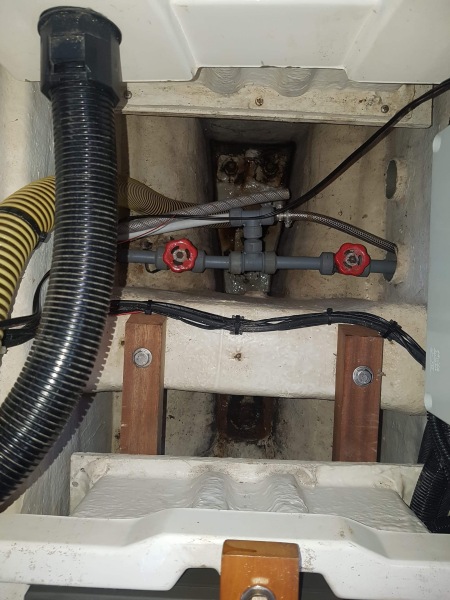
Maria is on a mission going into every bilge armed with a hoover and cleaning out even a drop of water. She finds some water at the bottom of the mast, which is not unusual. Apparently it is very difficult to get a good seal around the mast, not least of all with the strains a mast goes through with the sails up.  Little regular movements would probably break anything that provided a water tight seal and the gaiter at the bottom of the mast protects from most of the water but some gets through. 53620353-6267-4792-8937-4C42C342573EWe also have some water down by the keel bolts and this is soon gone. Finally, Maria decides that the grey water box is going to be spotless! First clean out the dirty water and then clean the box which looks amazing.  Just fill it with water to make sure that switch is working well and….. nothing… no pumping at all. Maria starts to apologise for cleaning our new switch and breaking it but it can’t be that. I check the connectors and everything seems fine, give them a little wiggle and the pump jumps to live. Right so a loose connection, quickly traced to the live wire. Firstly, I try to reuse the existing connector by bending it back using the new crimping tool, why do we try to botch these jobs?  Eventually, common sense prevails and I decide to put a new connector on it. EEBED97D-1C03-4255-AC99-2AB1DFFFD234 Unfortunately the small box of connectors I have is in the toolkit in the motorhome.  I ask Maria to pass me the keys without being clear and neither of us check, it is only after I have walked a couple of hundred metres to the far car park that I glance into my hands to find the keys for the land cruiser. Ok, all the way back, ask for the right set of keys, both of us check it and I return to the motorhome. Pull out the old crimper, you can’t have too many, and the small box of electrical terminators. It is only as I return to the pontoon clutching these that I recall that I bought a big box of terminators which is in one of the spares areas on the boat and I already have a much better crimper on the boat! So that is 30 minutes of my life I will never get back.  On my return, Maria says she thought it was strange that I wasn’t using the ones on the boat…. bless her for not mentioning it! New terminator and industrial crimper later and we have a positive connection that looks good.  Quick pull on the wires to check and the negative comes off in my hands. Seconds later that one is done too and everything is working as it should.
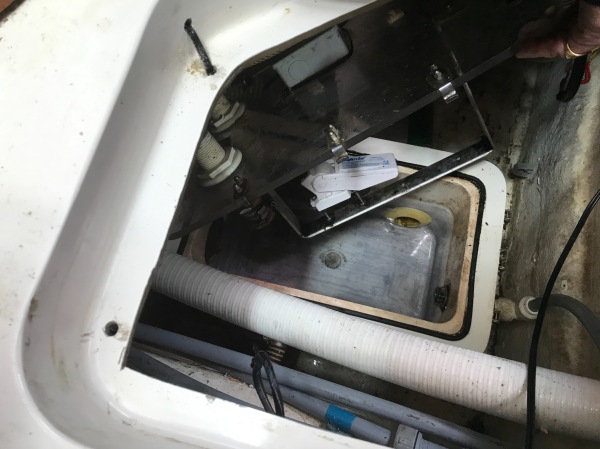
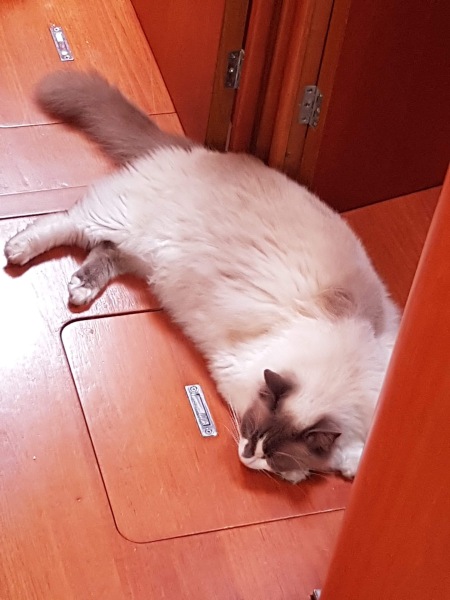
As we have been lifting the floor boards, one of those truisms comes to the fore.  I have always noticed that a “simple” job always seems to end up in a few more jobs. The cleaning of the grey water box was a perfect example. EC0783F3-B77F-47D6-849D-A7EB1114C7CEOn this occasion, lifting the floorboard and the metal lifter comes off in our hands! This was obviously after Clyde had woken up! Right, longer screws required which is where my reputation as a hoarder comes in well. I have a box of assorted screws, bolts, nuts and washers collected over time.  Of course the one I am looking for takes some searching but it was never in doubt that I would be able to find one that sorted this latest problem out.

Now to see if we can trace the water leaks.  Quite often we have to bleed and prime the water pump for the air conditioning unit in the aft cabin.  Some of the water will be from this process but not much but maybe the pipe isn’t on properly and leaks when the unit is being run? A test shows that isn’t the case. The next test will be the engine.

So a couple of days later, it is time to do some more work on the engine and there is no trace of oil on the laid down pads. Right then, time for a proper test under load.  While in our berth we will run the engine under load for a period of time and see what happens then. Although, Mariadz is tied well in her berth, I decide to add extra springs to spread the load as the engine tries to pull Mariadz out of her berth.  We will be going astern, so away from the pontoon.  Probably better to be heading away from the pontoon if anything gives rather than straight at it! I have set the revs to a shade over 2000 which is good enough for five or six knots in open water and the lines are holding well. Ninety minutes later, we inspect the engine room…. to find some oil dropped off the front of the engine behind the alternator. I have never been so happy to see a problem, it means we can set about fixing something that has annoyed me for some time.

When looking at the front of the engine you can see a line of wet oil coming from where the domestic alternator joins the engine. I am going to ask Lindsay from Seapower to help make sure that we fix this properly but we will go the work together.  A few days later, Lindsay and I are looking at the problem.  It seems that the leak is coming from the cover directly behind the alternator so the alternator will have to come off.  Of course I have had to do this before when replacing the alternator the other year and hopefully the relatively recent fit will make this a simple job.


An hour later, the alternator is off, the cover is off and we can see the culprit. The gasket is damaged and oil is seeping between the cover and the engine block.  Something so simple.  We will get in touch with Yanmar and order a couple of these, fit, test and then we can set about a full service. Tune in next week for the exciting conclusion…. quite exciting conclusion… alright, conclusion.

A cheeky play down the Orwell

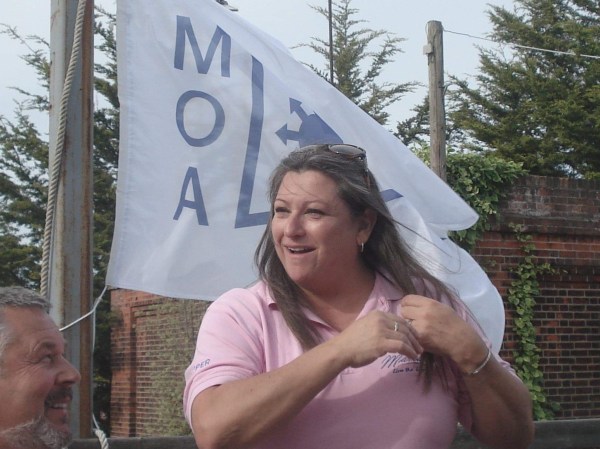
The second May Bank Holiday was also the second time that Ipswich has hosted the Moody Owners Association.  As much as Maria enjoys the social element of this, she does miss the opportunity to go out for the whole weekend and to go a little further afield. However, she had plans to make sure she did get out for a while.

The event was similar to last year with a barbecue in the old Ipswich Haven Yacht Club followed the next day by a few drinks, nibbles and cakes.  This time there were fewer attendees with a few people popping up even if they couldn’t bring their boat.  This included a new friend with a Moody 54, Rene from Amsterdam, who’s yacht is currently being fixed at Fox’s Marina, having only recently acquired it.  We had spent a bit of time with Rene, who has some great ideas for looking after the Moody.  I suspect there will be more on these in future blogs as we ruthlessly copy his good ideas!  We had been asked to start the Saturday afternoon fun a little earlier than usual so at 3pm we are all set up with some music playing from Maria’s portable karaoke setup.  As always in these situations, you are either running late or ready with loads of time and on this occasion we were sitting around for an hour waiting for anyone to turn up 🙂 At least the weather that Maria ordered has arrived and it is glorious sunshine and warm, if a little breezy.

The event goes very well, with Maria’s salads all being finished, and we all know how much food Maria makes. I’m sure the alcohol we had provided also helps with the atmosphere but a lot of people have also brought their own drinks.  We had asked everyone to bring food for the grills and with two large grills set up, and lovingly cleaned by me for an hour, there is enough room for everyone to do their cooking. A236C7B7-1197-43A8-8EE3-4C71F64C91C9Towards the end of the afternoon, the inspiration of using the karaoke setup means that a microphone is available for a few short speeches by the branch captain, Giles, and then by Maria herself….  You can imagine. With a microphone in her hand, Maria kicks off with a couple of lines of “i’m coming out” and then settles into a short thank you speech, remembering to invite everyone over the next morning at 11am for cakes etc.  Fortunately, she keeps the speech quite short.  As the afternoon drifts on, the group start to head back to their boats but a hard core are still drinking and chatting.  A number of these are relatively new members, and with respect to all involved, young members too.  Previously we have attended Cruising Association events where we have been younger than most people’s children and although the Moody age range isn’t that extreme, it is nice to have people of similar ages, or at least as old as we think we are in our heads.  This also includes our friends Sarah and Russ who own a Westerley but have come up for the weekend to see us. Having cleared up, it’s nearly 11pm when we finish but at least the place is mostly tidy as we head back with a few stragglers to Mariadz. The wine and beer are flowing and we agree that Rene should not drive home and also that nobody else should drive him to Fox’s either.  This means setting up our bunk room, since we already have guests in the fore peak. This will be a first but it doesn’t take long to setup the top bunk and convert this room from being a storage area to somewhere someone could sleep. The night doesn’t end there with a few more drinks and eventually it is 1am when we fall in to bed. In fact, Rene decides that rather than sleep in the bunk, he will sleep up in the cockpit, fortunately we are on the quiet side of the dock at Ipswich!

The next day and there are a few sore heads. I have to go back to the yacht club to finish tidying up and leave it in a suitable state.  The yacht club area is offered to berth holders as a courtesy but has to be left in a tidy state or we will lose the privilege.  It’s nearly 11am by the time I have finished and Maria has also been busy getting the boat ready for the descending hoard!  Again we are ready in good time and the first few come on board asking for soft drinks or tea! They have clearly all been Mariadz-ed the previous day!  As more drift over, the beers and wine are out again and the nibbles are quite popular. 35C1BC93-5C8A-4BEE-BA10-37BEFD298B34 After some time, Maria whips out the two Victoria sponges and a carrot cake that she spent all Friday baking, she starts to cut large doorstops of cake whilst cutting off huge chunks for people to take home.  The cakes, made by Maria’s fair hand, are lovely and very popular…..just like her……. Last year, I must have been too polite since, despite my sweet tooth, I didn’t get any cake and none was saved for me – I was going to fall for that again and I am straight in this time.
After the unveiling of the cake, it doesn’t take long for the group to dispel and Maria’s plan to get down the river can be put into action.  We have decided to sail down the river into the westerly wind, it’s gusting a bit but we have decided with our guests on board that we will have a gentle sail down the river.  As we head into the lock it starts to hammer down with rain so we are not convinced that this is a good idea but we will keep on going.  Actually in the lock we see Easily Led 2, who are sporting a just married banner, about time Richard made an honest woman of Janet 😉 but we are really pleased for them as they head out for a mini-moon.

I may have mentioned that we normally sail with the Bimini and most often cockpit tent up which protects us from the elements and for that reason we don’t wear wet weather gear very often.  Of course today, I am on deck in shorts and a t-shirt tidying lines and fenders and after a short period I am soaked. It’s warm in the cockpit tent so I take the shirt off and down below to dry but no point getting another dirty and wet. At least got ice to get my waterproof coat out in case I have to go out in the rain again, maybe I should have thought of that earlier. This is highly amusing for Maria who thinks I look like some kind of porn star with a coat on and no top! To be fair it doesn’t rain for long as we head down river and we are making good progress with the sails up.  Of course since my short isn’t dry yet, I am still sailing topless which is highly amusing to everyone who passes us in full wet weather gear 🙂  

As we pass Wolverstone, there are a number of two seater racing dinghies (I don’t think they were lasers but don’t profess to know all the different types). As is usual in this part of the river, they are all over the place.  They are usually so focused on their racing that they don’t think about how  larger yacht can avoid them.  This isn’t normally a problem and we give them a wide berth but when they are short tacking up river, it can be tricky working out what they are up to.  Today one in particular is tacking right in front of us setting off in one direction and then changing direction abruptly. It wasn’t the most seamless of tacks and their direction of travel seems to be random from one second to another.  They seem completely oblivious to the emergency turns we are doing to avoid them as they aim straight at us. They slip by our port side with no acknowledgement of the problems they have caused.

We have decided to stay out overnight but where is safe to go in a strong westerly?The Stour runs East to West so that wouldn’t be comfortable, not even in Mariadz. We decide to anchor adjacent to Shotley Marsh really close to Felixstowe docks.  It is a little noisy but we will be fine and it is well sheltered from the wind.  But first we will have some fun sailing.  With a westerly wind the best plan is to actually head towards the North Sea for a while where the path is north to south.  This is the same as the last part of the Orwell and I ask Russ if he would like the opportunity to hand steer Mariadz.  He jumps at this and with well-reefed sails we are soon going quickly through the water at over 8 knots.  This causes Sarah some joy since the other year when swimming around her boat she introduced herself to a buoy showing the speed limit of 8 knots adjacent to Osea Island. She may not have been completely sober at the time and was unfeasibly excited.  Since then buoys called 8 knots have been her favourite! Russ gets Mariadz up to 8.5 knots through the water as she cuts her way down river.  The lovely thing about the Moody is the balance she can get on the sails, the wheel feels very connected and the steering is light even in a strong wind. Russ is loving it.

As we make the turn towards Harwich everything slows down as the wind drifts round to the starboard quarter. The wind hasn’t dropped but the perception has because now we are travelling in the same direction as the wind so it is not as fast across the deck.  This can be quite unnerving especially when you turn around when the wind changes.  It can be worrying to feel hat the wind has increased by around fifteen knots, which is quite a stiff breeze, just by changing your course.  Anyway the north-south section of the Orwell has whetted our appetites and we decide we will do a similar section out of the harbour. It’s time for Sarah to take the wheel as we turn from Harwich harbour onto the same course as Russ had negotiated down the river.  The speed starts to build and there is a little more wind. Eight knots shoots by and Sarah is starting to look a bit nervous as the speed rises through the eights and over nine knots.  We get to 9.3 knots before Maria decides enough is enough and we should slow down.  That’s pretty good especially against the tide.  We all decide that it must have been 9.35 knots which makes everyone happy except Russ who is itching to have another go and beat the new “record”.  I’m sure with a following tide it would have been over ten, eh Sarah……

Ok it’s time to turn around and head back to our selected anchorage. Maria has decided that, with the wind strengthening, I will take in a little sail so there is no opportunity to beat our record for the day but it is still a really pleasant fast sail back into the harbour.  As we turn into the harbour to head towards the Orwell, we come up quite tight to the wind.  As mentioned, at any speed that is more uncomfortable than running with the wind with the faster wind speeds across the deck.  In preparation for this and knowing we will shortly be anchoring, I have reefed in more sail before we make the turn.

This coincides with a noticeable drop in the wind, probably caused by the wind shadow from the land. So we are travelling through Harwich Harbour at a slow pace but we have had our fun so it is fine. We approach the area where the rivers split, we need to cross the river Stour entrance to head down the Orwell.  Suddenly, there is a call from the cargo ship following us.  Normally, we steer well clear of anything on the water even if we are within our rights to hold course.  It just seems a safer way to go since it is everyone’s responsibility to avoid a collision and there is no “in the right” when your boat is damaged! Therefore in ten years of sailing, and we sail a fair bit, I don’t think we have ever been called up by another boat in this way.  That changes today as the cargo ship, travelling somewhat faster than us, asks us our intentions. As we are sorting ourselves out to make sure we are not in anyone’s way, the harbourmaster also comes on the radio.  Maria is able to explain that we are going up the Orwell at the same time that they notice our route.  They can then turn behind us to head down the Stour with no problems but it is a reminder that you always need to look behind since we should have sorted this out a lot earlier, in our defence, more ships head up the Orwell but it is a reminder that we need to keep alert.

As mentioned we have decided to anchor near Shotley where we have tried, and failed, before. I have found a spot out of the channel and marked it on the chart and as we approach this spot seems to be exactly where a small motorboat is anchored and fishing,  we quickly adjust our views and Maria has found a new spot, which is away from the channel and not too close to the shore.  When sailing, Maria and I hardly ever have a cross word and actually never when we are on our own. There may have been a slight “difference of opinion” when I asked for depth at admittedly high tide to be told we were in 10 metres of water.  Generally, we like to have a metre or two under the keel at low water but this is excessive. I point out that we normally have it a little shallower than that…. once or twice. Of course I hadn’t thought of checking the depth prior to starting to drop the anchor.  I gently suggest that we sort it out and go closer to the land.  The second or third time I suggest this is enough for a slightly snappy reply 🙂 We “agree” to bring the anchor up, which is good since I had forgotten to attach our marker buoy to it anyway, so at least on the second attempt I can remember to follow our anchor routine properly.  We get a bit closer to land, which doesn’t feel right but the depth is fine as we swing round after deploying the anchor.

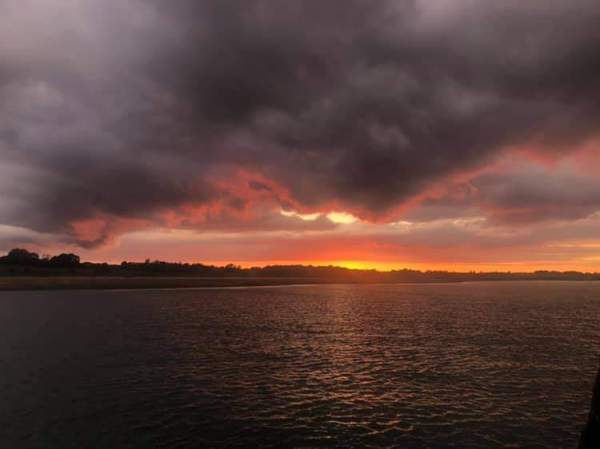
FB_IMG_1560185634773A few stern words between Maria and I don’t last very long, which I guess is lucky in a boat where you can’t really get away from each other, and we are relaxed as we watch a spectacular sunset.
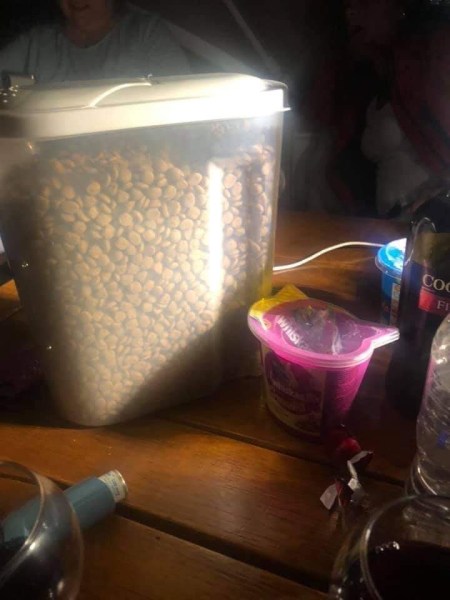
It is another lovely dinner from Maria but we are all quite jaded from the night before and suspect we will be in bed by 9pm…. yeah right. By 8:15, it is looking like 9pm is a bit ambitious as we sit in the cockpit chatting and, unusually, without music playing. Having eaten, we are all noticeably starting to wake up though, and that is before we start on the port. A little bit more port and some of the gathering are wondering why Clyde is always moaning for cat treats. E1A7C598-463A-4CFA-9BCA-409A0789496BThey must be really tasty…..OMG,  Nooooooooooooo. Russ, Sarah and Maria all try the Royal Canine cat biscuits. These are apparently quite nice but you wouldn’t catch me trying them, not least of all because I couldn’t deny the cats! These greasy “yummy” treats are washed down with a little more port before Sarah informs us that she was “Cleaning my teeth with my tongue and a tiny bit of cat treat came out….”, yum, yum.  It’s clearly getting later and we are starting to run out of port so it’s time for a great nights sleep, nicely sheltered from the wind.  Well it can’t be later than 9pm, 10pm, 11pm, not 1:30am! Oh dear.

The next morning we are up at a reasonable time to start the sail back up the river to Ipswich.  Russ is confident that he will beat Sarah’s record but if this is possible it will be in that first section of the river which goes North so that the Westerly wind is perfectly positioned. You can see lots of sail boats are having fun in the river today so after a quick breakfast, we pack up and are ready to sail immediately.

This slideshow requires JavaScript.

It’s a good wind but I still have a flea in my ear from Maria for having too much sail up yesterday so we are well reefed which means no faster than 8 knots – at least Sarah will be happy. Russ is not so happy but I am more scared of Maria than I am of him – sorry, mate 🙂

We make the turn at Suffolk Yacht Harbour, after which the Orwell snakes approximately North West, not ideal in a Westerly wind and we will be tacking most of the way home.  Maria and I rarely do this but Russ is keen and we actually start off the journey by tacking the headsail with the stay sail and main both out too! D1ACF413-41ED-4048-ADDD-5AE7ACC805A6 This is quite difficult since getting the head sail around the stay sail takes time and effort.  It does give a photo opportunity as our friends Christian and Elizabeth are on a buoy down the river and see us tacking so that’s good. You don’t get too many pictures of your own boat under sail.

After a while, Maria gets bored of winching this in and we are making less progress in a wind that is not as strong as it had been the previous day.  We bring in the headsail which means Russ can tack without anyone doing any work, that’ll make the girls happier.

We are able to sail all the way back home so we feel accomplished and have done quite a bit in a short weekend. Maria brings Mariadz into her home berth with no fuss and our friends can head home after a great weekend!