Category Archives: SY Mariadz

Almerimar to Sicily

Christian and I have arrived in Almerimar and it is now time to start thinking about leaving, all of the repairs are done and we need to start preparing. Our stern to mooring means that we have the pasarelle out to walk to shore which goes under the solar. To achieve this the rib is down and since the passarelle is stored in the lazarette, and we had work done in there, the entire contents need to be reloaded.

We have spoken to our neighbours who have suggested we can step across their boat if we need to get ashore after we have stored everything. This is particularly useful when putting on the rib cover which is possible just from the boat but is a lot easier if someone is on the far side making sure the cover is in the right place.

It takes some time to load our full lazarette with everything fitting into place like a jigsaw. It is difficult and especially surprising when we consider the stuff that isn’t going back in. How did we get it in before? The rib is lifted and the cover on but again it is taking time and it is looking like 5pm before we leave even though we started preparing at lunchtime. Finally, I need to adjust the stern lines so that we can slip them off from the boat. This is easier said than done since they refuse to budge and after much swearing and eventually putting mariadz into astern so that we can ease the pressure on them, we are able to get them ready.

Leaving the berth is easy, we drop the lazy lines that have held the bow for two weeks and let them sink before we head off. Maria brings Mariadz off sideways so that we stay away from the boat next to us and we are clear. Off to the fuel pontoon to top up the tanks with about 100 litres before we head off.

The wind is blowing across the marina and is reasonably strong at about 15 knots as Maria approaches turns hard over and ferry glides into the concrete fuel pontoon with the fenders taking the pressure before we tie her on. We add 94 litres of fuel and Mariadz is completely full and we now have 670 in the rank and another 85 in cans.

As we prepare to leave I am overthinking about the wind and decide that rather than doing our normal approach of coming off sideways, we will spring off as we have multiple times before which gives us a safer method when the wind is blowing you onto a dock. This involves loading up the bow with fenders and Maria moving mariadz slowly onto these and the dock which moves the stern out into the channel. Once it is out enough, you slip into astern and come off backwards before, once far enough away, turning and going out as usual. With our sideways approach, you steer into the dock with some revs to get the stern to “bite” which moves it out and then bow thrust off to get the bow out there and then drive off. As you can see these manoeuvres are very similar.

I clearly haven’t communicated the change of plan properly and Maria was down below when I moved the fenders to provide the protection for the bow. It means we are talking at cross purposes when I say steer in and go forward. maria thinks we are coming straight off but when she goes to use the bow thruster I tell her no but she is committed and has used the right power for the plan she thought we had. The hull hits the the fuel pontoon in the only place I didn’t have fenders. What a terrible start and Maria is blaming herself when it isn’t her fault. Firstly I hadn’t communicated well enough, then I didn’t have fenders along the whole side, even having one I hadn’t moved over which would have gone beautifully into the gap, finally the spring on the bow which holds us to the dock for the manoeuvre was loose allowing us to move forward before it took effect which was just laziness and a lack of concentration on my part. There’s a mark and some damage so we will be paying our tax for being stupid. The marina staff have taken a look at the scuff but it will be Sicily before we get to fully view the results of our mistake. It is frustrating and upsetting and Maria blames herself even though it is my fault. Still better than her blaming me, we can’t have both of us doing that for hours 🙂

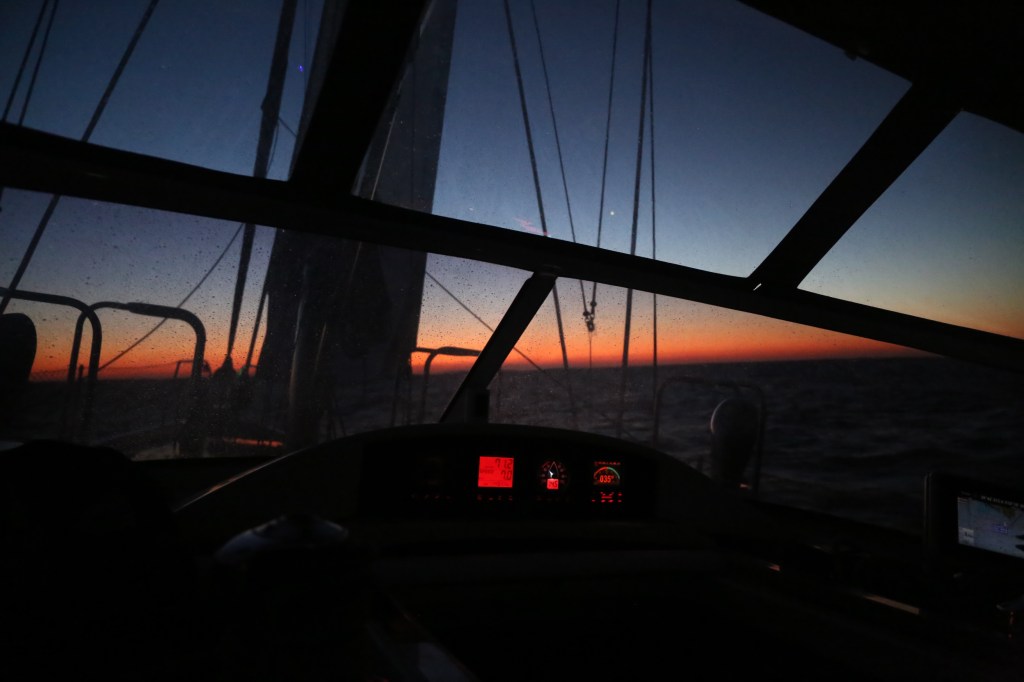
With a quiet boat, we head out to sea and set our course south east to clear the headlands before heading nearly due east towards Sicily.

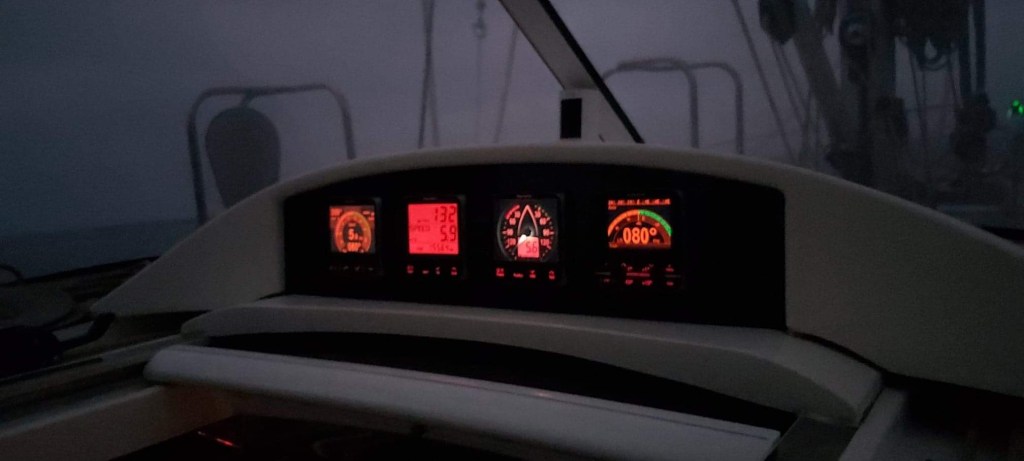
Our new engine communicates with the navigation so we now have full engine data that can tell us exact consumption at the revs we are at. Unfortunately we are still in a big sea and the wind is of course on the nose. All this is holding us up and we are at quite high revs making little progress. This trip looks like a lot of motoring with the five day weather forecast we have. Hopefully we will be able to use our sails to conserve some fuel. On average, at higher revs we are getting about one mile for a litre of fuel, which makes the range calculation easy! The timescale for our fuel is also easy since it is just under five days at 6 knots. This improves drastically if we are reasonably motorsailing and is of course best when we are sailing.

We head out and drop below the headlands to due east which is pretty much our course for the next five days!

However, we have been very silly. We have celebrated my return and the arrival of Christian a little too much and we are hungover and dehydrated. So I have now destroyed our immaculate record of not feeding the fish through Biscay by making sure I had an empty stomach on the first night! The next morning, I am a little better but the combination with little sleep is not good and I will need to recover my stomach slowly and gently having made sure the fish were ok again!

There are three of us on this trip and so a change to the watch system was required. We toyed with a few options, three hours on and six hours off is popular. However, we had benefited through Biscay having two people on watch and although that isn’t possible this time without wiping people out, we are keen to have a good overlap. We finalise our thoughts for the first night as effectively three hours on but you stay for an extra hour when the new person comes on watch. This means you have company for half of your four hour watch, which is nice but also useful if we need to change sail plan, and everyone gets a five hour break which should give the opportunity for a proper sleep and ensure this is sustainable for a number of days. We promise to review during the second day to see if it works but the first night I always a bit strange because everyone is excited and maria and I are also beating ourselves up for the fuel pontoon mistake.

In Almerimar, before we left, some of the crew of a large oyster, Dalliance, met us since we had mutual friends in Ipswich. They are planning a similar trip but intend to leave a little later than us after their evening meal. I’m sure they will catch us up though.

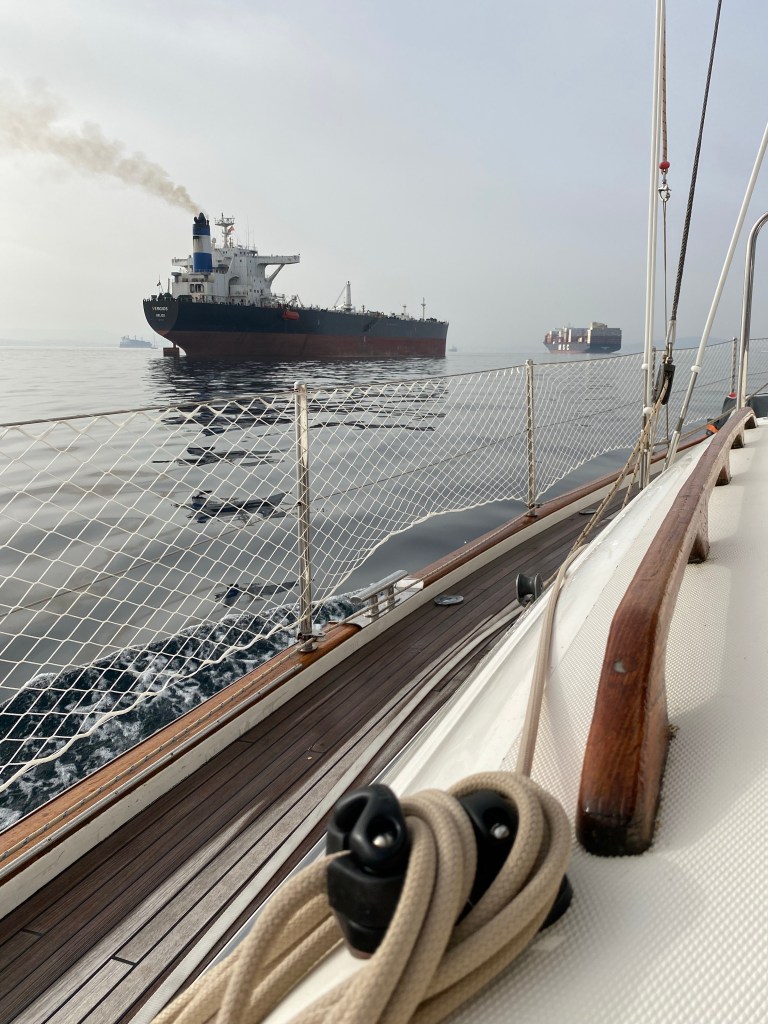
This trip is generally in 2-3km of water with only the occasional passing cargo ship to break the monotony. Apart from the dolphins shortly after leaving which were doing acrobatics off our port side but they didn’t come over to play with us, we have found med and Atlantic dolphins to be quite bashful, although it could also be that we aren’t going fast enough to give them entertainment in our bow wave.

Our evening watches start at 9pm and Maria has prepared us fajitas for dinner. I will be Maria’s company for the first hour. The wind is building but still in our faces and is rising to 20 knots. Maria and I implement our nighttime sail setup which will be half the main. That done, mariadz is Comfortably riding the swell but it is a bit bouncy for the rest of us. Still, we knew it would be like this for the 24hours out of port but we hoped we would make a bit better time.

The first set of night watches are fine although we did have to cross a busy route during the night, something I usually try to avoid. Our watch system also requires one person a night to do the first and last watch. Accidentally, I have let Maria do this which wasn’t my intention but I guess we will each be doing this over the next three days so much of a muchness. In the morning, the swell is dying down but so this is the wind until some clouds on the horizon promise a little more breeze. Christian and I are quick to seize the opportunity and get the main fully out as well as our staysail and headsail. We are cruising along at nearly seven knots although the engine is also helping at a measly 1500 revs. This means we get more than 3 miles per litre – that’s more like it. Except, just as we are settling into the ride, it’s over and we are back to 4knots of wind in front of us so the headsail and staysail go away and we keep the main for balance.

This sets the tone for the rest of the day. The monotony only being broken by Dalliance, the oyster from Almerimar, hailing us on 16 to see how we are doing and the occasional passing ship. This is of course mine and Maria’s wedding anniversary but no time to celebrate 😦

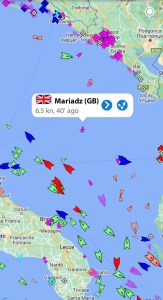
Night two and I am on the double shift while maria and Christian each have the single shift and the odd hour. During the day we have taken advantage of the easy nature of the trip to catch up on sleep so hopefully we will now get into the rhythm of the watches. Just as we start and Maria goes to bed we are buzzed by a couple of dolphins jumping out of the water on the starboard side. They head to our bow but quickly get bored of us and move on. That is the sum of our excitement for the evening apart from the odd cargo ship coming within a mile or two. All of the shifts are like this until the last one where I take over. We can see on AIS that we are being caught by a cargo ship who will overtake us but at exactly the same time there is one coming the other way straight at us who is also being overtaken by a fourth ship. So the two of us are quite constrained. We all jostle for position and there is a mile between all of us as we simultaneously meet in a line. It was the most excitement we had all day! The last part of my shift is on my own, and having heard Algeria coastguard informing all ships that the gulf of Algeria has navigation prohibited, I recheck our course. We were planning to be 15-20 miles off shore so outside of territorial waters which is the direct route to Sicily but I will move us a little further offshore. I also adjust the waypoints so they give us an expected target for each day, let’s see how that works out. Breaking the tedium continues as I get all of the engine and fuel data on one of my navigation screens and adjusting the screen for the handheld autopilot… you have to have some time on your hands for that. Of course, the fixed autopilot is creating this time as it operates perfectly with its replacement part and having been rebuilt expertly.
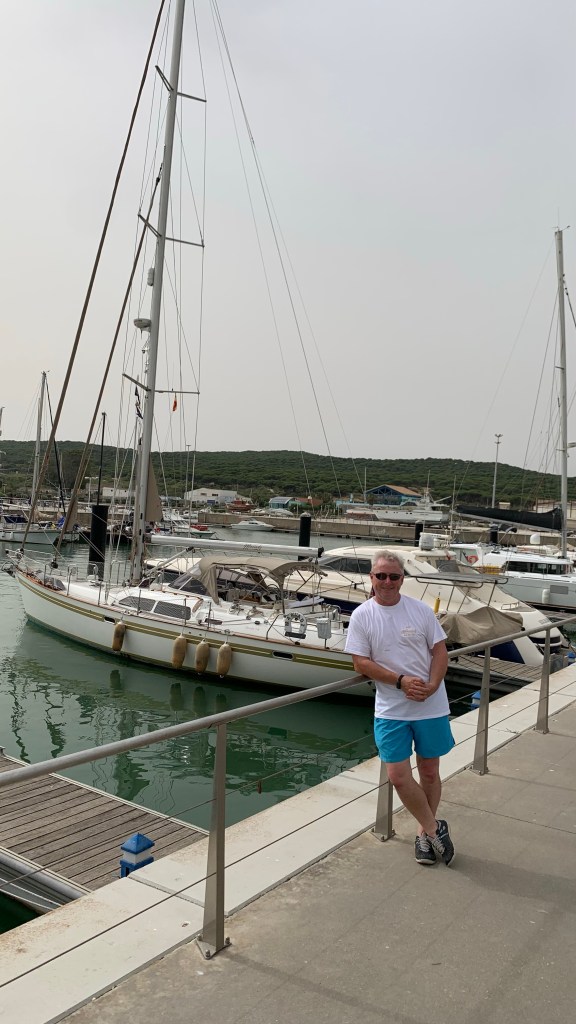
As the morning progresses, rest of the crew emerge, they have all had a good sleep. It’s hot and sunny and I sit here writing notes, as Christian reads,having updated our log, and Maria lies around in her bikini. Time for me to get some rest.

They say that the Mediterranean has two types of wind: too little or too much. For most of the day we have had a gentle westerly that has been just enough to mean no wind is going across the deck. It is 30+ degrees and very hot and sticky. Time for maria to break out the dominoes and teach Christian tabletop warfare!

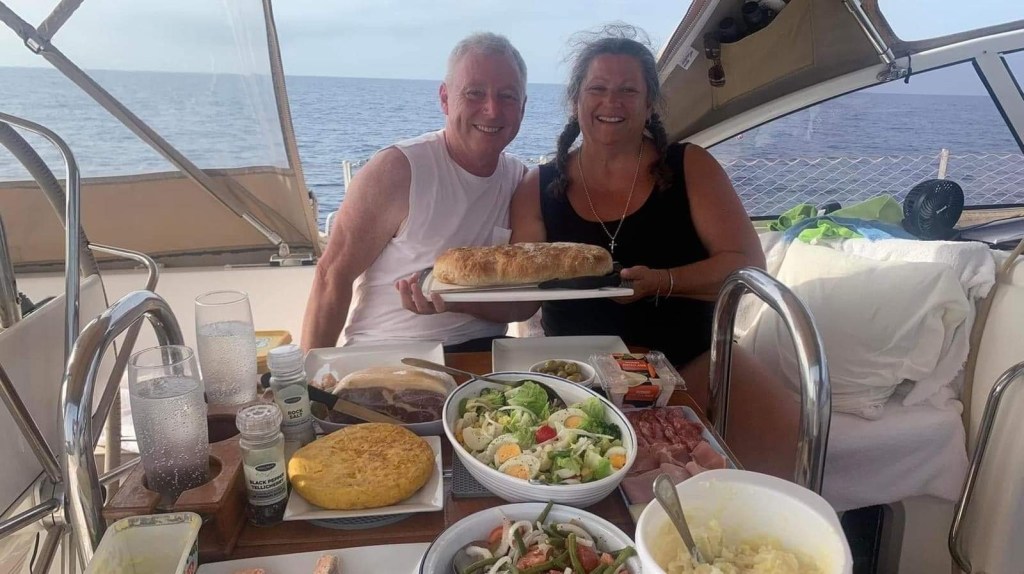
Maria has decided on an early Mediterranean style dinner with salads, meats, tortilla and cheeses. It is perfect at the end of a really hot day with some really great tastes. We are still seeing very occasional ships and a bit of rubbish in the sea but we seem to be in our groove now.

Another monotonous night with very little to report except the very occasional encounter with a cargo ship. However, visibility drops to about a mile so I put our radar on to make sure we can see and be seen.

It is three days since we left Almerimar. After a slow start we have had a couple of consistent days of approximately 160 miles a day. However, there has been negligible wind to motorsail and what wind there was on the first day really slowed us down. Three days of solid motoring has used a lot of fuel too. At reasonable revs, we use about 5-6 litres an hour so we have probably used half a tank getting to here and we will need to refuel. Our options are Sicily or Tunisia for refuelling which are both achievable even if we have to motor all the way there. You would have thought that Tunisia, as an oil state, would be cheaper for fuel but I guess there is only one way to be sure… over the next 12 hours or so we will have to make a decision, especially if we want to be sure to arrive wherever we are in daylight. Tunisia, as nice as it would be to get cheap fuel, is unlikely having rechecked the visa requirements and not knowing whether they would just let us refuel. It seems unlikely from the books and we can’t access the internet to check real world experience. In the interim, Christian and I add the spare fuel from the cans to the tank using my clever little pump which ensures no mess.

In the morning, we are hailed by name and call sign, always a sign of officialdom. Have we done something wrong? We heard the previous day, a standard Algerian message concerning their waters being protected from any traffic but we are a long way outside of this. The call comes from “naval operations” who are asking us our destination. It is a very polite conversation with us each referring to the other as “sir” as he requests our destination port and I explain that we are heading to Marsala in Sicily. It starts another day of keeping an eye on big ships and seeing lots of plain sea with the occasional dolphin coming over to play.

As night approaches, we have a little consistent wind on our port side and are able to take advantage by motor sailing with all sails up. We are bombing along at over eight knots through the water but the tide is against us at the moment so we are only going seven over ground, it imagine how slow we would be without sails. This continues for four or five hours which means we have a good start to our fourth day at sea. Our moods are improved even further later on when a pod of dolphins, probably around twenty, come over to play. They are jumping fully out of the water and as usual it warms the spirit, not that we need much warming, it has been hot again today.

We are back to the day 1 watch which means Maria has the double watch and Christian and I have the odd hour at the beginning and the end. The watch starts fine and just before I finish at 10pm, I check the ships and make sure we are ok. Fifteen minutes after I go to bed though there has been a wind shift and our rig of half main and stay sail is not doing anything. In fact the self tacking stay sail is now bouncing around the track which will wake Christian up. Maria gets me up to help with the sail change, we take another moment to review the traffic coming up and then it is back to bed for me and Maria has two hours on her own. Maria continued to be busy as we approach the funnel between Tunisia and Sicily which should be very busy with shipping. Maria is relieved by Christian at midnight and that is her opportunity to get four or five hours sleep before she is back on watch. Unfortunately Maria has been really struggling with sleep for the last few days. I think being out of contact whilst looking for a job, having a daughter who is ill, a cat that is ill and everything else is weighing on her mind and she is struggling to switch off. When I get up shortly before 3pm to take my watch, Maria is up with me saying she can’t sleep. We have to change round the watch system since Maria is going to stay up, so I am back to bed for a few hours and will get up at 6am when hopefully both Christian and Maria will catch up with their rest.

In the morning, the wind has completely changed direction but not enough to allow us to sail. It’s not as bad as the other day when the wind exactly counteracted the speed we were doing which meant that there was no air going across the deck and it was super hot. The morning is brighter than recently and we can actually see the sunrise rather than just thinking someone has switched the lights on. We now have 200 miles to Sicily and our scheduled stop for fuel. Hopefully, the forecasted weather from Saturday confirmed over the radio today will mean that we have a little more wind to play with.

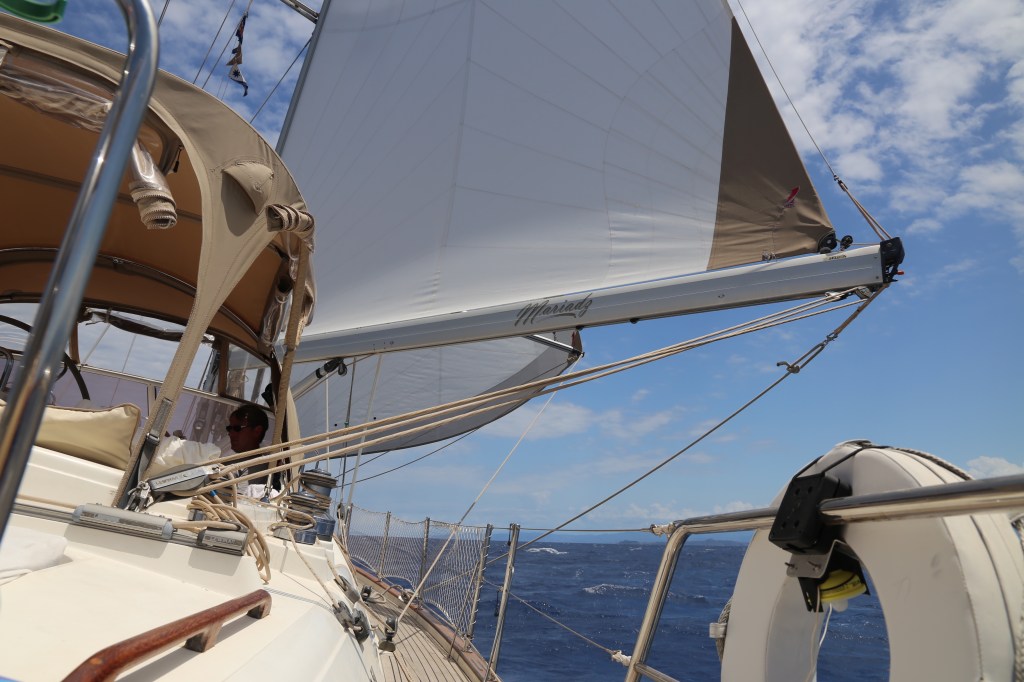
It comes to pass and suddenly we have a bit of a westerly wind. Enough for us to set up goose wing with the main on one side and the Genoa on the other. However, we are rolling quite a bit which makes the sails lose their shape and bang and clatter as they get it back. We are doing over seven knots so there is no chance of us stopping sailing! The solution to this is to use our pole to stop the Genoa from losing its shape. We did this a bit in the Biscay and Atlantic but struggled getting the Genoa sheet to work through our netting. I mention to Christian that we may take a few attempts to get this right but miraculously I choose the right loop in the brat nets to thread the sheet through and it is barely pulled at all when the sail is set. Immediately there is an acceleration as the sail sets well and stays there.

Over time the wind starts to bare to the north slightly which matches a prediction maria has been able to get from the Italian radio. We keep turning a little south to keep our goose wing working but at around lunchtime it is time to turn back to our track with the sails on the starboard side. For protection and because of the swell we have kept the pole out with preventers on both the pole and boom which should stop any risk to the rig. We have made good time during the day with the wind’s assistance.

Maria prepares a seafood pasta for dinner with the last of the bread she made the other day. As always it is delicious although a still very tired Maria keeps asking if it is ok. We are then into our fifth day at sea and our last night before getting to Sicily for refuelling. For most of the previous four days we have had shipping around us as we beat a well trodden path from the Gibraltar straights into the heart of the Mediterranean. We are now veering off towards Sicily when most traffic is heading further south. The night is incredibly quiet because of this with highlights being ships coming within five miles of us. However, by dawn we are fifty miles away from Sicily and we can start to see the fishing fleet in the distance. It looks like we will get all our “fun” in one big hit! Actually, it isn’t as bad as it looks and the wind is non existent. We are now beginning to think about getting into Marsala and giving Mariadz a very welcome long drink.

On the approach to Marsala, I speak to the man running the fuel pontoon and it sounds like he will be at lunch when we arrive. No problem, we will wait on the pontoon for him to finish. That sounds fine and we finalise the approach passing a French boat as we enter the harbour.

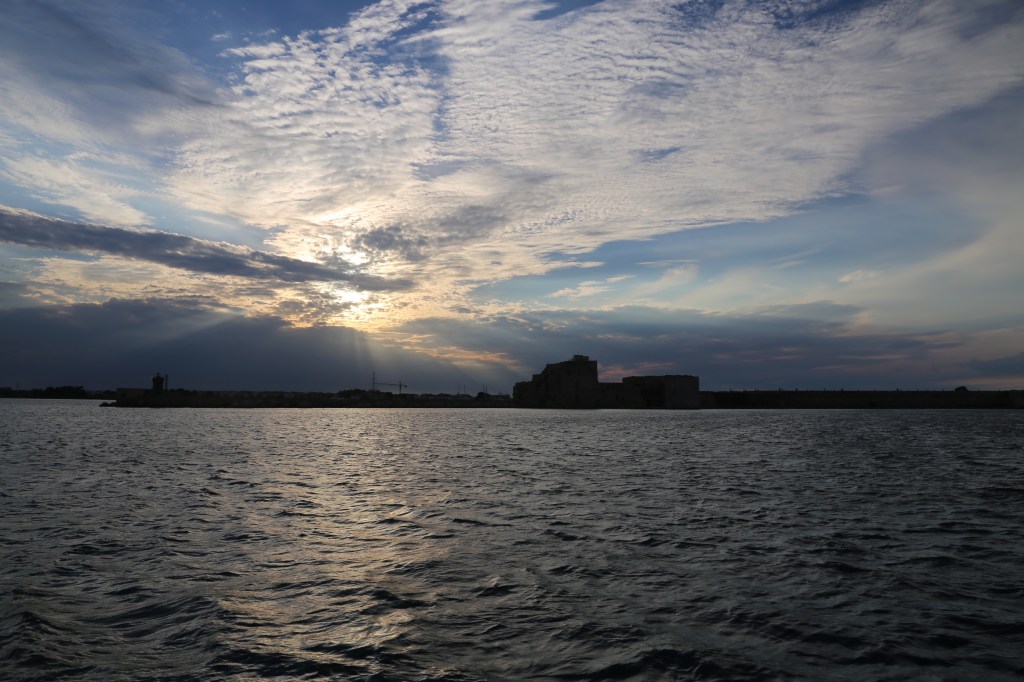
Maria is behind the wheel and the area for the fuel pontoon looks really tight as Maria goes into that channel. Then there is a man frantically waving at us. He wants us to one in stern to using lazy lines and has brought the fuel line all the way down the pontoon. Maria is able to stop Mariadz before she is too committed and comes back to the pontoon bringing her in to the pontoon expertly. We get her tied off and the refuelling can begin.

Almerimar

We have arrived at Almerimar with a few jobs to do, again. However, I will be flying back to the UK to return to work although Maria will remain in Spain for at least a week. With the boat going to Italy, we have lost our home in the UK, and as good as living with each of our children for a few months sounds, we will probably need our own place, not least of all so we can take our furniture out of long term storage. Unfortunately, the letting agency have demanded to see us face to face prior to handing over the keys and seem to want Maria to fly back to the UK just to do this. On my return I am able to persuade them against this so Maria is able to stay.

Maria selected Almerimar because it was a large marina in a reasonable place for our route and apparently it was one of cheapest in Spain. I will talk more about the work in a moment but as able to stay there for two weeks, have all the repairs done and refuel for less than Cartagena wanted to charge me for berthing. Considering the price difference, we weren’t expecting much if we are honest but we were really pleased. The security on the pontoons was good, you couldn’t get on the wrong pontoon with the fobs. Although the toilets could do with a refresh, we always used the boat facilities anyway. We also found, in common with all of Spain, the staff really helpful and welcoming which goes a long way in our book.

However, before I go we need to organise some works. Almerimar has a large yard which looks very professional and flush with the success of our trip to Vigo, we walk in expectantly and hopefully. As we walk into the office/shop, there are three people behind the counter, they all stop and stare at us. We say hi and does anyone speak English. The response is they do but an Englishman, let’s call him Dick to protect the innocent, curtly tells us that he is serving a customer and we will have to wait. We hadn’t meant to interrupt and in fact hadn’t said a word when they all stopped and stared at us. Not a great start.

There is cold water in the customer area and it has been a long walk in sweltering conditions, so we grab a small cup of cold water each. Dick stops again and tells us we will have to pay for that, which is apparently just a really poor joke, but this isn’t starting well.

I am thinking that the conversation with the other customer isn’t particularly helpful or friendly as well but hopefully we can break down some of these boundaries.

Dick finishes with the other customer, sending him away and turns his attention to us. We have done a fair bit of motoring since leaving Plymouth and the first year, or 250 hour, service is now due, after just two weeks! We ask if he can recommend a yanmar specialist who could service our engine since it is still under warranty or an engineer who could work on the autohelm. His response is he could put us in touch with someone but he wouldnt recommend them! Oh, ok. We could do with a rigger for a short period to sort out our bent stanchion and a stainless person to straighten the old one. The stainless person could also create a cheek plate, or bow protector, and fit it. His response completely non-pluses us. Firstly, he asks if we are taking the boat out of the water. No, we would expect the glueing and eight screws to be fitted in the water as confirmed by two experts in the UK that unfortunately ran out of time. Apparently, they won’t do that and anyway they are busy and it could be weeks. We then ask about air conditioning and refrigeration. Our saloon air con unit has stopped pumping cool air and we think it needs regassing. His response was there is no point in doing that because it has a leak. I point out that the leak may have occurred over the last twenty years and maybe we could try regassing the unit and see if it lasts another twenty years. He refuses to help us and says we will need to get the unit repaired even though we intend to replace it in the next year or two. Finally, since we are suckers for punishment, maria asks about her new fridge which continues to ice up. We have been told that this is likely because of air getting into the fridge through a slot that the sensor wire comes through. Maria has fashioned a fix using blutack but would like the proper gum. His response is that a completely different fridge that he has in the shop has had to have seven replacement doors and that all new fridges are rubbish ending with the line that if it front opening it will always ice up.

So we leave there completely unsatisfied with nothing resolved and having experienced one of the most obnoxious and unhelpful people I have seen in years. A completely different experience to the incredibly helpful Spanish team in Vigo. We now begin to understand why my parents didn’t want to associate with the English in Spain if that is what they are like.

However, our experience in Almerimar was about to change completely. Our initial view was to go back to the marina office and ask for details of Spanish engineers but we have one more opportunity. Maria has signed up to the Navily app on her phone which provides reviews of anchorages and marinas. This has been really useful on the way down and one of the reviews talks about a freelance English engineer called Paul. I give him a try and he can’t be with us today since he is in another town but should be back tomorrow and can pop along to discuss the work. His whole attitude is completely different and helpful so that sounds a good start.

Paul arrives as expected at lunchtime and discusses the work we have. He is a little time constrained and really needs to get the work done next week since he has a lot of friends coming out the following week and doesn’t expect to be in a fit state to work. I describe the Whitlock and what is required once the spare part arrives which should be in good time. We also discuss the engine service which needs to have Yanmar parts to protect our warranty, that will be no problem. Also can he recommend a rigger to take apart the safety lines and replace the stanchion with the one I have. Unfortunately this has defeated me but he says he will get that done too. We are on a roll! He doesn’t know an aircon guy who can regass the air con does he? Of course he does and he will put us in touch with them via a great guy at the chandlery called Mike. The answer to our dreams.

However, we still don’t have the spare parts we need to rebuild the autohelm. When we had left Gibraltar we had asked for the parts to be shipped. Unfortunately they couldn’t be done before because the marina refuse to accept parcels for boats that haven’t arrived and the last thing in the world we wanted was for our package to arrive before we did and get returned to sender. As it transpired, this wasn’t going to be an issue. The parcel shipped from the UK fine and then got held up in Spanish customs. At this stage, I was phoning two or three times a day to try and sort it out because I knew our window of opportunity with Paul was reducing and although I felt I could put it back together with the instructions and the observing I had done, I knew that Maria would always complain that I bodged it rather than get a professional to do the same as I would.

In the end I had to send three different pictures of my passport to the Spanish shipping company who were like Goldilocks, the first one was too shiny, the second too dark but the third one was just right! Once this part was complete, I could then get it delivered having paid the custom charge which was nearly as much as the cost of the part i needed. All of this introduced further delays and in the end we had missed the slot that Paul had offered us. Paul kindly suggested that he would do on one of the mornings when his mates were hungover or doing something else. So I paid the duty and now we are waiting for the part to arrive.

We still had to get the air conditioning fixed and buy the service kit for the engine to replace our spare that was being used for the service. This was Mike at the chandlery at Calle Valledero. He was great and got everything sorted for us and again restored our faith.

I hadn’t really noticed this about my wife before but she has a unique way of handling delays and waiting times. Need to wait for the washing – have a gin and tonic. Parcel not delivered yet, have a gin and tonic. I had better make sure the parcel gets delivered quickly or she will be hammered.

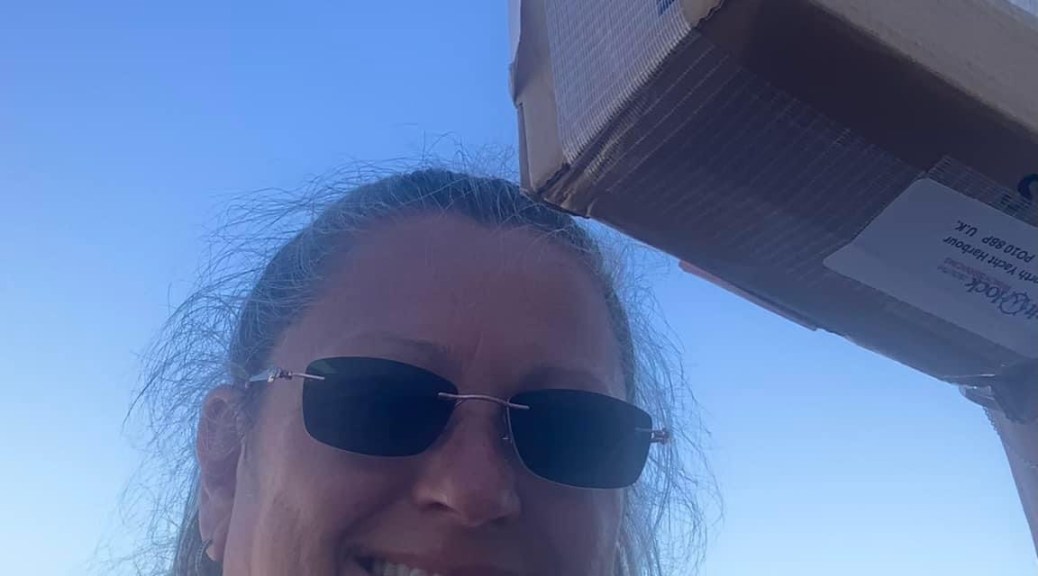
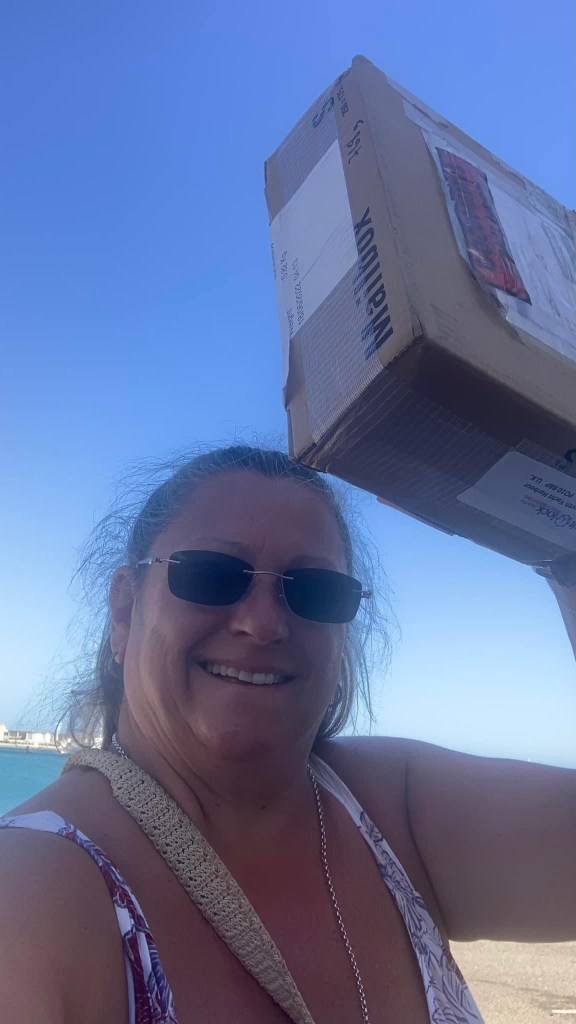
When the parcel arrives it is like Christmas. I am a little apprehensive in case Cliff from Whitlock south has sent me the wrong part and I apologise now for ever doubting this, since when marina opened it, there was a lovely sparkly new spindle with all its vanes intact just waiting for a nice Whitlock drive to nestle into.

Needless to say, before my return everything was done and done brilliantly with the autohelm being fixed making maria particularly happy. We can’t speak highly enough of Paul and I would recommend him to anyone.

So that is the boat fixes done, what about Maria’s time in Almerimar? Those who know Maria from Facebook will have seen numerous posts of her living the high life, watching washing machines go around in launderettes. Maria likes things to be clean and this will be no different as she gets lots of bags ready to go do some washing. Now despite appearances, Maria doesn’t actually like to watch the washing machines for thirty minutes and since we are on our own for a change, suggests that we go for a drink next door to the launderette while we wait for our washing. I may have mentioned this habit before and I confess I joined her on this occasion. She orders a very nice gin and tonic and this was to define her stay over the next couple of weeks.

Firstly, we met Wade at the bar and started discussing the requirement to get to the airport next availability of taxis. Like a number of resorts, there is a thriving community who help out in these situations and within minutes we have a car organised to take me and the boys to the airport for our flights.

Over the coming days, maria got to meet quite a few of the local expat community. Their experience of the guy in the yard was exactly the same as ours so at least it wasn’t anything to do with us.

Apart from busy about the boat trying to get her ready for our second leg to Brindisi, maria was able to join in the expat life with a group who welcomed her with open arms.

When I return two weeks later, the boat looks great. Maria also looks refreshed and has made a lot of new friends including all of Paul’s friends from England. Well at least she wasn’t bored while I was away…..

Gibraltar to Almerimar or Mariadz Search and Rescue

We have stayed an unexpected night in Gibraltar when the fuel man left work having said he would wait for us. He must have had something important on but to be fair, it gave us a night off the boat to see Gibraltar and sets us up for the last journey to Almerimar and reasonably simple day and night cruise east.

We want to be ready early so we can get fuel and get going but just before they open another boat sneaks onto the fuel area in front of us. Hmm, if we want here for it to be clear, we may be here a while. We agree to go over and get Mariadz onto the front part of the fuel area which is tricky meandering between various boats and sneaking in front of the large catamaran before getting in and tying off. Fuel here is about £1.20 which is more than we used to pay in England but in the current situation is very cheap. We take more than 500litres filling up a few spare cans on top of the main tank of 670L. Soon enough we are ready to go.

It is back to the slalom course avoiding the anchored and moving ships outside Gibraltar but this time we will be heading east rather than being on the opposite side when we came in. Since we are no longer rushing to be in time for an already departed fuel man, we can take a look at our surroundings and admire the rock itself, I guess it is also the start of a day rather than the end of a stressful one too.

We get to the bottom of the bay and are at Europa point and now it is a single turn towards Almerimar a little north of due east. We can now settle into our standard watch patterns of two hours each as we look at an arrival time of early morning the next day.

It’s a quiet morning as we all just settle into the routine that has become our sailing lives. We are always looking at how we can get the sails out but as a delivery trip we don’t have the luxury of time so the engine is on and we are making sure we are making good progress.

It’s around lunchtime when I am idly scanning the horizon and see something strange. We are seventeen miles out and I can see a lone canoeist paddling away. Our first thought is that if he is trying to get from Africa to Spain, there are shorter journeys! One of the crew suggests that he is paddling and therefore ok but he is probably nineteen miles away from the nearest land on a scorching hot day. We are investigating and if he says he is fine then great.

He is now waving to us as well as paddling so we are Co fire t we have done the right thing. As we approach, we can see that his canoe is well fitted with a small outboard and safety gear but it becomes apparent no radio.

Before we hear his story I call tarife, who control this part of the sea, and explain what we have found. Interestingly, a few things go through your mind here. There is no imminent threat to life because he was stable in his canoe and he has now transferred to us so it isn’t a mayday. It may not even be an urgency message or Pan Pan since actually I may just be asked to take him to the nearest marina. So I decide to treat it as a routine message and ask Tarife for their advice and instruction. They are grateful that we have acted and say that they will send out a search and rescue boat to pick him up. By this stage, we have him on board, his canoe is tied off and being towed behind mariadz and we have offered him refreshment while Ex-nurse Maria has got her beady eye on him looking for signs of any issues. The lifeboat will be here in about 30 mins so we settle down, Mariadz going round in circles again.

Pedro, is from Madrid, and he comes down to the coast to explore it in his canoe. The previous night the strong winds had capsized his canoe flooding the engine with water and water logging his phone. He then got swept out to see. He had some water and chocolate but didn’t expect to be out for long so didn’t have lots of provisions. He had been trying to signal to various ships during the night by flashing SOS on his torch but no-one had seen him. It was very distressing for him and he said he felt that we were probably his last chance. To be fair there was another yacht behind us who may have seen him and may have been able to help but it was a powerful message of just how quickly it can go wrong and you can be in real trouble.

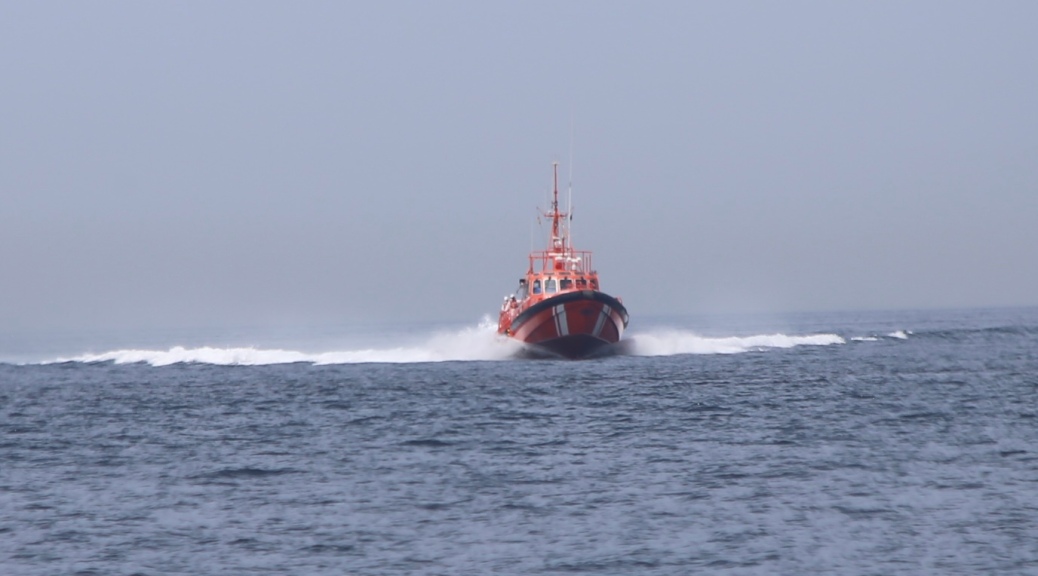
Fifteen minutes later and we get another call on the radio from tarife. The search and rescue boat will be with us in 35 minutes and they are on their way. We check AIS to see if we can see them since they should be in range. Eventually we find them coming along at 22 knots.

Pedro is in good spirits, more worried about the dirt he is leaving on our deck than his own well being. The life boat has arrived and we straighten our course so that they can come alongside. One of the crew has been asked to be a roving fender since, although we have set up fenders on both sides, it is difficult with two moving boats to get it right this close together. Actually, this didn’t work out very well for us, since he was so focused on filming what was happening that he forgot his fender duty and the lifeboat struck us reasonably gently right where he stood with his fender in his hand.

As soon as the lifeboat is alongside, Pedro is away and on board. We are not sure what we said but he seemed to be very happy to see his compatriots. Maria takes our line off mariadz and hands it to them so they can get the canoe on board and then they are ready to go. With our line. Pedro points out that the line isn’t his and asks for them to return it for us so they back next to us wanting to throw a line with a metal shackle at us. Instead I reach over with the boat hook and they place it on there and we get it in quickly.

An hour later, it is all done and we are back on our way towards Almerimar knowing that we have done the right thing. Tarife have been on the radio thanking us for our actions and all is good with the world. We gave our contact details to Pedro and hope he will write to us to say he is ok and back on the water having bought a waterproof VHF radio so he can contact help if he needs it.

The rest of the day is a little anticlimactic if we are honest. We are travelling in light winds putting sails up as we can and motor sailing. As the day draws in, a large dark rib is approaching us at speed. It is the Douane, or Spanish customs. We could see them moving and then divert at speed towards us. They take quite a long look while they are checking our details and then with a cheery wave before hammering off to another AIS track further out to sea.

The night watch starts, and one thing I have noticed is that despite everyone having six hours on and six hours off, it is rare that Maria and I are in bed at the same time for more than an hour or so. Tonight is one of those occasions but I am woken a couple of hours earlier than my watch by the unmistakeable sound of our main flapping as Mariadz pitches forward and back clearly in a reasonable sea. So there is wind but we don’t seem to be taking advantage. I pop up top to check the situation and we have a stiff breeze behind us but our main is tight in so not benefiting from the wind. We are also doing about three knots which means rather than arriving early in the morning, we are now looking at late afternoon. Mariadz and I are not having that. Having heard that the reason the sail is not set properly is because they were worried about waking us, we agree to get it done quietly but efficiently. The speed is back up and I can go back down for the last parts of my sleep.

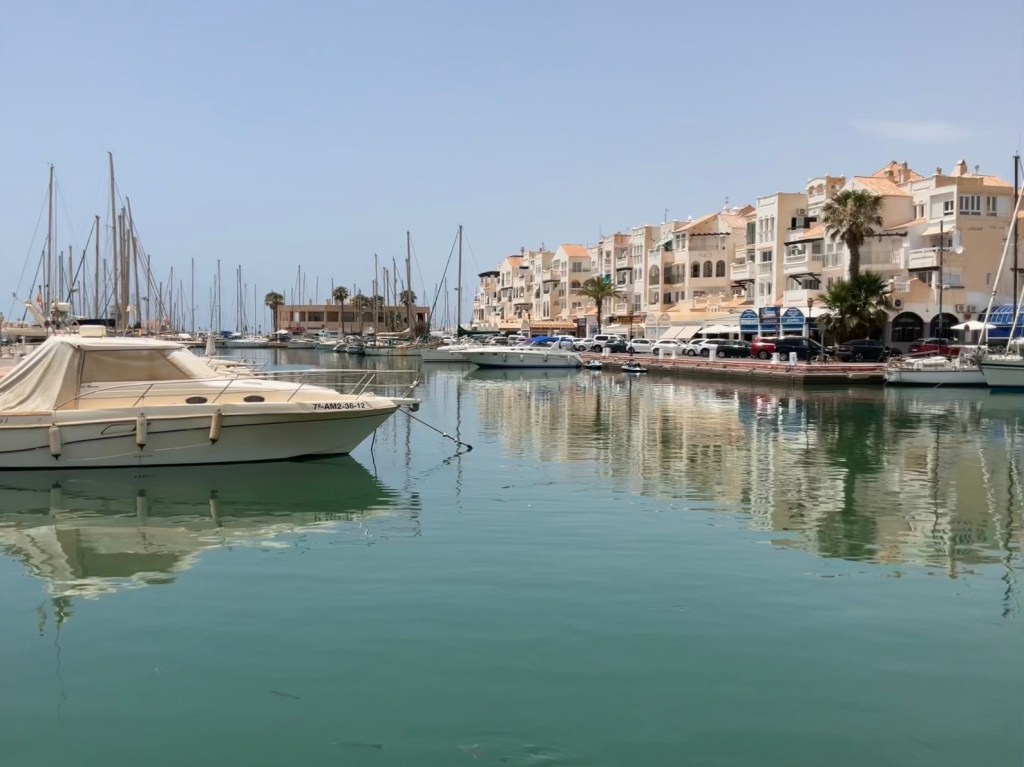
I am up for my watch at 6am and can see we have a real opportunity with the wind to catch up some time. Overnight it has come round from a gentle south westerly to a good 15-20 knots further to the south and heading south east. This will make it a bit tight for us but I will take advantage of the wind we have to pick up some speed. The sails are up and set right and we are now whizzing along at a cracking pace and back on track to arrive in a few hours time. At 9am we arrive at Almerimar and are guided to our berth for the next fortnight which is stern to using lazy lines. Maria and I have experience with lazy lines from our sailing holidays in Greece but never on Mariadz so this should be interesting. Despite Maria’s concerns, she brings her in beautifully. The stern lines are on, the boys go to the bow with the lazy lines, which are really messy and tie them as tightly was they can. We can then tighten the stern lines up even more and Mariadz isn’t moving.

We now have the minor detail of how we get off the boat. Mariadz has a nice wooden and metal passarelle which folds in two and is deployed off the stern using the pasarelle line. Of course since acquiring her we have fitted a funky solar array above the rib which is where that pasarelle line would go. Fortunately we had considered this while we were stopped over in Vigo and had spent a some time setting up the pasarelle in a variety of ways to see how it was done. This has helped a lot and, after taking down the rib and moving it out of the way, we set upon creating an exit we can use to get off the boat. The biggest problem is that we have to empty the entire lazarette to get the pasarelle out! That will all need reloading too but needed to be done anyway so that we can sort out the Whitlock autohelm problem we had in Biscay.

Once we can step off the boat we can add extra mid lines to help make mariadz more stable with the strong winds that are coming.

We have now completed the first part of our journey to Brindisi. Me and the boys will be going to the airport to catch our flights to different destinations. It has been great having crew, and we really like Richard and Gerald. After two weeks, I think we probably all need some time apart though 🙂

Cadiz to Gibraltar via barbate – a trip down Orca alley

It is with some trepidation that we start the journey down the coast towards Gibraltar. Over the last few years there have been a large number of documented attacks, the authorities prefer them referred to as interactions, where sailing boats have been badly damaged by Orca or killer whales a more familiar name for them.

No one seems to have an idea as to why this is happening although there are several theories including playfulness, an understanding that these boats are in the same space as their beloved food, tuna, and may be competition or they are training the youngsters with slow moving vessels that don’t bite back.

The authorities’ response to this has been pitiful although, to be fair, there are well documented attacks but no one knows what proportion of craft this is happening to and some believe the whole problem is overstated. The authorities also give advice on what to do in the event of an interaction. Switch everything off and let them do what they want, once they are bored, and have smashed up your pride and joy, they will move on. Needless to say this hasn’t gone down well with the sailing community. A number of approaches have been suggested including certain courses through the tuna nets that are common on this coast or going way off shore away from the tuna. Some people suggest “going dark”, with no electronics running or engine to reduce the sound of the boat, this includes switching off the autohelm, not a problem for us obviously. Finally, in the event of an attack, it has been suggested that using a dolphin deterrent used by fisherman on their nets my keep them away. These are called pingers. The other action that has been suggested is to go gently astern since the theory is that a killer whale won’t want to swim backwards and won’t like the look of the propeller spinning towards him. This is not suggesting aiming at the orca at all just showing what will happen if they removed the safety of the rudder blocking the propeller. This later two actions are prohibited by the Spanish authorities who believe that any action interferes with the orca doing its thing should be prohibited. So clearly any such actions would have to be taken more than 12 hours off shore in international waters. I suspect that some people when fighting for survival may just adopt the tactics and take the punishment later rather than potentially losing their home.

Still we have just left Cadiz, it’s a lovely day and Maria has provided instructions that no one is to get too much rest today since we need to be on the look out for Orca. Incidentally, this is a request that is mostly ignored with the boys listening to music, reading or resting in their room but Maria and I are taking it seriously. There is also the last remnants of the military exercise with warships, aircraft and helicopters just out to sea of us.

The route down to barbate which is a small village a long way down the coast is covered with nets to catch the tuna as they race down the coast. These are well marked on the chart and so we have agreed to take a shallow route of 20M and tiptoe either side of all of the nets. We are also going to trust the chart, since the nets may be partially submerged, so we will go around them even if it appears that they aren’t there.

Most of the trip down is uneventful but at about 3pm, maria and I spot a lone Orca crossing our bow approximately 100m ahead. We are on tenterhooks as the Orca just keeps swimming towards land oblivious or uninterested in us.

Apart from the one siting it is an easy passage all of the way to the outskirts of Barbate. Here there genuinely is a large net with lots of buoys and markers. You have to round this to get into the marina. As we are nearing the turn, across the radio comes the call we are dreading. Fortunately, it is not a May Day but a pan pan so an urgent message. The person reports that they have just been attacked by a pod of orca and gives his position. He is three miles away from us. He says they did not cause significant damage but it was a vicious and vigorous attack. They have no moved on. If I am honest, I am not an expert on the swimming speeds of various marine creatures but I bet an orca is a lot faster than a sailing boat. We tip toe as quickly as we can into Barbate and are grateful for its safety.

We feel a little silly as we negotiate the locations of the nets with no obvious signs that they are actually there but we fell safer for doing it even if it does look weird when we do a couple of 90 degree turns, almost like a crazy Ivan from hunt for red october.

As has been usual in Spain, the staff at the marina are really helpful and give us a hand mooring up as maria brings mariadz into the berth expertly. We tie up and tomorrow we will truly run the gauntlet down to Gibraltar where a lot of the attacks have happened.

The next day we check the weather and it isn’t great until late afternoon but that causes us problems with negotiating the Gibraltar straight at a good state of tide and hopefully making it to Gibraltar before refuelling place closes. The wind for most of the trip will also be south easterly which isn’t great for the straights but hopefully enough of an angle for us to make progress and then take advantage on the route up to Gibraltar from the tip where it should be on the beam. This is also the scariest part of the trip for Orca.

The attacks are being plotted on a chart and it makes sobering reading. It seems that they wait outside Barbate like a cat outside a mouse hole, waiting. There are a lot of attacks here including the one the previous day that we heard about. So we will be running the gauntlet.

By 2pm, we have prepared everything we can and hopefully the weather will be kind to us as we leave the marina. Maria is nervous and on the look out for Orca especially after our siting and the attack. The crew are not so worried it seems, staying down below when not on watch.

The south easterly is right in our faces and not for the first time this trip, Mariadz is knocked out of her stride by the strong winds and swell. Unfortunately the next few hours of progress is so slow that, arriving before 8pm at Gibraltar, when the fuel pontoon closes, seems unlikely. However, we will continue to give it our best shot. Another boat has left at the same time and is motoring. Now there are two routes south, the first goes inside or over the tuna nets, if they are there and the second goes outside, as close to the 20m line as possible. The other boat has taken the former and we have taken the later. They are going faster than us with no sail up and are on a shorter route so it will be interesting to see how this works out. We can only imagine they are hammering their engine since we have some sail up and are motoring at reasonable revs but they are still going faster.

They seem to have made a good call as they are getting ahead of us and for the moment there have been no sightings of orca so we seem to be doing ok. In fact we pretty much get down to the turn at tarife without maria worrying too much that we are in the place of the most attacks. The south easterly is strengthening though and generally for the Gibraltar straits they say never try and go through on an easterly. My view was that the south element of this gave us enough of an angle to sail through the straights and then as you head north east to Gibraltar you will get a cracking sail.

Firstly you have to negotiate the straights. The main advantage of our departure time even with the slow progress so far is that the tide is on our side, however the wind is decidedly not which means wind against tide and a bumpy ride. This is exacerbated at this point where the Atlantic Ocean meets the Mediterranean Sea in a heavyweight contest where you seem to be in the middle with them. We have cut in close to tarife but this seems to be a mistake since the seas are especially turbulent here. I turn away to try and find some smoother water for us all and, as I do, two huge waves crash together and a huge plume of water comes out from between them. My language was colourful but something along the lines of “by Jove, that’s a bit of a surprise”. it’s a whale ten metres from our bow at the surface. I steer hard to port to avoid hitting him and the pilot whale slides down our starboard side before jumping out of the water just behind us. Wow. We are still heading out on this tack towards the shipping channel so I can get away from the turbulent water. As I start to tack back to head up to Gibraltar, we get called by name by a passing ship who want to know if we are intending to go across the shipping channel. So my apologies for worrying them but as we completed our turn the answer was clear and we start to accelerate up towards Gibraltar.

Mariadz is in full sail and eating up the miles, the other boat was a mile in front at this stage but is being hauled in as we sail up the coast. We have pretty much caught up as we get to the turn into the bay where Gibraltar sits. Martin Hubbard, when he taught us, always instilled upon us a safety first mantra and although we laugh about touching the east coast mud on a rising tide, we are incredibly safe and never take risks with mariadz. So I am taking the turn to Gibraltar quite wide and outside of the shallower areas whereas the other boat takes an inside route close to shore. The wind is also dying but Mariadz is clinging on to the last of it, gaining every ounce of speed she can. I suspect she knows there is a good drink for her at the end of it and she has definitely got the thirst to get to the pub before it closes. Maria rings ahead to the fuel pontoon to say that we are running a few minutes late, it looks like 15 at the moment and they agree to stay open for us. This is brilliant news and means we can continue to Almerimar non-stop and arrive a day early.

The approach to Gibraltar is littered with large ships anchored and as we get through all of these, we finally go past the other boat that left Barbate with us. It’s all about winning at the end….

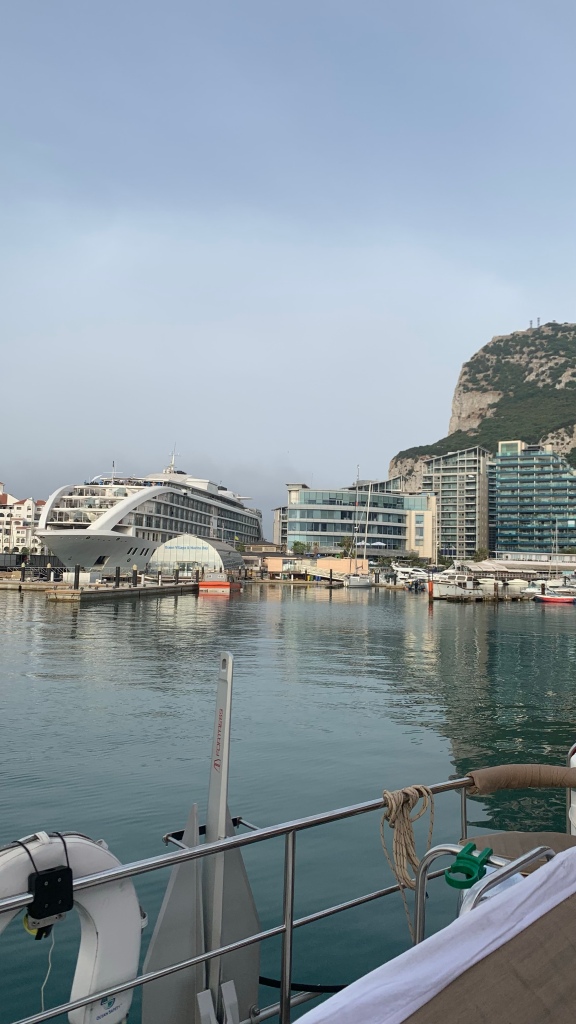
We are in good spirits as we approach the fuel pontoon opposite Marina Bay and the Gibraltar ship hotel. However, the fuel area seems a bit quiet and as we tie up, we can see there is nobody there. So we are stuck for the night. We investigate and the entire fuel area is fenced off and bolted so if we stay here overnight, we will only see Gibraltar at a distance.

I call across to Marina Bay who clearly have a berth or two available and they say we can pop over there. Maria is still having confidence issues, particularly about going astern, Plymouth has shaken her and Maria wants me, the less experienced helm to do it. We come off the fuel pontoon sideways, steering into the dock and bow thrusting off – I always love how cool that looks like you have bow and stern thrusters. From the middle of the fairway, I start to go astern towards the berth but firstly have to skirt around a moored vessel before then lining back up with the finger pontoon. It all goes quite well and we are safely in our berth and going through our registration with the marina. If we are stuck in Gibraltar we are going to go out and enjoy ourselves especially since Marina may have been working here last year if philips had won a contract. We wander round the bay and it is as if we are in little England. It’s weird because it probably isn’t really what Marina or I wanted. In the end we settle on the Thi Vietnamese restaurant and had some lovely food and a lovely chat with the staff who were very welcoming. On the way back, and despite being in shorts and t-shirts, we wander into the casino. Yep, Maria wants to play roulette again! She plays her normal system, I have only given her twenty pounds to play with and doubles her money. Giving half her winnings to the croupier, we leave and get ready for the last leg of the first part of our journey.

Portimao to Cadiz

Having had a bit of a scare at Portimao, we are happy to be going, and Maria has vowed never to return.

At this stage we have a choice of whether to day sail along the coast to Mazagon with a further long sail to Cadiz or to cut across the bay and head straight for Cadiz. We agree we have lost enough days and we are keen to make progress so it is off and just keep going until you get to land.

We are not making great speed across the bay as we go past the algarve but we are happy we are effectively catching up a day. It takes nearly eight hours to get past Faro, with its busy airport, a journey that probably takes an hour from anywhere in the algarve. No one said that sailing to places was fast!

As we travel across the bay towards Cadiz, there is a lot of chatter on the radio and it soon becomes clear that there is a major NATO naval exercise underway. We had seen lots of naval ships in Plymouth and had been shadowed as we entered Biscay but a full military escort was beyond our wildest dreams. As we look on AIS, it seems that one ship per group is on AIS but it is disconcerting when they keep calling up other sailing boats explaining that they have a live firing exercise about to start and you may want to move from there….

This has been a long and quite slow journey of over 130 miles so we are expecting to arrive in darkness but Cadiz is such a major port and the detailed plans we have show a very simple entrance to traverse so we have agreed to put aside our usual rule regarding new ports at night. This is also helped by us being under a full moon.

It has gone sunset as we approach the bright lights of Cadiz but we have good visibility and little wind. This helps our decision making since there is a huge bay at Cadiz which makes a great anchorage but is a little exposed to the wind but protected from the swell, if there isn’t any then we are fine. It is easy to imagine the Spanish and French fleets hiding here a few hundred years ago before running towards Trafalgar and Nelson.

It’s 2am when we eventually anchor and we are the only boat there, hopefully not a pointer to problems later but we are confident in our anchoring gear and settle down for a good nights sleep.

The next morning is bright and we have decided to report into the police and customs to show we have arrived. Rather than taking Mariadz into a marina, we agree to drop the rib and the three brits head in.

We go into the real club nautico which in all the guides says can’t take a vessel the size of Mariadz. Maria is taking a good look and is convinced that there would be no problem. Having left the rib safely locked on the docking bay we pop into the office to explain. The people there couldn’t be friendlier and say that the rule forbidding Mariadz is only without prior arrangement. They have a number of berths that could take us. It’s a shame to have to pass up the opportunity but we have plans. The marina kindly let us leave the boat there while we head to the ferry terminal where the port police are located.

After some time and a nice walk across the old walks of Cadiz, we find the port police tucked on the side of the port building. A ring of the bell shows that this seems to be quite a small office but the policeman takes our papers and passports and shortly afterwards returns them, all checked. We feel we have done the right thing as we head back to the boat.

So just quickly lift the rib and we are ready to go. Nothing is that simple on Mariadz as we start to lift the bow and the same davit that had a problem before we started this journey stops working. Maria is of the opinion that we should jury rig it as we did before and get moving but I would like a little time to see if it is fixable.

On investigation, nothing seems wrong in the davit control box but I remembered that one of our recent problems was caused by the switch that controls our automatic shut off system. I flick this switch and the davit is working again although obviously with no safety shut off so I will need to be careful. At least it allows us to get the rib back up easily and put the cover on it before heading off on the part of the journey that Maria has dreaded: the trip down to Gibraltar or down by Orca alley where a pod of killer whales are attacking (sorry I mean interacting!) and disabling boats by chewing off their rudders.

Lisbon to Portimao via Sines

We are now behind on the clock on our delivery trip to southern Spain and as we know you shouldn’t be pressured by the clock when sailing. However, the weather is starting to come in from the Atlantic and if we don’t leave quite soon we could be stuck in Cascais for some time. Cascais is nice but at over €100 a night, we couldn’t stay for long!

The next part of the trip will take us down the Portuguese Atlantic coast and around cape st Vincent into the algarve. The trip would take nearly 24 hours skirting the coast with the risk of lobster pots to catch our propellor. We decide to do this in two hits having found a safe anchorage along the way.

On our second day in Cascais, we quickly get the boat ready to go. There are a few annoyances as one of the crew releases the spring line stopping Mariadz going forward despite my questioning it. Mariadz hits the pontoon in front of us and leaves a lovely dent in her bow. Funnily enough, I was then told that I had approved it when I absolutely hadn’t. It also wasn’t the other person pulling the boat hard either! The frustration grows when I find that my iPad has been locked and deleted by someone trying to get through its security. The crew deny all knowledge but in all our experience with iPads we have never known one security lock itself without anyone touching it!

Putting these frustrations to one side, and the loss of all of my data and photographs for six months, we head out of the marina at 2:30pm and head down the coast. We are making good progress with a following wind pushing us along at 7-8 knots. As the afternoon turns into evening, we are touch and go as to whether we will reach the anchorage before sunset especially when the wind dies down.

It is an uneventful trip down the coast and as we approach Sines, we can see the big commercial terminal just outside the anchorage with a number of ships waiting like expectant fathers outside the maternity unit. We turn towards the anchorage as the sun slips down and we have the last of the light to guide us in. The anchorage itself is delightful with a wide beach, being groomed as we arrive, protected by two walls, one of which has a small marina tucked behind it. We head directly to the centre of the anchorage away from the other three smaller yachts nearer to the marina. The anchorage is renowned for having a slight swell as the large boats come in and although were only there overnight, we didn’t have any problem and it was very picturesque towards land even if the terminal out to sea was a little less so.

The next morning we are all rested, the shenanigans from the day before have been put behind us and we are ready to move on to Portimao. We have decided to leave at first light since we have 90 miles to go which could take 15 hours and we always like to arrive at new places in daylight, the day before being very close to breaking that rule.

The wind has died down and the bad weather is well to the north of us, we are grateful we left when we did. However, sailing is not an option is 8 knots of wind, at leant to make your destination in daylight. This will be the whole of the morning so we motor down making good progress against our plans. After lunch the wind changes direction and picks up a bit which gives us the opportunity to get some sail up.

Gerald has been down to the furthest tip of the algarve where it meets the west coast and it is a look out point where you can watch the boats rounding the corner. This is an opportunity for Mariadz to unfurl her sails and show off her beauty.

She is a lovely sight under full sail carving through the water and I hope there was someone up there to see. Four hours later we arrive at Portimao at 8pm so shortly before dark and see an incredibly full anchorage. There seem to be a few gaps as we wander around looking for a suitable spot. We decide on one just in from the edge with boats on all sides. It is difficult to come up with where to drop the anchor in these situations. Our general rule is to look at the way the boats are pointing and recognise that their anchors are likely to be in front of them so place ours favouring the stern of another boat over the bow of the boat behind. As we all turn in unison we should find ourselves in a good place. We take two drops of the anchor to get this where we want it and some of the boats are not lining up the same which points to features underwater which are changing the way that the water is flowing. I’m still not 100% happy but decide to keep an eye on it for the next thirty minutes while Maria prepares dinner. One of our neighbours, a Dutchman, is also not happy with us, as is often the case when people anchor anywhere near each other. He finishes off by suggesting that we had better have good insurance, really quite rude. We are settling nicely and everything looks fine but we will need to be careful at the change of tide and I am not convinced I will get the rest I need. After a short time we agree to move to outside of all of the other boats where we will definitely have enough room and can have a solid nights rest. We eat dinner and get our heads down preparing for the long journey tomorrow to Cadiz.

However, this is not before we convince the boys that the water is lovely and warm so they both go for a swim. A couple of laps of the boat and a shower down on the swim platform caps the evening

As described previously, our standard approach is to attach a buoy to our anchor to show us and others the location of our anchor. We have various snubbers to protect the windlass and put on an anchor alarm that constantly monitors your position compared to the anchor to confirm that it hasn’t shifted. We always have a lot of chain out which means we go round in a bigger circle but we never drag our anchor. So it is somewhat of a surprise at 2:30am after an early night to hear the anchor alarm blaring. Usually when this happens it is because I have made the arc that is monitored too small for the amount of chain and the length of the boat. On waking the first check is that we are nowhere near any other boats and we are a good distance away and not dissimilar to when we anchored. I check the anchor watch, reset it and go back to bed after a short while to check that everything is as expected.

On waking the next morning, I come out on deck and we had moved. Although the distance to the boat that I checked last night is the same, we have moved across them by about 25 metres. I also can’t see our anchor buoy and I am reminded of the Dutchman’s comment the previous evening that they used to have one of those and it was stolen. Surely he didn’t get up in the middle of the night, steal ours and trip our anchor accidentally… of course not. As we prepare to depart and the instruments are switched on, Maria points out that we are now in ten metres of water. We wouldn’t usually anchor in that depth despite having more than enough chain to handle it. However, it does explain the buoy problem. Although I have twenty metres of line on this, it is doubled to a length of ten metres which is fine for most of our anchoring. However, now it is slightly under the surface as I find when I pull in the anchor and it pops up. It is good to see it back although our assumption is that someone, probably drunk in the middle of the night, pulled at it thinking it was a a lobster pot, with a 40Kg stainless lobster in obviously. They must have been disappointed to find an anchor and dropped it. It then took twenty metres for the anchor to reset properly. Lucky we had moved or we would have been speaking to the insurers of other boats!

Vigo and on to Portugal

I have discussed the repairs that needed to be done in Vigo elsewhere but this wasn’t our sole focus.

We were lucky to find an incredibly friendly and helpful at Davila Sport in Vigo. Vigo itself is a huge fishing town and so we had to try two of our favourites while we were there: fish and tapas.

Maria had been in the kitchen for a solid few days and quite rightly suggested we eat out. The first night we wandered into town and found a lovely corner bar that did a fantastic selection of tapas (La Bodega de Aguila). We tried a wide variety and they were all excellent so definitely a recommendation from Mariadz. The second night it was agreed we would find a really good fish restaurant and the marina recommended a few places. We booked one of these (Bar Rocio) and of course ate at a standard English time. Our experience has been that the Spanish prefer to eat a little later but we were surprised to be completely alone in the restaurant. We had a good chat to the waiter who suggested a selection of starters. One of which was cuttlefish which had our vet performing an autopsy on the first and refusing to finish the second. The mains were very good too especially the monk fish.

Maria had to go shopping for provisions and was accompanied by Richard and when the marina suggests the shops are walking distance, they may be for keen walkers. Maria found them walking distance there but a much more comfortable taxi drive home! The chandlery was in a similar place which Maria and I also walked, she’s a glutton for punishment. Still another cheap taxi home though. It allowed me to replace the broken block for the downwind rig and get some other essentials.

After a couple of days of mostly successful maintenance, we are ready to leave, albeit without a working autohelm. We have a good forecast of quite strong northerly winds pushing us down the coast towards Lisbon and our destination of Cascais. There is quite a swell which we will be mindful of as we hand steer down but we should have a good sail.

As we set off, we are quickly in the groove. We have decided to go goose wing at the beginning with the main sail out on one side and the head sail out on the other. It has been a standard downwind sailing setup for us on the easy coast and I think we weren’t 100% confident of the twin headsail setup after the recent problems.

By the end of the day, we are making great progress with a 20-25knot wind powering us along at ten knots with the current. The swell is probably 2.5m which we have to surf along as we progress which takes a bit of practice and to start with is quite unnerving, a 25 tonne boat trying to be a surfboard. It is incredibly rewarding though when the wave gently puts you back having surged it for some time. As night draws in and the wind remains strong, we continue our usual practice of reducing sail at night and go to half of the headsail and half of the main.

The next morning, and despite our deliberate slowing down at night, we have covered 170 miles, mostly under sail.

It is lunchtime the next day as we approach Lisbon, we are greeted by dolphins which we have been fortunate to see nearly every day. We are still in downwind sailing mode although there have been a few wind shifts. However, we will need to change to a port tack for the approach to cascais. This is the issue when downwind sailing, at quite strong wind speeds, it seems quite benign because the speed of the boat offsets the wind and makes it feel slightly breezy! Of course when you turn ninety degrees, it is directly across you and you get the full brunt of it. If you happen to have full sail up, it can be quite a shock.

For this reason, we know we will reduce sail to about half sail immediately prior to the turn so that we can have a nice sail on beam reach. Just prior to doing this, there is a sudden wind shift which takes hold of our main and tries to gybe it to the other side of the boat. The preventer for this is on our furthest forward mid cleat which stops the worst happening but the power of the gybe is immense and the preventer bends the stanchion near to the cleat. I am behind the wheel so it is definitely my fault but incredibly frustrating and any mitigating circumstances would sound like excuses! I get the sail back on the side but that is also quite uncomfortable. A lesson learned but the lessons don’t stop there.

You may recall we had all new running rigging and one of the things that John our sailmaker mentioned was that the halyard for the sails may need tightening as the halyard stretches a little. They are dyneema so we aren’t expecting much but we should keep an eye on it. The power of the gybe seems to have pulled at the halyard or maybe the strength of the wind, however, I notice a small few creases that we will need to sort out. To be fair, I haven’t really noticed these minor creases until we decide to bring the sail in and then it jams at the opening because of the creases. We go forward to lift the halyard but that isn’t happening with the amount of power in the sail. So we need to deposit the sail by going head into the wind. We decide that we should do that when in the shelter of the headland since the swell is still quite large and the headland will help us here too. We take down all other sails and turn with just mainsail up. It’s going to be a wild ride for a short period. Mariadz is heeled over a lot and the boys are loving the exhilaration but maria not so much. We know this will only be for a few miles until we get to the lee of the land but it isn’t great.

It seems an age but actually is only a few minutes until the sea starts to settle and the wind starts to reduce. Since we are going into cascais and the wind is in the north, I am thinking that we should wait for the turn towards the marina since we have to head into the wind anyway. Myself and Richard head to the mast to try and fix the problem. Having eased the main a bit we can then tighten up the sail with the halyard and that was all that was required to get the sail in neatly. Quite a bit of stress and distress for a short period for what was a simple fix but I now have a permanent reminder of my mistake with a bent stanchion, fortunately I have a spare.

As we go into the marina, we decide to top up the fuel, we have used quite a lot across Biscay and we are keen to fill up properly at Gibraltar. As we get there, the marina staff help us and take a stern line letting our momentum continue so that we get other lines on. Normally we would go with a mid line but they were insistent. Actually it worked really well and probably better than Our standard approach. Topped up, I pay and check which berth we are to go into. They have allocated us a berth well inside the marina next to a large motor boat that is poking out quite a way. They suggest that we come in astern along the whole length of the pontoon and then bring it in astern. This looks a difficult manoeuvre even without the confidence sapping experience in Plymouth. I suggest we will go in bow first and worry about getting out later. Maria isn’t happy and delegates the driving to me, which doesn’t inspire confidence in the ease of the task at hand. I come in and we are doing fine. The marina staff are waiting to take our lines again and this goes without a hitch. I ask for one of the guys to put the mid-cleat line on to stop me being pushed by the wind onto the motor boat, but that doesn’t happen. Fortunately the marina staff have fashioned this with our second mid cleat but it would have been a lot less nervy if we had done what we normally do. Afterwards I spoke to Maria about this, who had been told by one of them that they would do it and she wasn’t needed. The shame is that Maria is the most competent and knew what was needed to be done. I suggest that if that happens again she should tell me and we will stop that immediately. In the end I am grateful for the help of the marina staff and our bow thruster for keeping Mariadz nice and safe until we could get all lines on. We have a few scars but we are in Cascais, our original end point for the trip across Biscay, albeit a few days later than we hoped.

Post-Biscay maintenance at Vigo

I am no longer captain of my ship and I am back to being maintenance boy with a long list of problems that need resolving.

We have already spoken to the marina who have been incredibly accommodating and will send a team of people to see us in an hour or so.

In the interim I decide to take a trip to the top of the mast, to try and understand why we had the chafe on our green spinnaker halyard. I take a look and a number of pictures but it is difficult to see what has caused it.

I am thinking that on the way down I could swap out the spreader lights, one of which is slightly faulty – still working but not as bright. That is a forlorn hope and I don’t get round to it!

I have now looked at the boom block and how it was positioned and know why this happened. Youtube and the internet isn’t always your friend and I should have checked this earlier rather than after eight hours of fantastic twin headsail sailing at 8+ knots. Still a new block is a small price to pay and we think the sheet for the headsail can be cut and still retain enough length to be used properly. The problem appears to be where I attached the block, which was as far back on the boom as I could get it. This meant that it was slightly obstructed by the main sheet blocks which meant it didn’t deploy properly and was at an angle. This resulted in the block being mangled by the rubbing of the sheet and damage from this to the line itself.

Probably most importantly is to try and sort out the Whitlock drive system, this could be as easy as a loose bolt in the workings that is obstructing the gears. Anyway fingers crossed.

While I am messing about with the steering I may as well check whether there is excessive play in the steering, which would have made the autopilot work harder.

So first up is the rigging. Firstly let me introduce our rigger. The marina have sent their rigging expert, Laureano Wizner. It was only afterwards that they asked me if I knew who he was: a former European sailing champion and americas cup contestant. At that stage, we thought he was just a really good rigger! Laureano climbs our 70 foot mast like a monkey jumping from section to section, checking our rig as he goes. I watch open mouthed. We do quite a bit while he is up there including setting up the sail so that he can see exactly what happens. He comes down with lots of photos and an explanation. Apparently the green halyard is rubbing against the top drum of the headsail. We discuss what can be done but actually the simplest solution is to use the red halyard which has suitable clearance, as checked when Laureano jumped up the mast again. He takes away our two lines to be cut and sorted out. When he returns he has also used the core of our dyneema lines and spliced these into two large circles which are to be threaded through the hoops in the boom for our block to stop the problem with the block not deploying correctly. A simple and elegant fix and a man talented enough to knock that up really quickly. In fact the whole thing is fixed in an afternoon and accompanied by a ridiculously cheap bill! I also go to the chandlery to buy replacement blocks and we are back ready to downwind sail.

Onto the Whitlock drive to hopefully stop us having to hand steer the whole way. I have spoken to the expert in Southampton. The problem could be a loose screw that has dropped into the gears and is blocking the wheel turn although this would not usually stop it in exactly the same place every time. Still we can hope. Cliff sends me detailed instructions including photos of how to disassemble the drive and get to the inner workings, it doesn’t look to difficult so let’s give it a go. Firstly, I will need to extract the mechanical part of the autopilot. This piece of equipment is held by four bolts to a metal plate which is itself bolted to the hull. Initially I decide to undo the large bolts holding the plate to the hull. Two of these move easily enough, simultaneously moving the almost inaccessible nut under the plate. But I can get these sorted. The other two will not budge. I intend to use my new torque wrench but then notice that it is a half inch rather than the 3/8 for my socket set – that will be an adapter on the shopping list! I speak to the yard who helpfully cut a metal pole to act as an extension and provide greater leverage. This works and now I have the heavyweight plate loose. On to the four smaller bolts that hold the Whitlock drive to the plate. The first takes a bit of pressure but eases and we are going. Unfortunately the second isn’t budging until finally it does, as it sheers quarter of an inch down the thread – great. Another problem but I will come back to that. Bolt three helpfully does exactly the same, double great and just my luck. The fourth bolt actually comes out as it should and we are close. The electrical side is very simple, there are two pairs of wires one providing power and the other the control from the autopilot. These are live/neutral pairs so having marked one set with tape to connect them up correctly, I set about removing these. Now I have the, really quite heavy, drive out of the lazarette. We can now see what we have to deal with. It is exactly the same as the pictures that i have so once I can resolve the two sheered bolts removing the plate will be a cinch!

I have asked the yard if it is possible to use one of their benches to do the work which promises to be quite messy and ingeniously gives my access to a large number of curious Spanish engineers who may be able to help. Unfortunately that doesn’t work out as despite using corrosion x and wd40 to try and break the corrosion locking the bolt to the case and cutting a slot into the bolt with an angle grinder, we still can’t free the bolts. It is time to call professional help. Unfortunately, the mechanic isn’t available til the next day which means we have another day to wait rather than the single overnight we had hoped for. We are now being significantly delayed with no guarantee of fixing the problem. It will be a real shame if our planned 1,500 mile journey in two weeks is reduced to less than half of that!

The next day the mechanic arrives at just after 9am. I explain that I would like to work with him so I can understand it and he says no problem, he will give me a call about 11ish and I assume that he has something to work on first. Just after 11am I get the call that the mechanic is ready for me. I arrive in the yard where he has set up an impromptu workbench in the back of his van. The Whitlock is already in bits but now he needs the detailed instructions on my iPad to get into the workings. I am pleased with his success and I believe he used a torch to superheat the bolt to break its seal before using mole grips to undo it but I am guessing. Anyway we get into the workings and the culprit is clear. There is a chain that drives the arm that attaches to our steering, this is controlled by some gears and the sprocket on this has two teeth missing. He has located one of them in all of the gunk but this part needs replacing. I am quickly on the phone to Cliff who is really helpful. He has the exact same drive on his shelves which was water damaged and this caused the electronics to stop working. It was two weeks old at the time. He will tear it apart retrieve the sprocket and send it to me. All at a very reasonable price. This is fortunate since he has informed me that a replacement would be over £9,000 (This was a mistake since I had confused matters by thinking it was a higher spec model – in the end the replacement would be a shade over £2,000, a paltry two boat tokens, almost cheap!). However, this will take time and then it needs to be shipped to me in Spain in a post brexit world. Clearly, we are going to be hand steering for a little while. The mechanic has taken half of a day with two of them to do this work and he kindly boxes it up for me ready for when I have the spare delivered.

We are as far as we can go but the rig is fully functional and we have a plan for the autopilot. A plan that doesn’t fill us with joy but a plan all the same.

Now for the dreaded part, the bill. We have had immediate attention from all services in the yard and I can’t speak highly enough about how professional and helpful the team are at Davila marina, Vigo. I would recommend it to anyone needing post Biscay maintenance and let’s admit it, this is probably a fair few of us. The mechanic had two of them working on it for several hours and was a shade over €100, the brilliant rigger was double that and again we had a few of them working for hours sorting us out. Everywhere else I have been the bill would have been double or triple that! You would also have been lucky to get anyone to look at it for a few weeks. Thank you for the fantastic facilities and brilliant people at Vigo!

(Spanish) Maria and the other Spanish Rias

Our plans are in tatters and the boat is in need of some TLC however we have a new plan and the upside is that we took Ma-Ria to the Rias. Everywhere we go on holiday everyone thinks Maria is a local whether that is the West Indies, India, Portugal, Italy or now Spain.

Having crossed Biscay, we now have our first major sea under our belt. We have sailed for multiple nights getting our rest when we can and although tired we have overcome problems and are generally a happy crew.

At the end of this crossing, we are in a plain Ria, Puerto de currobedo, protected from the South West wind and it is time to celebrate our achievement with a bottle of bubbly. I’m sure it is a lovely place with lovely people but we had been told don’t miss the Rias and this wasn’t quite what we were expecting. There had been quite a lot of weed on our approach and the engine note had changed a few times as the prop and rope cutter dealt with it but Maria is worried and we should check that the prop is clear. The oldest member of our crew, Gerald, is clearly the most virile as he offers to jump in, inspect the prop and then swims around the boat for a while enjoying the somewhat chilly water. One thing we did notice was how clear the water was and we could see our chain for a long way underneath, now that’s different to the muddy east coast!

We have some lovely food, as always. It is a slightly boozy night but we have a relatively short hop to Vigo the next day and we will head off early.

At this time of year in the UK it is getting light at 4:30am and so we agree to get up at 5am. When the time comes, it is still pitch black and we don’t enter or leave unfamiliar anchorages during darkness if it can be avoided. Of course it is also Spanish time, which means we have effectively lost an hour, so we will get away at 6am then….. but we are a long way further south and at 6am it is still very dark with not even a hint of light in the sky. In the end it is 7am before we have enough light to depart.

When we arrived the wind was from the South west and this was a protected anchorage but overnight the wind has moved around to the south east, and now the anchorage is exposed. The previous evening two out of three weather forecasts say this won’t happen, only one suggests it might but this is much later. Not for the first or last time the short term weather forecast has been very wrong. The wind is now Southerly and at 15-20 knots, rIght on the nose, it is going to be an uncomfortable journey.

Having picked up the anchor, I am on the foredeck tidying up the anchor and lines. This includes putting two lines and a bolt in the anchor and chain, we are not having a repeat of a lost anchor with Maria’s new shiny stainless anchor. on the East coast of England, pulling up the anchor normally means pulling up quite a large amount of mud, so this work is messy. Since it is at the beginning of the day, I am normally in clean clothes which are instantly dirty. I get into trouble. Today i take my top off before starting work on the anchor. Gerald is taking us out of the anchorage into the swell and wind and we are bouncing around a lot. So much so that a wave breaks over the bow and a load of water runs over me. So much for that plan of keeping clean and dry, I will have to get changed anyway but at least my t-shirt is ok.

Unfortunately we are making little progress. It is a big sea and we can barely get more than a couple of knots. This won’t work and so we have to find a better anchorage, north facing and protected form the wind and seas. We can the sit out the bad weather and wait for the better weather following it.

Having checked the charts, we have found a lovely north facing cove completely protected from the southerly winds. It is In the ria de arousa, and I am sure maria is hoping it won’t have that effect on me….

It’s been a short but bouncy passage with wind and a sea that we are beating into but as we turn into the ria there is an immediate change partly because everything is now coming from mid ships but also because of some protection from the headland.

After a short time we arrive at our anchorage to find it protected by a large number, maybe 100, mussel rafts. These are about ten metres by five and all linked together completely covering the entrance of the anchorage. I recheck the chart to find a series of microscopic green crosses on the chart, I thought they were local indicators but the whole area is covered in these rafts.

We continue further into the Ria because surely these can’t be everywhere and also shouldn’t Ria Arouca be full of oysters! We finally choose another anchorage which again is protected but has a reasonable route through and is well protected from the weather. When we arrive it looks amazing with a beach bar at one end and a beautiful beach with gorgeous trees behind and a large ominous rock at one end. Three other boats in the anchorage, typically the last spot is adjacent to the huge rock and is quite deep. That wouldn’t normally be a problem but that means more chain and potentially a wider circle for Mariadz to swing within, did I mention there was a large rock? It means that I will be keeping an eye on our position very carefully for the afternoon.

Maria has checked the weather and it is clearing up in the afternoon up in the afternoon. We discuss whether we should push on to Vigo but are worried it will be too dark when we arrive. The place we are in is beautiful too and I am sure that influenced our decision too. The afternoon weather is lovely with glorious sunshine.

Sunset is spectacular and at 10:30pm so we would have been fine for Vigo but ho hum.

Our anchoring on Mariadz has gone well in the past and this is no exception. We are nowhere near the rock as Mariadz hangs off her shiny chain glistening in the sand below.

It’s a lovely evening and we all enjoy it but tomorrow we will definitely go to Vigo and get some repairs done.

The next morning, we are aware of what time dawn is so we don’t get up too early but we are keen to arrive in good time so we set off at first light. Now of course there is no wind so it looks like we will motor all the way.

However there are problems as we start to lift our anchor. The windlass is definitely straining more than usual and the cause is obvious as the anchor comes to the suffice. The large rafts are moored with long lines that go into the anchorage and unfortunately we have hooked one. Here is where our mooring ball comes into its own. Since it is on the roll bar of the anchor it can also be used as a trip for exactly these circumstances. I gather the buoy and tie off the line to a cleat. Then lowering the anchor the buoy line holds the head of the anchor in place while the shaft drops and the thick mooring line slides off the blade of the anchor. I am maybe a little smug that one of our ideas has worked so well in practice 🙂

We are back to our standard watch system with no autohelm, with everyone taking an hour on the wheel. I have timed it so that Maria is there for when we approach the marina.

As we approach, the marina we are told to wait and they will direct us to our berth. Having checked the plans we are sure we know where they will put us but of course we are wrong! We are waiting in the entrance drifting around for five to ten minutes before someone comes to us in a rib and we follow up into the depths of the marina. Maria’s confidence is still low after the problems in Plymouth but I persuade her to keep going and of course she brings her in astern perfectly. We hand the lines to the guy assisting us and we are now settled in. Let’s hope we can be here for just 24 hours and not delay further!

The adventure begins – Biscay

It’s the start of the queens jubilee celebrations and our opportunity to take the extra couple of days on top of our two week holiday to get Mariadz out of Plymouth across Biscay and into the south of Spain ready for a final shot at getting her to Brindisi.

A lot of people who cross Biscay decide to hug the French Atlantic coast which gives them options around safe havens if the weather turns. However, it is shallow here and the Atlantic swell can be much worse here than in the deeper water beyond the continental shelf. Also when the weather is bad a number of these ports are forced to close since the entrances become dangerous. We have decided to take the outside route by heading south west to start with and then heading south to start to go down the western coast of Spain and Portugal. We have also decided that we ideally want to get a lot of the travel done early so we can take it easy as we get further round. To this end, we intend to skip past the Spanish Rias and head to Lisbon as our first stop. This route has the advantage of avoiding the “motorway” or ant trail of cargo ships that follow the same line from the north west tip of Spain to the north west tip of France. However, since we have no idea how well we will all handle the overnight watches, we have discussed bolt holes if we need to get to land and safety sooner. To sail through Biscay you ideally need wind from the north, even is it is has some east or west in it but we don’t want a forecast with any south in it. We are really lucky that the weather window has coincided perfectly with our preferred departure date – clearly someone is smiling on us.

We have decided to get a good nights rest beforehand and leave at about 10:30am which also means we will have a fair tide at the beginning of the journey. This is purely for morale purposes so that you see a large chunk of miles disappear at the beginning of the journey. In the grand scheme of things it will make little difference.

There is little wind so we start by putting the sails up to see how we will do. We are going so slowly, it would take ten days to just get across Biscay, so clearly that won’t be happening! The engine is on and we motorsail to keep our speed up.

Maria has spent a lot of time researching and perfecting the watch system for our trip. We have four people who can stand watch but Maria is keen to make sure that no one is ever on their own especially as we don’t know the real competence of the people who are with us. I will talk about the nigh watch later but by day, we had a watch that lasted two hours with Adam, as skipper, being allocated a single day time watch, 1-3, and the other three covering 9am until 9pm in rotation which nicely rotated the time slots. The thinking here was that the skipper could be called at any time and so a slightly easier watch schedule provided the opportunity to catch up on rest when there were extraordinary circumstances. Which there were! On that first day, we weren’t taking our rest as we should though. We soon discover that le is less of a skipper and more as the maintenance team for Mariadz and I seem to spend most of my down time fixing one thing or another. However, plans never survive first contact with the enemy!

We are all settling into this journey well when we suddenly notice there are spots of blood everywhere, Gerald is bleeding from cutting his foot on something around the deck. So Adam, the skipper, maintenance, medic, is there with some plasters and cleaning the upholstery and deck. A short time later, he does it again, so we need a shoes on deck but not down below rule we think.

As we head into Biscay the water starts to get deeper. We recall when sailing the med years ago, the raymarine depth only registered to about 100M. Will the new equipment be any better? It certainly won’t register the 4000M depth that we will experience.

We have a good day of sailing heading south but realistically still not very far from England since the start of the journey. Nightfall means the start of the night watch. Since we have two crew on board, we have options around the watches but Maria is keen to make sure that we always have two people on watch especially since we know very little about the experience of the two crew. To this end, Maria has put me on for three hours at the beginning and the end. Again the other three alternate between 9-3, 12-6 and 3-9. Everyone gets six hours rest to hopefully make sure they get a good rest. Basically it is six hours on and six hours off although in practice it is three hours on watch, three hours on standby and six hours rest. Maria has given me the best times since it is possible that I could be woken at any time if there are problems.

This also fits in well with feeding the crew. Maria has spent ages preparing meals for the trip and making sure that we had easy, wholesome and great tasting food for our trip. She has planned a menu that means that no meal will be repeated throughout the two weeks we intend to be away. The freezer is organised with military precision and none would dare to interfere.

Gerald and I are on the first watch and as it starts to become twilight, I look to turn down the brightness of our instruments so that we can protect our night vision. Most of these are quite easy and I am merrily pressing buttons when I notice, after doing the autopilot, that the wind instruments are going crazy. There is a fair bit of wind but it is constantly changing direction. I can’t understand this, have I changed the calibration settings. It is a minute or so before I realise that I have inadvertently stopped the autopilot when I was adjusting it and we have done three 360 degree turns. Fortunately it isn’t a bad sea and mariadz hasn’t been noticeable different as it has done it’s turns! We will keep that between ourselves…. Except the track showing our path has three neat little circles in the middle of it!

The watch system seems to work really well although the rolling motion of the ocean means that in order to sleep in our normal bed comfortably you need to sleep across the bed. You are then rocked like a baby in a cradle as opposed to rolled from one side to another.

Apart from my gaff, the night is quiet and after 24 hours we are now 75 miles west of Brest and as Gerald points out 300 miles south of Dublin! Our first day is 168 miles or an average of seven knots which is exactly what we have always planned upon when working out times and distances. To be fair, we are mostly at eight knots during the day but I cut the sail plan and therefore speed during the night for safety and because we have limited people on watch.

The new day starts and we are all still feeling fresh, we are making sure that we are getting our rest during the day although my extensive medical knowledge of plasters is called upon as Gerald once again cuts himself and leaves blood across all of the boat.

Our depth instruments are reading approximately 150m but then as it gets deeper they get confused and start reading 6m. I suspect that this is because we have two different sets of depth instruments, not including the forward facing sonar, so maybe there is some confusion between the two units. Fortunately we can independently switch off the main depth sounder before it starts warning us of shallow water when we are in hundreds of metres. Interestingly the sensor for our navigation works to a much deeper depth and we can see 400m on that one. At some stage we will look into the settings to see if there is something better we can do.

The wind is behind us and blowing a healthy 15 to 20 knots, the sea is also mostly following us with the occasional rogue wave that causes us to roll. It is time for our downwind sailing plan to be deployed. There are a number of options when you want to attempt long distance downwind sailing. We had a cruising chute on our old Dufour that got used twice as I recall. Others use a spinnaker or a parasailor but Mariadz has a Twin headsail setup, this means that our standard head sail is set and then a second headsail is rigged and poled out. The rolling seas mean that even the standard head sail needs to be held in place and this is achieved using the boom as an additional “pole” on Mariadz. We start to get the pole ready and it is seized and won’t disconnect from the stainless bar used to store it. I remember years ago in Ipswich we had suffered with similar corrosion problems locking various bits of our rig and our lovely neighbours Pete and Linda had introduced me to Corrosion X. This is a god send which eats the corrosion and fresh up the movement. I do this on the pole and it is working fine so thank you Pete once again!

After four attempts we have the two sails how we want them with our clever new block on the boom redirecting the sheet for the head sail and the pole doing the same for the second sail. Mariadz looks lovely with these twin wings pulling her forward and we are making great progress hammering along at eight knots. Today is going to be better.

We finally reach the continental shelf where the depth drops from a few hundred metres to many thousand of metres in the space of thirty miles. We are interested to see whether the sea state will change. Most of our experience has been in the English Channel and North Sea which are shallow and result in high waves being very close together. In deeper water the wave period should increase and the motion should be gentler. If we are honest we didn’t notice a huge difference across those few miles but did think that most of the crossing, once we got into deeper waters, was quite a pleasant motion from the sea.

On our trip along the south coast we had eventually been blessed with visits from dolphins. This coincided with the arrival of our Irish vet, Gerald, aka the dolphin whisperer. We were interested to see if his powers would still work when Richard was on board since. On day 2 we discovered that Gerald’s talents were indeed still working although we did find that the Dolphins in the atlantic were shy compared to the playful pods we had experienced in lyme bay. Still it breaks the monotony and is a little bit of excitement for us all. At least until Richard comes on deck and scares them away!

After five hours, the wind is changing and we are looking at our setup for the night. I decide we will change our plan and have something that is easier to manage during the night. As we take down the second head sail, we notice a major problem of chafe on the halyard that has been used to lift the sail. All of the outer cover of our brand new line has been cut and has peeled back revealing a metre of the core. That isn’t good and we will need to understand what causes that so we can fix it. The situation is worse when we pack away the main headsail where we also have a little chafe on the sheet that goes to the boom. The cause of this is obvious when we bring the boom back to the centre of the boat. My new gorgeous and very clever block is a mangled piece of metal. It is clear that whilst the plan to put the block as far back on the mast is standard, it is blocked by another part of our main sheet which means the block can’t deploy properly and is caught on an angle. Over five hours this had worn a groove on the wheel part of the block and mangled the frame. Until we solve these problems, there will be no more twin headsail sailing.

We are now ready for our second set of night watches and are getting into our rhythm. It should also be noted that despite quite a rolly journey, none of us have had any symptoms of seasickness although that may be because of the lack of alcohol or hangovers!

The start of another day, and we are clearly adding a lot to the repair list. It seems pretty standard that, after a long voyage, there are days spent fixing everything that is broken and I fully expect that the definition of cruising as fixing your boat in exotic places will be equally true of Mariadz despite the great start we have of a clear to-do list.

At the start of our third day, we are deep into biscay, the depth is now four and a half kilometres which is mind numbing. It is daylight so let’s get some more sail up and we are soon cruising along at a great pace, tuning the sails as best we can as the wind changes. At the end of our second twenty fours of sailing, we have coincidentally travelled exactly another 168 miles!

As we reach the half way point of our 750 mile initial journey, we are all happy especially as we have seen two whale spouts a long way off. One is quite a bit bigger and higher than the other so we assume it is a mother and calf? I guess one could have been asthmatic though.

It is the back end of the day and I am resting prior to my evening watch when I am suddenly woken by Gerald, it appears the steering is broken. We haven’t even got close to the orca that attack the rudder and we are already disabled! The boat can turn right but like Zoolander can’t turn left. As you get to the mid point and the wheel is straight, it locks.

The steering quadrant is at the bottom of the lazarette so we have to empty the lazarette and investigate. It seems to be working some times but stops at the mid way point in one direction sometimes. We check the steering console to see if there is something catching there but the chain is moving freely. Gerald in the lazarette thinks it is the driving arm of the autopilot. I think he means the sensor arm, which was a problem previously causing the autopilot not to work and poo poo the idea but he means the mechanical arm that drives the steering for the autopilot and to be fair he is right. There seems to be something wrong with the internal mechanics of the Whitlock drive. It isn’t easy to get out and I suspect not something I can fix on the move so we decide to find somewhere closer than Lisbon and hand steer having safely stowed the arm of the Whitlock.

The decision is taken to head into the Spanish Rias to Vigo or bayona to try and get everything fixed.

We will need to change the watch system since the workload is much greater when hand steering rather than letting the boat do the work and just keeping an eye out. We decide that the two people on watch will do alternate hours on the wheel. It is also time for the skipper to step up and not take it easy. I decide to do the first few hours on my own, giving my partner on the first night watch a couple of hours off. That person has an extra hour at the end as they do three hours driving shared with the other person on watch which gains the second person on watch an hour of extra rest before the third person comes on who I relieve early and they get an extra hours rest at the end of their watch.

During the night we pass through the motorway since our new destination is on the other side. Although this looks like playing frogger, there are reasonably sized gaps between the ships and I am able to negotiate a way through without inconveniencing anybody. It must have been difficult for the big ships though seeing a somewhat erratic hand stirred course from us when they are used to a consistent course from everyone they meet. At least we didn’t get called up by name to explain what we were up to! For most of our trip we haven’t been remotely near another vessel with even fishing boats being at least a mile away from us so it is nice to know they are still out there.

Over the night the crew all get some extra rest and now we are getting closer to Spain. It isn’t long before “Land ahoy” and Gerald armed with our hand held compass has found a lighthouse on the horizon. Gerald and lighthouses would become a feature of the trip!

Gerald is again on watch when we are joined by literally a hundred dolphins off our starboard side. The whole sea is churning with jumping dolphins for as far as the eye can see. It is a great site but when Richard appears from down below they all start to disappear. It is certainly a talent!

We are making reasonable progress but will arrive at Vigo too late and in darkness so decide to find an anchorage in the rias protected from the expected south westerly winds. We find one and are the only boat in the little cove but it isn’t a particularly pretty anchorage and certainly not the area of outstanding natural beauty we were expecting,

Anyway, we have negotiated Biscay with only a few wounds to lick and the repairs can soon begin.